I found this at a flea market, and the seller had no idea what it was. It intrigued me. Does anyone know what it is?

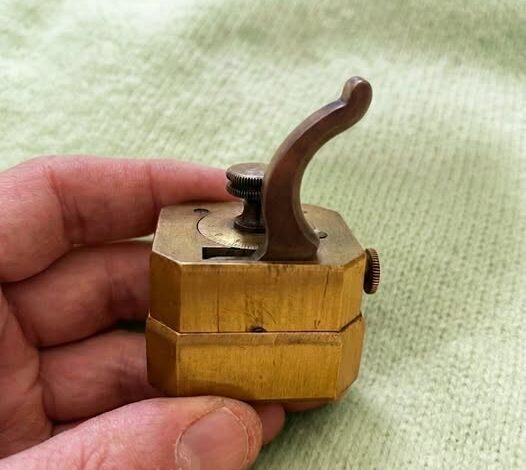
I Thought It Was Just an Odd Antique. Then I Learned It Once Drew Blood for a Living.
At first glance, it didn’t look particularly sinister.
It was small.
Compact.
Almost delicate in a way that felt intentional, as if it had been designed to sit comfortably in a hand rather than dominate it.
The sort of object you might find behind glass in an antique shop, resting on faded velvet, or tucked away in a drawer at an estate sale where everything smells faintly of wood polish and time.
Made of metal, but not crude metal—carefully finished, with edges softened by age and use. It carried the quiet confidence of something built in an era when tools were expected to last longer than the people who used them.
I turned it over slowly in my hands.
There was a weight to it that felt surprising for its size.
Not heavy.
Just… certain.
I examined the seams, the joints, the small mechanical details that suggested moving parts hidden beneath the surface. I pressed a section gently and felt a faint resistance, like something inside was waiting to be triggered but refusing to reveal itself.
At first, I thought it might be harmless.
A measuring device.
A watchmaker’s instrument.
Maybe something used in early engineering or precision repair work.
Something delicate.
Something technical.
Something ordinary.
It certainly didn’t look dangerous.
And it definitely didn’t look like something that once had a direct relationship with human skin.
But the longer I held it, the more it resisted every assumption I tried to place on it.
There were openings too deliberate to be decorative.
A spring mechanism hidden too carefully to be incidental.
Tiny internal structures that suggested motion, release, and repetition.
Not measurement.
Not assembly.
Action.
When I finally understood what it actually was, it didn’t arrive as a single moment of realization.
It came slowly.
Uncomfortably.
Like a door opening in a room you thought you already understood.
Because this wasn’t just an antique.
It was a scarificator.
A medical instrument once used in bloodletting.
And suddenly, the object in my hand stopped feeling like history.
It felt like memory that hadn’t fully faded.
A Tool From Another World
Modern medicine has trained us to think in a very specific language.
Scans.
Lab results.
Evidence-based treatments.
Sterile environments.
Controlled doses.
Statistical outcomes.
We assume this has always been the shape of healing.
But that assumption only survives because we rarely look directly at how recent this understanding actually is.
For most of human history, medicine existed in uncertainty so deep it feels almost unfamiliar today.
Doctors observed symptoms without knowing their causes.
Diseases appeared without explanation.
Infections spread invisibly.
Pain arrived without pattern.
And in that uncertainty, humans did what they always do: they built systems to explain what they could not yet understand.
One of the most influential of those systems was the theory of the four humors.
Blood.
Phlegm.
Yellow bile.
Black bile.
Health was believed to depend on balance between these substances.
Illness was imbalance.
And imbalance demanded correction.
This framework shaped medicine for centuries, across cultures, across continents, across generations of doctors who were not careless—but simply working with the only model available to them.
The Logic Behind Bloodletting
From inside that worldview, bloodletting was not strange.
It was rational.
If excess blood caused fever, then removing blood reduced fever.
If imbalance caused suffering, then reducing one component of the imbalance seemed logical.
If the body was overwhelmed, then draining it might restore order.
It was a theory built on incomplete knowledge—but it was internally consistent.
And that consistency is what gave it such longevity.
Bloodletting became one of the most common medical procedures in the Western world.
It was used for almost everything.
Headaches.
Inflammation.
Infections.
Fatigue.
Digestive issues.
Respiratory illness.
Even emotional disturbances.
If a patient could not be clearly diagnosed, bloodletting often became the default response.
Sometimes patients improved.
Not because the treatment worked in the way doctors believed, but because many illnesses resolve naturally over time.
Recovery was credited to the intervention.
Illness progression was blamed on severity.
And so the practice reinforced itself, generation after generation, surviving not because it was correct, but because it was plausible within its framework.
The Device Itself
The scarificator was not the earliest version of bloodletting.
It was an attempt to improve it.
To refine it.
To mechanize it.
Earlier methods relied on lancets or blades operated by hand.
Effective, but inconsistent.
Dependent on skill, steadiness, and judgment.
The scarificator promised something better.
Uniformity.
Speed.
Efficiency.
Inside its compact metal body was a carefully engineered system of springs and blades.
When activated, the mechanism would release a cluster of tiny sharp edges in a rapid, synchronized motion.
They would extend outward for a fraction of a second—just long enough to create multiple shallow cuts across the skin.
Then they would retract instantly, resetting for reuse.
To nineteenth-century physicians, this was progress.
A modern solution.
A way to make a difficult procedure faster and more controlled.
Holding it today creates a contradiction that is difficult to resolve.
On one hand, the engineering is undeniably impressive.
Precise.
Intentional.
Even elegant.
On the other hand, the purpose it served is impossible to separate from its design.
It was not built to observe.
Not built to heal in the modern sense.
It was built to wound in a controlled way.
To extract something essential from the human body under the belief that removal meant recovery.
Trusting the Experts
Perhaps the most unsettling realization is not the instrument itself.
It is the context in which it was used.
Imagine being a patient centuries ago.
You are sick.
Weak.
Afraid.
You are told by someone in authority—someone educated, experienced, respected—that the best course of action is to remove blood from your body.
You do not have alternative explanations.
You do not have competing medical systems to compare.
You have trust.
And trust, in that environment, is not optional. It is survival.
Doctors believed they were helping.
Patients believed they were being helped.
Entire institutions reinforced the belief.
Medical schools taught it.
Books documented it.
Apprentices learned it.
Communities normalized it.
It was not deception.
It was consensus.
And that makes it more complicated, not less.
Because it reveals something uncomfortable about knowledge itself.
The Thin Line Between Science and Certainty
Looking back at the scarificator, it becomes difficult not to think about certainty.
Not knowledge.
Certainty.
Doctors who used this instrument were not villains.
They were participants in a system that reflected the limits of its time.
Many were deeply committed to healing.
Many genuinely saved lives, even within imperfect frameworks.
But sincerity does not guarantee accuracy.
And confidence does not guarantee correctness.
That is the uncomfortable lesson embedded in medical history.
Progress does not come from unwavering belief.
It comes from the willingness to question belief.
To test it.
To challenge it.
To discard it when evidence demands it.
Medicine did not advance because people became more confident.
It advanced because they became more skeptical.
More precise.
More demanding of proof.
A Witness to Human Hope
The longer I held the scarificator, the less it felt like an artifact of error and the more it felt like an artifact of hope.
Not misplaced hope.
Human hope.
Every patient who ever encountered this instrument wanted the same thing people want today.
Relief.
Recovery.
A chance to feel normal again.
To stop suffering.
To continue living.
The methods have changed.
The science has changed.
The understanding has changed.
But the desire has remained exactly the same.
That continuity is what makes the object strangely difficult to judge.
Because it is not only a symbol of misunderstanding.
It is also a symbol of desperation.
Of people trying, with the knowledge they had, to reduce suffering in others.
The Cost of Being Wrong
Medical history is filled with breakthroughs that define modern life.
Vaccines.
Anesthesia.
Antibiotics.
Imaging technologies.
Surgical advances.
Each one represents a moment where understanding improved dramatically.
But buried beneath those successes are countless discarded ideas.
Treatments that were once standard.
Procedures once considered advanced.
The scarificator belongs to that forgotten lineage of “correct at the time” solutions that later proved fundamentally flawed.
And that realization is not limited to medicine.
It extends to every field built on evolving knowledge.
Science.
Technology.
Even everyday decision-making.
The uncomfortable truth is that progress is often invisible while it is happening.
It only becomes obvious in hindsight.
Seeing Antiques Differently
Before learning what it was, I saw the object as a curiosity.
A relic.
Something decorative.
Something detached from consequence.
Now I see it differently.
It is not just metal and mechanism.
It is evidence.
Of belief systems.
Of medical uncertainty.
Of human effort directed by incomplete understanding.
Every antique carries a fragment of the world that produced it.
Some carry craftsmanship.
Some carry culture.
Some carry mistakes.
This one carries all three.
More Than a Medical Instrument
Today, the scarificator sits quietly where it can be seen but not easily overlooked.
People sometimes ask about it.
They assume it is mechanical.
Or decorative.
Or industrial.
Their guesses are usually reasonable, because nothing about its appearance immediately reveals its history.
And then I explain.
And the room changes.
Not dramatically.
But noticeably.
Curiosity turns into surprise.
Surprise turns into reflection.
Because the object forces a confrontation with something subtle but profound:
Human progress is not a straight line.
It is a series of corrections.
The scarificator is not just an outdated tool.
It is a reminder that every generation inherits both knowledge and error.
And often, it is difficult to tell the difference until much later.
Final Reflection
Every time I look at it now, I am reminded of something simple but difficult to hold onto:
The most dangerous idea in any field is not ignorance.
It is certainty without understanding.
Because certainty feels like safety.
It feels like progress.
It feels like truth.
Until it isn’t.
And sometimes the most revealing objects are not the ones that show us what we knew.
But the ones that quietly expose how much we misunderstood.