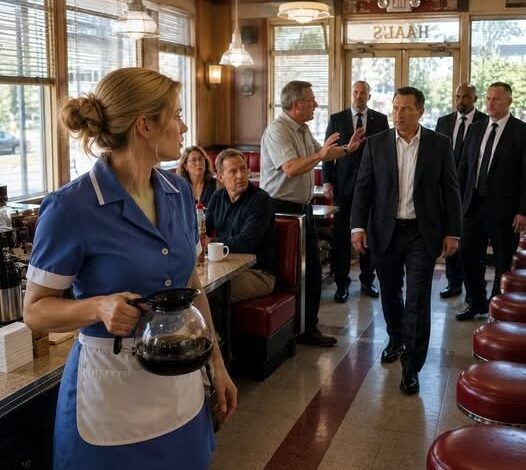
My Boss Publicly Embarrassed Me for Helping a Hungry Girl—Then Her Father Walked In Looking for Me

And sometimes, all it takes to change a life is making someone feel seen.
What people in town didn’t realize at first was how quickly that idea spread.
Not through advertising.
Not through marketing.
But through stories.
Waverly Café—now renamed simply “Vera’s”—became something of a quiet landmark.
At first, it was just curiosity.
A few regulars from the old diner followed her out of loyalty.
Then word began to travel.
A server who remembered your name.
A place where no one rushed you out the door.
A place where small kindness wasn’t treated as a financial loss, but as part of the culture.
And slowly, almost imperceptibly, the café began to fill with people who weren’t just there for food.
They were there for something harder to define.
Dignity.
One afternoon, months after the opening, Vera noticed a teenage boy standing hesitantly near the entrance.
He looked around sixteen.
Thin jacket.
Eyes fixed on the floor.
He didn’t move when the door chimed behind him.
Didn’t approach the counter.
Just stood there like he was waiting to be told he didn’t belong.
Vera walked over herself.
Not quickly.
Not cautiously.
Just normally, like it was the most natural thing in the world.
“Hey,” she said gently. “You okay?”
The boy hesitated.
“I… don’t have enough.”
His voice was almost apologetic.
As if hunger required permission.
Vera nodded once.
“Then we’ll figure it out together.”
He blinked.
Confused.
“Together?”
“Yeah,” she said. “That’s usually how it works here.”
That was all she said.
No questions about money.
No judgment.
No attention drawn from the room.
She handed him a menu and told him to take his time.
He ordered something simple.
When she brought it out, he didn’t eat immediately.
He just stared at it for a moment, as if waiting for someone to change their mind.
Then he finally picked up the fork.
And ate like someone who hadn’t realized how hungry he’d been until the food arrived.
Across the café, Emily sat in her usual booth.
She had grown taller now.
More certain in her presence.
Still quiet sometimes, but no longer withdrawn.
She watched the boy for a while.
Then leaned toward Vera when she passed.
“He looks like I used to,” she said softly.
Vera paused.
Then nodded.
“I know.”
Emily glanced down at her own hands.
“I don’t think I understood what you did back then.”
“You didn’t need to,” Vera replied.
A small silence followed.
Then Emily asked, “Did you ever think about what would’ve happened if you hadn’t helped me?”
Vera considered the question carefully.
“I think about what did happen,” she said. “That’s enough for me.”
Emily smiled faintly.
“That’s very you.”
Over time, the café began receiving visitors Vera never expected.
Teachers brought students to show them what community could look like when it chose compassion over profit.
Social workers stopped by on difficult days, sometimes just to sit in silence for a while before returning to their work.
Even former employees from the old diner came quietly, some to apologize, others just to see what had become of it.
Not all conversations were easy.
Some were heavy with regret.
Some with gratitude.
Some with things left unsaid for too long.
But Vera never turned anyone away.
Not because it was simple.
But because she understood something most people only learn after being tested:
Kindness is not a moment.
It is a practice.
One afternoon, Nathan Fraser returned.
He didn’t arrive with a convoy this time.
Just a single car.
No announcement.
No formality.
He stood outside the café for a moment before entering, as if taking in how much had changed.
When Vera saw him, she smiled.
“You’re early for lunch,” she said.
He returned the smile.
“I wasn’t sure I’d be welcome just dropping in.”
“You’re always welcome,” she said.
That made him pause.
Not dramatically.
Just enough to feel it.
Inside, Emily noticed him almost immediately.
She didn’t run to him.
Didn’t hesitate either.
She simply stood, walked over, and hugged him.
Longer than before.
More certain than before.
When she pulled back, she said something quietly to him.
No one else heard it.
But Nathan closed his eyes for a moment, as if absorbing it fully.
Later, after the café had quieted, he sat with Vera at a corner table.
“You changed more than I expected,” he said.
“I didn’t change anything,” she replied. “I just didn’t stop something from growing.”
Nathan nodded slowly.
“That might be the same thing.”
Vera didn’t answer.
She didn’t need to.
Outside, the city moved as it always had.
Cars passing.
People rushing.
Lives unfolding in directions most would never notice.
But inside the café, something different persisted.
Not perfection.
Not safety.
Not ease.
Something quieter.
Something steadier.
A place where a child once counted coins too carefully.
A place where she was told she mattered anyway.
And where that message, once planted, didn’t stop growing.
Years later, when people asked Emily what she remembered most about those early days, she rarely mentioned the hardship.
Instead, she always said the same thing.
“I remember the first place I felt like I could stay.”
And Vera, when she heard that, never corrected her.
Because she understood something simple and lasting:
Sometimes a life doesn’t change because of one grand gesture.
It changes because someone, somewhere, refuses to let small moments of kindness disappear.
And that is how a five-dollar breakfast becomes something worth far more than money ever could.