I Rushed Home to a Police Officer Holding My Toddler—What He Told Me About My Son Changed Everything

When my phone rang in the middle of a hectic hospital shift, I almost let it go to voicemail. The ward was alive with noise—monitors beeping, voices overlapping, footsteps rushing past—and I was already stretched thin trying to keep up. But something inside me, something quiet but firm, told me to answer. It didn’t make sense in the moment. It wasn’t convenient. But it felt necessary.
So I stepped away and picked up the call.
The voice on the other end was calm, almost too calm, but there was urgency underneath it. They didn’t explain much. No buildup, no details—just a simple request that didn’t feel simple at all: I needed to come home immediately.
My chest tightened.
I asked questions as quickly as they came to me. “What happened? Are my kids okay?” But the answers were vague, carefully measured. “Please just come home as soon as you can.” That was all they would say.
From that moment on, nothing around me felt real. Everything slowed down, except my thoughts, which raced ahead to places I didn’t want them to go.
I finished what I could at work, though I barely remember doing it. My hands moved, but my mind was already gone—back home, running through every possible scenario. By the time I got into my car, my hands were trembling, and my heartbeat felt too loud in my chest.
And one name kept repeating in my head:
Logan.
Being a single mother had never been easy. Leaving my boys at home while I worked long shifts was something I had learned to live with, but never something I felt fully at peace with. After their father passed, Logan had grown up faster than any child should have to. He had stepped into a role that wasn’t his to carry—helping with his younger brother, trying to fill in the gaps I couldn’t always cover.
And he tried. He really did.
But he was still just a kid.
There had been small mistakes before—nothing dangerous, nothing serious—but enough to plant a quiet worry in me that never fully went away. Moments that made me question if I was asking too much of him. If I was leaning too heavily on someone who was still learning how to be a child himself.
So when I heard his name on that call, my mind didn’t search for reassurance.
It went straight to fear.
By the time I pulled into the driveway, my chest felt tight, like I couldn’t take a full breath. And then I saw it.
A police car.
Everything inside me dropped.
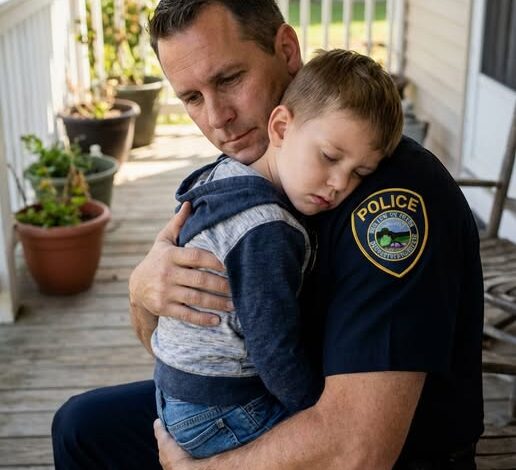
I got out of my car too fast, barely closing the door behind me. My eyes locked onto the officer standing outside—and then I saw who he was holding.
My toddler.
Safe. Calm. Unharmed.
But the panic didn’t leave. If my youngest was okay… then where was Logan?
“What happened?” I asked, my voice unsteady despite trying to stay composed.
The officer looked at me, serious but not alarmed. “Your older son is inside,” he said.
Inside.
The word echoed in my head as I rushed past him, my heart pounding, bracing myself for something I wasn’t sure I could handle.
But when I stepped through the door, everything looked… normal.
No damage. No chaos. No signs of anything terrible.
And then I saw him.
Logan.
Standing there, quiet, a little tense—but completely okay.
For a moment, I couldn’t move. I just stood there, trying to process what I was seeing.
“You’re okay?” I asked, my voice softer now, almost fragile.
He nodded. “I’m okay, Mom.”
The relief hit me all at once, so strong it almost made my knees give out. I walked toward him, instinctively checking him over, my eyes searching for anything I might have missed.
“There’s nothing wrong?” I asked again.
He shook his head. “No.”
Behind me, the officer stepped in and began to explain.
And slowly, everything started to make sense.
Logan hadn’t made a mistake.
He had done something right.
Something brave.
Earlier that day, while he was out with his little brother, he had noticed a neighbor in distress. Something didn’t feel right—and instead of ignoring it, instead of panicking, he paid attention. He acted. He called for help.
And then he stayed.
He stayed with that neighbor, making sure they weren’t alone, making sure someone was there until help arrived.
The officer explained how important that was. How those moments—those decisions—can make a real difference.
I turned back to Logan.
But this time, I saw him differently.
Not just as my son. Not just as the child I worried about constantly.
But as the person he was becoming.
And something inside me shifted.
All the fear I had been carrying—the quiet doubts, the constant “what ifs”—suddenly felt smaller.
Because right in front of me was something stronger than fear.
Proof.
Proof that he was capable. That he was thoughtful. That he could handle more than I had allowed myself to believe.
He hadn’t just stepped up because he had to.
He chose to do the right thing when it mattered.
Later that evening, after everything had settled and the officer had gone, I found myself watching him from across the room. He moved through the kitchen like it was any other day—getting a glass of water, checking on his little brother, doing small, ordinary things.
There was no need for recognition. No sign that he expected praise.
Just quiet normalcy.
And somehow, that made it even more meaningful.
Because it showed me that this wasn’t something extraordinary to him.
It was simply who he was.
I realized then how much space fear had taken up in my mind—how often I had focused on what could go wrong instead of seeing everything that was already going right.
Logan wasn’t just growing up.
He was growing into someone strong. Someone dependable. Someone kind.
And maybe he had been becoming that person for a while.
I just hadn’t fully seen it yet.
That night, as the house finally grew quiet and both of my boys were safe, I felt something I hadn’t felt in a long time.
Not just relief.
But certainty.
We weren’t just surviving.
We were building something steady. Something real.
A family that held together, even in the middle of uncertainty.
And for the first time in a long while, I let myself believe something simple—but powerful:
We were going to be okay.