At first glance, I honestly thought I had found a body.
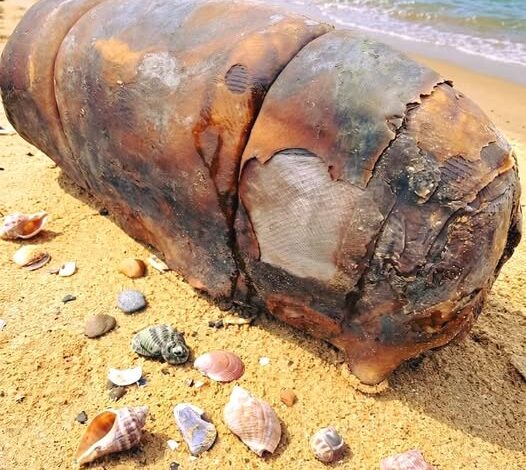
The shape stretched across the wet sand looked far too organic, too twisted, too disturbingly human for my mind to process calmly. It lay near the edge of the tide, partly buried and partly exposed, with one end curved upward in a way that made my stomach drop.
I had gone to the beach that morning expecting peace.
The shoreline was nearly empty. Gray clouds hung low over the water, and the wind carried the sharp smell of salt, seaweed, and rain that had not yet fallen. Waves rolled steadily toward the sand, gulls circled overhead, and the whole coast seemed wrapped in a strange, uneasy quiet.
Then I saw it.
At first, I stopped completely.
The object was motionless, half-covered by dark wet sand. Its middle section looked swollen and torn, and its surface had been worn into shades of gray, brown, and faded pink. In the dim coastal light, parts of it looked horribly similar to damaged skin.
For several seconds, I could not move closer.
My heart began pounding so hard that the sound of the ocean seemed to disappear. Every instinct told me to back away, to call someone, to not be the person who discovered whatever this was. The beach felt suddenly too empty. There were no voices nearby, no other footprints except mine, no one to confirm what I was seeing or tell me I was wrong.
My imagination filled the silence instantly.
Maybe it was someone who had drowned.
Maybe the tide had carried in remains after a storm.
Maybe something long hidden beneath the water had finally surfaced.
Fear is fast that way. It builds entire explanations before reason has time to catch up.
Still, I forced myself to step closer.
The wet sand shifted beneath my shoes. The wind pressed cold air against my face. Every movement felt slower than it should have, as if my body itself was resisting the decision to approach.
But the closer I got, the less certain I became.
The shape still looked disturbing, but now there were details that did not fit. Torn sections revealed woven material beneath the outer layer. Some parts looked fibrous, almost like rope. Others seemed too rigid, too industrial, too mechanical to be anything biological.
Confusion began to replace panic.
I leaned forward carefully, trying to understand what I was actually seeing. It was not flesh. It was not bone. It was not a body at all.
It was an old industrial cable.
Most likely, it had once been part of an underwater communication line or heavy electrical system before breaking loose and eventually washing ashore. Time and the ocean had transformed it into something almost unrecognizable.
The outer protective coating had been shredded by saltwater, sand, sunlight, and years of movement beneath the waves. Beneath that damaged shell, braided fibers pushed outward in tangled layers, creating the unsettling illusion of tendons, torn tissue, or exposed muscle.
The relief came quickly.
But it was not complete.
I was relieved because no tragedy had unfolded in front of me. No family was waiting for terrible news. No emergency call needed to be made.
And yet, the object still made me uneasy.
It was not horrifying in the way I first imagined. It was unsettling in a different way. It was proof of how much human-made material exists beneath the surface of places we like to think of as wild and untouched.
I stood there for several minutes, watching the waves move around it.
At some point, that cable had probably served a purpose. It may have carried power, communication signals, or data across long distances beneath the sea. It had once represented progress, engineering, and connection.
Now it lay broken on the shore, half-buried in sand, stripped of purpose and shaped by the ocean into something that could easily be mistaken for death.
That thought stayed with me.
We build things and send them into the world as if they will remain obedient forever. Cables beneath oceans. Pipes beneath cities. Machinery across landscapes. Networks that support modern life quietly, invisibly, until they fail, break, or are abandoned.
Once they are no longer useful, we stop thinking about them.
But the earth and the ocean do not forget.
Coastlines are strange places because they are always returning what was hidden. Storms uncover debris. Currents carry lost objects across unimaginable distances. Waves reshape material until it becomes strange, almost alien. Something discarded years ago can reappear suddenly, transformed into a shape that tricks the eye and unsettles the body.
That morning reminded me how quickly the mind reacts to uncertainty.
When we see something unfamiliar, especially when we are alone, the brain does not wait politely for evidence. It searches for patterns. It compares shapes, colors, textures, and shadows to things it already knows. Sometimes that instinct protects us. Other times, it turns a harmless object into a threat.
From a distance, the cable had all the wrong ingredients: the color of weathered organic matter, the shape of something collapsed, the partial burial, the eerie silence of an empty beach. My fear made sense, even though my conclusion was wrong.
Even after I understood what it was, I could still see why I had mistaken it for something terrible.
I took a photograph.
Later, when I showed it to friends, several reacted the same way I had. They flinched. They guessed it was biological. Some thought it looked like remains. Only after I explained did their minds rearrange the image into something industrial.
That fascinated me.
It proved how powerful first impressions can be. Once the brain decides an image means danger, it can be difficult to reinterpret it calmly. The truth may arrive quickly, but the body remembers the fear a little longer.
As I walked away from the beach, the shoreline no longer felt as simple as it had when I arrived.
It still had its beauty — the waves, the gulls, the wind, the soft gray light. But now it also felt layered with hidden histories. Beneath the sand and water were not only shells, stones, and seaweed, but fragments of industry, forgotten systems, abandoned materials, and evidence of human activity waiting to resurface.
I still love walking along the coast.
I still look for shells, driftwood, sea glass, and stones smoothed by the tide. But now there is a quieter awareness beneath that curiosity. I find myself wondering what else lies offshore, waiting for the right storm, the right current, the right morning to appear.
Not monsters.
Not myths.
Just the things we built, used, lost, and left behind.
That old cable taught me something I did not expect to learn from a frightening shape in the sand.
Fear often arrives before understanding.
The mind races ahead, creates a story, and convinces us we know what we are seeing before we have really looked. Sometimes the thing that terrifies us becomes ordinary once the light changes, once we step closer, once we allow reason to catch up.
But sometimes the ordinary explanation carries its own discomfort.
Because what I found was not a body.
It was evidence.
Evidence that progress leaves remains. Evidence that the ocean is not an endless hiding place. Evidence that what humanity discards does not simply vanish because we stop looking at it.
Sometimes the terrifying thing on the beach is not death.
Sometimes it is what we have left behind, returning quietly with the tide.