One Strange Bite Changed the Way I Look at Frozen Food Forever
It started as one of the most ordinary moments imaginable.
The kind of moment so routine it doesn’t even register as a decision. Something you do on autopilot while thinking about everything except what you’re about to eat.
A frozen pizza.
An oven preheating in the background.
A long day still sitting in your bones.
A quick dinner chosen not because it excites you, but because it doesn’t require anything from you.
No effort.
No thought.
No risk.
At least, that’s what it is supposed to feel like.
I had made frozen pizzas before—dozens of times, maybe more. They weren’t special. They were part of the invisible structure of modern life, the kind of food that fills a gap when cooking feels like too much and ordering feels unnecessary.
Open the box.
Remove the plastic film.
Slide it onto a tray.
Wait.
Eat.
Move on.
That was the entire agreement between me and frozen food: simplicity in exchange for trust.
Nothing about that evening suggested anything different.
And yet, sometimes life doesn’t announce when it’s about to become memorable.
It just quietly shifts direction inside a single moment.
A single bite.
The Moment Everything Changed
The pizza looked perfect in the way frozen food is engineered to look perfect.
Evenly melted cheese.
Edges crisped just enough to feel intentional.
A smell that filled the kitchen with manufactured comfort—the kind of scent that tricks your brain into believing warmth and satisfaction are guaranteed.
I didn’t hesitate.
I never had before.
I picked up a slice, folded it slightly the way people do without thinking, and took a bite.
And immediately stopped.
Not because of taste.
Because of wrongness.
It’s hard to explain that moment to someone who hasn’t experienced it.
Your brain reacts before your thoughts catch up.
A microscopic alarm goes off somewhere behind instinct.
Something doesn’t belong.
At first, I couldn’t identify what I was feeling. It wasn’t just texture—it was interruption. A break in the expected structure of food.
I pulled the bite away slowly, chewing stopped halfway through realization rather than decision.
Then I felt it again.
Hard.
Not crust-hard.
Not burnt-cheese hard.
Something different.
Something foreign.
My appetite disappeared so quickly it felt like it had been switched off.
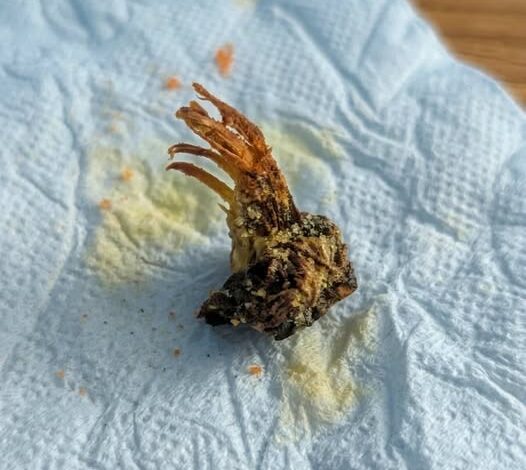
I leaned forward, opened my hand, and let the object fall onto a napkin.
Small.
Irregular.
Darkened from heat.
And completely wrong for anything that should exist inside a pizza.
In that instant, dinner stopped being dinner.
It became evidence.
The Growing Unease
Most food surprises resolve themselves quickly.
A burnt edge.
A spice you didn’t notice.
A texture you misidentified.
Something harmless.
Something explainable.
This wasn’t that.
The longer I looked at it, the more unstable the moment became.
Because it didn’t fit into any category my mind could comfortably assign.
I turned it slightly under the kitchen light.
It didn’t reflect anything recognizable.
It didn’t behave like packaging.
It didn’t resemble cheese or crust.
It wasn’t soft enough to be food in the traditional sense, yet it wasn’t clearly artificial either.
And that ambiguity was the problem.
Because the brain hates ambiguity more than it hates bad news.
I found myself cycling through possibilities.
Plastic?
Metal?
Broken machinery?
Contamination?
Something biological?
Each option created a different kind of discomfort.
None of them were reassuring.
The pizza cooled untouched on the plate beside me, slowly losing the identity it had had minutes before.
What had been a simple meal became an unanswered question sitting on my kitchen counter.
And I couldn’t stop looking at it.
Why the Unknown Feels So Disturbing
There’s a strange psychological truth most people don’t think about until they’re forced to.
Humans tolerate bad outcomes better than uncertain ones.
Bad news ends speculation.
Uncertainty feeds it endlessly.
That small object became a perfect demonstration of that principle.
It wasn’t dangerous in any confirmed way.
But it might have been.
And that “might” grew louder than anything else in the room.
I kept returning to it without meaning to.
Picking it up.
Setting it down.
Re-examining it as though repetition might suddenly unlock clarity.
It never did.
Instead, the experience shifted from curiosity into something heavier.
A low, persistent unease.
The kind that doesn’t shout.
Just stays.
Quietly rearranging how you think.
Because suddenly you’re not just asking what this is.
You’re asking broader questions you normally ignore.
How much do we actually trust the systems behind our food?
How many steps separate production from plate?
How many invisible points of failure exist between factory and kitchen?
And how often do we simply never notice when something goes slightly wrong?
Searching for Answers
Eventually, I gave up pretending I could identify it on my own.
I turned to research.
At first casually.
Then more intensely.
Then with a focus that surprised even me.
Images.
Manufacturing breakdowns.
Food safety discussions.
Consumer reports.
Forum posts from people describing similar discoveries.
The internet, as always, contained everything—comforting explanations and unsettling possibilities in equal measure.
Hours passed without me noticing.
The object on the napkin became the center of a widening circle of investigation.
And slowly, patterns began to emerge.
Similar shapes.
Similar discoloration.
Similar descriptions from others who had experienced “unexpected fragments” in processed food.
Each match narrowed the possibilities.
Each comparison reduced the chaos slightly.
Until finally, something clicked.
The closest explanation was both simple and uncomfortable:
A fragment of chicken thigh bone.
Relief and Disgust at the Same Time
The reaction came in two waves that collided immediately.
Relief.
And disgust.
Relief because it wasn’t something catastrophic.
Not plastic.
Not metal.
Not intentional contamination.
Not something sinister hiding in the system.
Just an error.
A fragment that should have been removed but wasn’t.
A flaw in a process that usually works well enough that most people never think about it.
But disgust remained because explanation does not erase experience.
Knowing what it was did not undo the fact that I had bitten into it.
Did not erase the sensation.
Did not make the memory less vivid.
It simply reframed it.
From mystery to mistake.
From unknown to unintended.
From alarming possibility to uncomfortable reality.
The Hidden Journey of Food
Modern food production is almost invisible in its complexity.
Ingredients sourced from multiple locations.
Factories operating at massive scale.
Machines designed to process thousands of units per hour.
Quality control systems designed to catch what humans cannot.
And yet none of those systems are perfect.
They are simply effective enough that perfection feels assumed.
That assumption is what makes moments like this so jarring.
A frozen pizza feels like a single object.
In reality, it is the endpoint of an enormous chain of decisions, processes, inspections, and human labor.
A chain so long and complicated that most consumers never see it.
Until something slips through.
Even something small.
Even something almost harmless.
The Heat Changed Everything
There was another detail I couldn’t stop thinking about.
The oven had altered the object itself.
What might have been recognizable in its original form had been transformed by heat.
Darkened.
Warped.
Compressed.
Cooking didn’t just prepare the pizza—it disguised the anomaly inside it.
By the time I discovered it, the fragment had become something visually ambiguous.
Not because it was inherently unidentifiable.
But because it had been physically changed by the very process meant to make it safe to eat.
That realization added another layer to the discomfort.
Not fear.
But awareness.
Of how easily small things can become unrecognizable under ordinary conditions.
Trusting What We Eat
Every grocery trip is built on an invisible agreement.
We trust systems we do not see.
We trust processes we do not witness.
We trust that somewhere along the line, enough people are paying attention.
Most of the time, that trust is justified.
Food arrives safe, consistent, and predictable.
Which is exactly why exceptions feel so disruptive.
Not because they are common.
But because they expose how much we rely on things we never consciously acknowledge.
That night, I became aware of that trust in a way I hadn’t been before.
Not as a belief.
But as a dependency.
The Strange Aftereffect
What surprised me most wasn’t the moment itself.
It was how long it stayed with me afterward.
Not as panic.
Not as fear.
But as a quiet mental echo that returned at unexpected times.
Opening the freezer.
Looking at packaging.
Reheating food.
Each moment carried a faint reminder of that small object on a napkin.
It didn’t make me afraid of frozen food.
But it made me more aware of it.
More attentive.
More conscious of something I had never previously considered worth noticing.
The incident didn’t change what frozen food was.
It changed how I saw it.
Looking at Everyday Things Differently
In the end, the pizza was forgotten.
But the experience wasn’t.
What began as an ordinary dinner became something else entirely.
A disruption.
A reminder.
A lesson hidden inside a single bite.
The fragment turned out to be something simple: a production error, nothing more.
And yet its impact was disproportionate to its size.
Because that is how perception works.
We don’t remember scale.
We remember rupture.
Even now, I notice it.
Whenever I open a box of frozen food.
Whenever I prepare something quick and routine.
Whenever I assume everything inside the package is exactly as it should be.
I still eat frozen food.
But I no longer do it on autopilot.
Because once you discover something that clearly doesn’t belong where it’s found, you stop assuming that “normal” means “perfect.”
And you never quite go back to not noticing.