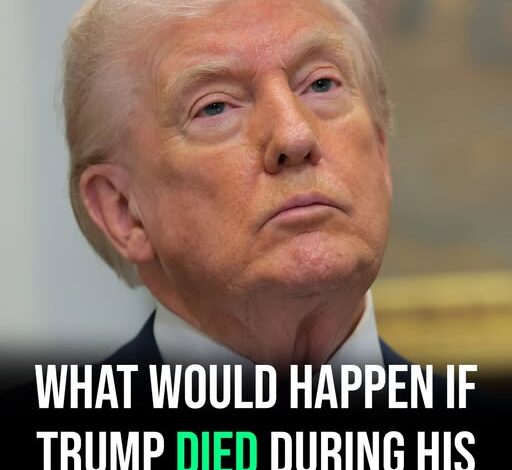
If Donald Trump were to die while in office, here’s the very first thing you would hear

Public conversations about a sitting president’s health often go beyond simple curiosity. They can raise broader questions about political stability, continuity of leadership, and how institutions are designed to handle unexpected events. In Donald Trump’s case, these discussions tend to draw added attention, influenced by both his age and his own frequent comments about his physical condition.
As he approaches 80, Trump has consistently portrayed himself as energetic and resilient, often emphasizing his fitness compared to others in his age group. At the same time, speculation occasionally circulates in media and online spaces, sometimes driven by minor observations or unverified claims. However, as with any individual, predicting health outcomes or lifespan is inherently uncertain and not something that can be determined with confidence.
What is clear, though, is how the United States is structured to respond if a president dies while in office.
The process is firmly established in the Constitution. Under Article II, if a president dies, resigns, is removed, or is unable to perform their duties, the vice president immediately becomes president. This transition is automatic and designed to prevent any gap in leadership.
In practical terms, if such an event were to occur during Trump’s presidency, the vice president—currently JD Vance in this context—would assume the role right away. The formal oath of office would typically be administered as soon as possible, often within hours, to reinforce continuity and reassure both the public and international partners.
Once in office, the new president has full authority to lead. They may choose to maintain the existing cabinet for stability or make changes to reflect their own priorities. One of their first constitutional tasks would be to nominate a new vice president, who must then be confirmed by both the House of Representatives and the Senate.
There are also longer-term considerations tied to presidential term limits. If the new president serves less than two years of the original term, they remain eligible to run for two full terms. If they serve more than two years, they are limited to one additional term.
History provides several examples of how this system works in practice. After President John F. Kennedy was assassinated in 1963, Lyndon B. Johnson was sworn in aboard Air Force One within hours, demonstrating the speed and clarity of the transition process. In total, eight U.S. presidents have died in office—four by assassination and others from illness—each instance reinforcing the durability of the constitutional framework.
While the procedural side of such a transition is well-defined, the public and political response would likely vary depending on the circumstances. In today’s highly polarized environment, reactions could include a mix of mourning, political interpretation, and intense public discourse.
Ultimately, the U.S. system is built to ensure continuity and stability in moments of uncertainty. The legal mechanisms are clear and reliable, even if the broader societal response remains difficult to predict.