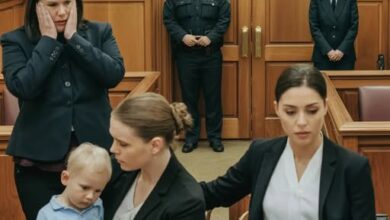
I remember the silence that followed the gavel, the way it seemed to press in on everything. The scrape of chairs, the murmur of voices, the shuffle of papers—it all blurred together until it felt distant, like it was happening in another room. And in the middle of it, one thought kept rising, steady and undeniable: he really stayed.
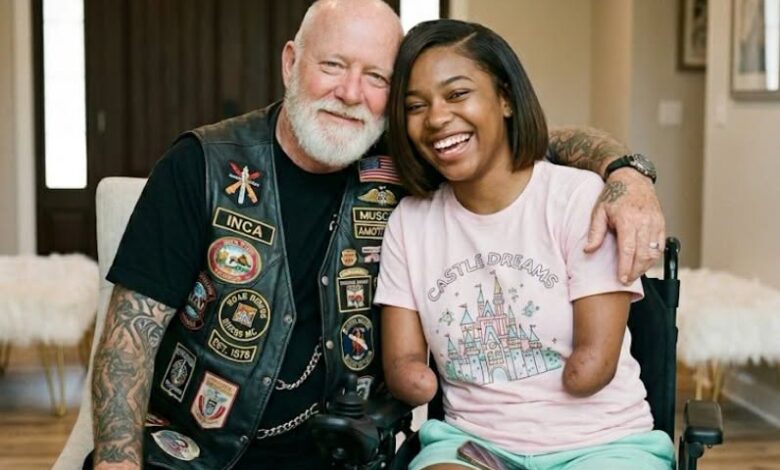
Robert didn’t try to make the moment bigger than it was. There was no speech, no dramatic pause meant to mark the significance of it all. He just did what he had always done. He stepped behind me, rested his hand on the back of my wheelchair—firm, grounding, familiar—and said, “Let’s go home, kid.” His voice wasn’t loud, but it didn’t need to be. It carried everything.
When we stepped outside, the sunlight felt different, like it belonged to me in a way it hadn’t before. The bikes were lined up along the curb, engines quiet but present, like a silent guard. They weren’t just there for show—they were there because people had chosen to stand beside us. That line of chrome and leather looked, to me, like protection. Like a boundary drawn around a life I had never imagined I’d get to live. For the first time in a long time, the future didn’t feel like something to brace for. It felt… possible.
The years since haven’t been perfect. Not even close. There’s no version of this story where everything suddenly becomes easy. We’ve argued over small things that turned into big ones. We’ve misunderstood each other in ways that left both of us frustrated and quiet for hours. There are days when the past shows up uninvited, sitting between us like a third presence neither of us asked for.
His PTSD doesn’t disappear just because there’s love in the house. Some nights, it comes crashing back without warning—loud, vivid, impossible to ignore. And my own fears, the ones that taught me to expect abandonment, don’t just dissolve because paperwork says I belong somewhere now. They linger in small ways—in hesitation, in overthinking, in the instinct to prepare for loss even when there’s no sign of it.
But what’s different—what changes everything—is that we don’t face any of it alone anymore.
When his nightmares come, I’m there. Sometimes all I can do is sit quietly beside him, waiting for the storm to pass, reminding him he’s safe now. When mine surface, when old memories twist themselves into something sharp and hard to shake, he stays. He doesn’t try to fix everything. He doesn’t rush me past it. He just stays, steady as ever, until the feeling loosens its grip.
Angela’s letter still lives in my top drawer, folded carefully along the same lines it’s had from the beginning. The paper has softened over time, the edges worn from being handled so often. I don’t read it every day anymore, but I know it’s there. Sometimes I take it out and trace the words with my fingers, remembering the girl I used to be—the one who didn’t believe she’d ever feel safe, or chosen, or truly seen. That letter feels like a bridge, connecting who I was to who I’ve become. It reminds me that the distance between those two versions of me wasn’t crossed all at once, but step by step, choice by choice.
There was a time when I measured love by how long it took for someone to leave. I learned to watch for signs, to read into silences, to brace myself for the moment everything would fall apart. Love, to me, was something temporary—something you held carefully because you knew it wouldn’t last.
Now, I measure it differently.
I measure it in the ordinary days—the quiet mornings where nothing remarkable happens, the shared meals, the small routines that build a life without anyone noticing. I measure it in the arguments that don’t end in walking away, in the misunderstandings that get worked through instead of ignored. I measure it in the way he shows up, again and again, even when it’s hard, even when it would be easier not to.
I measure it in staying.
There’s a kind of peace in that steadiness that I never knew before. It’s not loud or dramatic. It doesn’t announce itself. It just exists, quietly, in the background of everything. And over time, it becomes something you trust.
So now, when I think about love, I don’t think about grand gestures or defining moments. I think about consistency. About presence. About the simple, powerful truth that someone chooses to be there—not once, but every day.
And in that choice, I’ve found something I used to believe wasn’t meant for me.
I am not waiting to be left.
I am not preparing for the end.
I am here. I am wanted. I am chosen.
And for the first time, that truth feels steady enough to hold onto.
I’m not going back.