After our mother died, and our father passed away a few years later, my younger brother Noah and I learned how quickly a house can change when love disappears from it.
What had once felt warm and familiar slowly became tense, silent, and difficult under the control of our stepmother, Carla. After Dad was gone, she handled everything — the bills, the house, and the savings our mother had carefully set aside for the milestones she had always dreamed we would experience someday.
Noah and I tried not to cause problems.
We tried not to ask for too much.
Tried not to take up space.
Tried to survive quietly.
But grief has a way of making you feel like a guest inside your own life.
By the time prom season arrived during my senior year, I already knew money was a dangerous subject in our house. Still, after weeks of turning the idea over in my mind, I finally gathered enough courage to ask Carla if I could use a small portion of the savings my mother had left behind to buy a dress.
I remember standing awkwardly in the kitchen while she sorted through mail at the counter.
“It doesn’t have to be expensive,” I said quickly. “Just something simple.”
She did not look up at first.
Then she sighed, long and heavy, as though I had asked for something outrageous.
“Prom dresses are a waste of money,” she said flatly. “Your mother’s savings aren’t there for childish things.”
The embarrassment hit me immediately.
I tried to explain that everyone at school was going, that it mattered to me, that I wasn’t asking for much. But Carla’s expression only hardened.
“You need to start thinking realistically,” she snapped. “Life isn’t about parties and dresses.”
The conversation lasted less than three minutes.
Somehow, it made me feel smaller than I had in years.
I went upstairs and closed my bedroom door quietly so Noah wouldn’t hear me crying.
What I didn’t know was that he had already heard everything.
Noah was two years younger than me and naturally quiet, the kind of person people often overlooked because he rarely demanded attention. But he noticed everything. He absorbed the mood of a room before anyone said a word. Since Mom died, we had become each other’s safe place in ways we rarely talked about out loud.
A few days after the argument with Carla, Noah walked into my room carrying an enormous stack of old denim jeans.
Most of them had belonged to our mother.
Some were faded light blue.
Some were dark and worn at the knees.
A few still had patches from years of use.
I stared at the pile in confusion.
“What’s all this?”
He dropped the denim onto my bed with dramatic seriousness and shrugged.
“You trust me?”
“That depends,” I said cautiously.
A small smile appeared on his face.
“I took sewing class this year,” he said. “And I think I have an idea.”
At first, I honestly thought he was joking.
Noah had always been creative, but this felt impossible. We did not have money for fabric, professional supplies, or mistakes. We barely had enough privacy in that house to breathe freely some days.
But he was serious.
That night, after Carla went to bed, Noah pulled our mother’s old sewing machine from the closet for the first time in years. Dust covered the edges, and the machine still carried the faint smell of the lavender lotion Mom used to wear when she sewed at the dining room table late at night.
For a moment, neither of us touched it.
Then Noah sat down carefully and switched it on.
The sound nearly broke me.
Over the next week, we worked in secret.
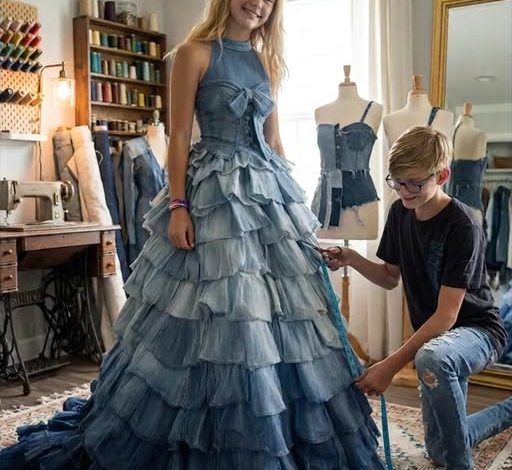
Every evening became its own quiet mission. Noah spread denim across my bedroom floor and sketched ideas in a notebook already filled with half-finished drawings. He cut the fabric carefully, mixing shades of blue in ways I never would have imagined could look beautiful together.
At first, the dress looked chaotic.
Random patches.
Uneven pieces.
Loose threads everywhere.
But slowly, something incredible began to take shape.
Noah worked with a focus I had never seen in him before. He studied every seam, adjusted measurements again and again, and stayed awake long after midnight fixing details nobody else probably would have noticed.
“This part needs movement,” he would mutter while pinning fabric together.
Or:
“The lighter denim should go near the top so it catches the light better.”
Watching him create something from almost nothing felt strangely emotional. For the first time since losing our parents, he looked hopeful again.
And somehow, through those quiet nights surrounded by scraps of old denim and the steady hum of Mom’s sewing machine, the house began to feel a little less lonely.
When the dress was finally finished, I could barely speak.
It was not just wearable.
It was beautiful.
The different shades of denim flowed together like watercolor. Noah had added stitched details along the waist and small hand-sewn patterns near the sleeves using fabric from one of Mom’s favorite jackets. Somehow, the dress looked modern and deeply personal at the same time.
Like memory turned into clothing.
When I tried it on for the first time, Noah just stood there silently.
“What?” I asked nervously.
He swallowed hard.
“You look like Mom,” he whispered.
That almost made me cry right there.
Unfortunately, Carla discovered the dress the day before prom.
She stopped in the hallway when she saw it hanging on my closet door and laughed openly.
“You’re seriously wearing that?” she asked.
I felt my whole body tense.
“It’s homemade,” she continued, her voice sharp with mockery. “People at school are going to think you’re desperate.”
Noah stepped forward before I could answer.
“She’s felt invisible enough already,” he said coldly. “I’m not letting you ruin this too.”
Carla rolled her eyes and walked away, shaking her head.
But her words followed me all night.
The next evening, as I sat getting ready for prom, doubt crept in with every passing minute. I kept imagining whispers, stares, pity, and laughter.
“What if she’s right?” I asked quietly.
Noah looked genuinely offended.
“She’s not.”
Then he adjusted one of the sleeves carefully and added:
“Besides, if people stare, it’ll be because they wish they had something this cool.”
That made me laugh despite myself.
When we arrived at the school gymnasium, I braced myself for humiliation.
Instead, people stopped me before I even reached the entrance.
“Where did you get that dress?”
“Did someone design it for you?”
“That is actually amazing.”
Teachers complimented the stitching. Students asked for pictures. Even girls wearing expensive boutique gowns kept staring at the details sewn into the denim.
For the first time in years, I did not feel embarrassed.
I did not feel less-than.
I felt seen.
Halfway through the night, the principal approached us looking unusually emotional.
Someone had already told him the story behind the dress.
He asked Noah and me to come onto the stage.
The gymnasium quieted as he explained how Noah had designed the dress using our late mother’s old jeans because we could not afford to buy one. But he did not tell the story with pity. He spoke about creativity, resilience, grief, and love.
Then he looked directly at Noah.
“What you created wasn’t just clothing,” he said. “It was art with a heartbeat behind it.”
The applause that followed felt endless.
I looked over at my little brother standing beside me under those bright gymnasium lights, blushing furiously while trying not to smile too hard, and suddenly understood something important.
Carla had spent years making us feel small.
But small people do not create beauty like this.
Over the following weeks, photos from prom spread online far beyond our school. A local arts organization contacted Noah after seeing the dress and invited him to attend a summer design workshop for young creatives. That workshop eventually opened doors neither of us had known existed.
At the same time, relatives began asking difficult questions about our finances and the money our mother had left behind. Once people started looking more closely, things changed quickly. Within months, Noah and I moved in with our aunt while legal matters surrounding the estate were handled properly.
For the first time in a long while, we felt safe again.
Today, the dress still hangs in my closet.
The denim has softened with age, and a few stitches near the hem have loosened over time. But I will never repair them.
Perfection was never the point of that dress.
It represents something much bigger.
It reminds me that love can survive grief.
That creativity can grow inside hardship.
That beauty can still be made from what was left behind.
And most of all, it reminds me of Noah.
My quiet little brother, who overheard one painful conversation and decided, without hesitation, that if the world refused to give his sister something beautiful…
he would make it himself.