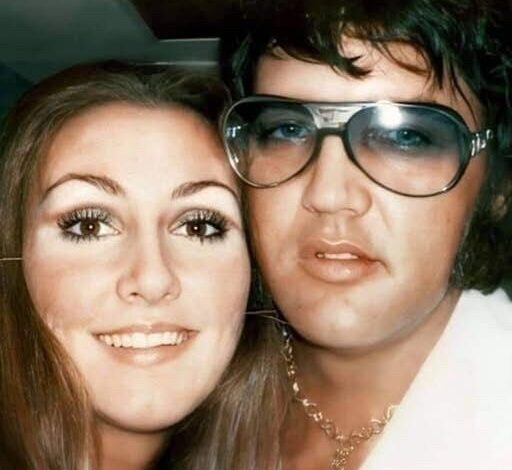
The story of Linda Thompson and Elvis Presley stands as one of the more intimate and revealing chapters in American pop culture—a relationship that unfolded behind the spectacle of fame, offering a rare glimpse into the private world of a global icon during his most complicated years. While the public saw Elvis through flashing cameras and roaring crowds, Linda experienced the quieter, heavier truth of life beside him between 1972 and 1976.
She entered his life shortly after his separation from Priscilla Presley. At the time, Linda was a former Miss Tennessee—graceful, intelligent, and emotionally perceptive. Those qualities would prove essential in a world that was anything but ordinary. What began as a romance quickly evolved into something deeper: she became not just his partner, but his emotional anchor and, increasingly, his caretaker.
In her recollections, Linda often emphasizes a side of Elvis that rarely made headlines. Away from the stage, he could be playful, deeply curious, and disarmingly warm. He loved to laugh, to joke, to explore ideas about spirituality and life. Their relationship was built on long conversations, shared Southern sensibilities, and a mutual appreciation for music. One of the most intriguing details she has shared is the existence of a private duet they recorded together—a moment untouched by commercial pressure, where Elvis was simply a man singing with someone he loved.
But that intimacy existed alongside a growing darkness. As the years passed, the demands of Elvis’s career and the weight of his own legend began to take a visible toll. His dependence on prescription medication intensified, and the atmosphere at Graceland shifted. What had once felt vibrant and full of life became increasingly fragile.
Linda found herself in a role that extended far beyond that of a romantic partner. She became vigilant—watching, waiting, managing, and worrying. Nights were often spent ensuring he was safe, that he was breathing, that he would wake up. It was an exhausting, emotional burden, one that required constant alertness and quiet strength. Life inside Graceland began to resemble a closed system, insulated from the outside world but heavy with unspoken tension.
Despite her deep love for him, there came a point where she had to confront a difficult truth: she could not save him. That realization didn’t come easily. It was gradual, painful, and ultimately clarifying. Leaving Elvis was not an act of abandonment, but one of self-preservation. She understood that staying meant witnessing a decline she was powerless to stop—and losing herself in the process.
When she left in 1976, it marked the end of their romantic relationship, but not their connection. They remained in contact, maintaining a bond rooted in respect and shared history until his death in 1977. That continued closeness speaks to the depth of what they had—something that transcended labels.
In the years that followed, Linda Thompson forged a path that was distinctly her own. She became an accomplished songwriter and lyricist, contributing to major works for artists like Whitney Houston and Celine Dion. The emotional insight that defined her writing was, in many ways, shaped by what she experienced during her years with Elvis—the extremes of love, vulnerability, and loss.
Her reflections today offer a more balanced and human portrait of Elvis Presley. Rather than focusing solely on his decline, she highlights his kindness, his generosity, and his brilliance. She reminds people that he was not just a symbol or a myth, but a man—one capable of deep affection, loyalty, and creativity, even while struggling internally.
There’s also a quiet wisdom in how she tells her story. She doesn’t romanticize the pain, nor does she diminish the love. Instead, she holds both truths at once. Her experience becomes less about celebrity and more about something universal: the challenge of loving someone you cannot fix, and the strength it takes to walk away without losing compassion.
Looking back now, Linda does so with a sense of gratitude rather than regret. Her time with Elvis was intense, transformative, and undeniably significant—but it was only one chapter in a much larger life. She has carried its lessons forward, shaping a career and identity that stand firmly on their own.
Her story ultimately reminds us that not all relationships are meant to last forever. Some exist to teach, to shape, and to reveal parts of ourselves we wouldn’t otherwise discover. And even when they end, they can leave behind something enduring—clarity, strength, and a deeper understanding of what it means to love.