Japanese Prime Minister’s Unexpected Praise for Barron Trump During White House Visit Sparks Conversation About Diplomacy, Image, and the Subtle Role of Personal Compliments in High-Level Political Meetings Between World Leaders Amid a Complex and Highly Scrutinized Global Political Climate

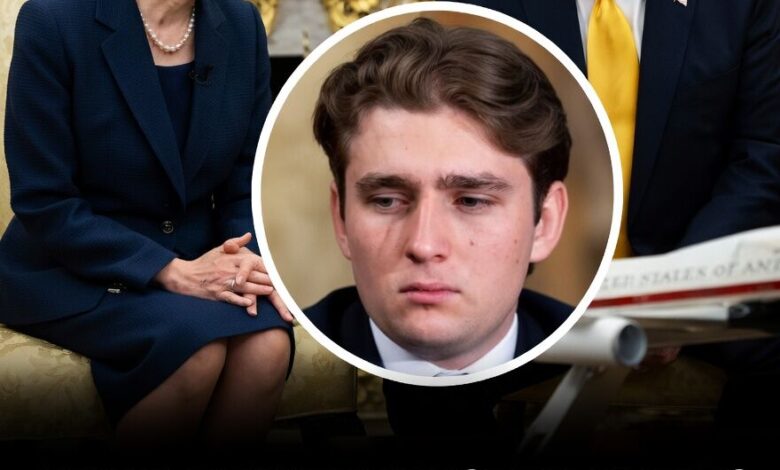
During a recent White House meeting expected to center on policy, security, and international cooperation, an unexpected personal moment drew widespread attention. Japanese Prime Minister Sanae Takaichi, on her first official visit to the United States since taking office, made a brief remark about Donald Trump’s youngest son, Barron, that quickly became one of the most talked-about aspects of the visit.
High-level diplomatic meetings are usually guided by structured agendas, focusing on economic ties, defense collaboration, and global challenges. At the same time, they often include informal moments meant to build rapport and ease communication. It was within one of these lighter exchanges that Takaichi’s comment arose—not as part of formal discussions, but as a gesture of courtesy and personal acknowledgment.
Speaking through a translator, Takaichi mentioned that Barron Trump was nearing his 20th birthday and described him as a “very tall, handsome young man.” She added, in a friendly tone, that his appearance clearly reflected his parents. The remark was warm and respectful, consistent with a long-standing diplomatic practice of recognizing family members as a way to foster goodwill between leaders.
Donald Trump responded positively, smiling and thanking her for the compliment. His reaction appeared relaxed, highlighting how small, human moments can soften otherwise formal interactions. While brief, exchanges like this can help establish a more comfortable atmosphere before or alongside serious negotiations.
Barron Trump, who has largely remained out of the public spotlight compared to other members of his family, has nevertheless drawn attention for his height and occasional public appearances. By choosing a widely observed and non-political detail, Takaichi’s comment stayed neutral while still creating a personal connection.
From a diplomatic standpoint, such gestures serve multiple purposes. They signal friendliness, demonstrate attentiveness, and contribute to a more open tone in discussions. Complimenting a leader’s family member—when done respectfully—can function as an extension of diplomatic courtesy.
At the same time, the moment illustrates how even small interactions can quickly gain traction in today’s media environment. With intense public and media scrutiny surrounding political events, brief exchanges often become focal points of coverage. This reflects a broader shift, where audiences pay attention not only to policy outcomes but also to personal dynamics and symbolic gestures.
The timing of the visit adds further context. Takaichi’s trip took place during a period of global uncertainty, with ongoing geopolitical tensions and shifting alliances. In such circumstances, maintaining strong bilateral relationships is especially important. The United States and Japan share a long-standing partnership built on economic cooperation, security commitments, and strategic alignment in the Asia-Pacific region.
Within this framework, moments of personal connection can complement formal diplomacy by reinforcing trust and goodwill. While they do not replace substantive agreements, they can help create a positive tone that supports more productive dialogue. Diplomacy is shaped not only by policy but also by relationships.
Trump’s own casual remarks about Barron in the past—often referencing his height or interests—have contributed to a public image of him as someone largely separate from political life. This distinction highlights the broader question of how leaders’ families are perceived. While they are often part of the public narrative, there remains a balance between recognition and privacy.
Cultural differences also play a role in shaping such interactions. Norms around formality, humor, and personal remarks vary across countries. Effective diplomacy often depends on navigating these differences carefully, ensuring that gestures are both appropriate and well understood.
Public reaction to Takaichi’s comment has been varied. Some see it as a simple example of polite diplomacy, while others view it as an unusual moment precisely because it diverges from policy-focused discussion. This range of responses reflects the complexity of modern political communication, where even brief remarks can carry multiple interpretations.
Ultimately, the exchange serves as a reminder that diplomacy operates on more than one level. Formal agreements and official statements are essential, but personal interactions play a meaningful supporting role. They help build the trust and understanding that underpin cooperation.
As global politics continues to evolve, these interpersonal elements remain important. Leaders operate in an environment where every word and gesture is observed and interpreted. In that context, even a short comment about a family member can contribute to a broader narrative about communication, relationships, and the human side of diplomacy.
In the end, Takaichi’s remark may not have influenced policy decisions, but it offered a glimpse into how personal connection and diplomatic practice intersect—showing that even in the midst of serious global discussions, small human moments still matter.