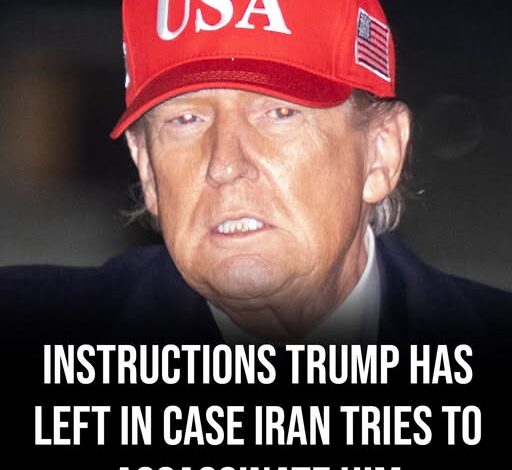
Trump Says He Has Clear Instructions for How the U.S. Would Respond to an Assassination Attempt by Iran

A sharp rise in tensions during early 2026 involving the United States, Israel, and Iran has sent ripples across the Middle East and the wider international community. What began as mounting pressure tied to nuclear policy, sanctions, and regional power struggles has quickly developed into a rapidly unfolding crisis with significant global implications.
At the center of the situation are reported military operations carried out by U.S. and Israeli forces targeting locations inside Iran believed to be linked to military planning and strategic infrastructure. According to several reports, these strikes focused on command centers and facilities connected to Iran’s security network during the opening phase of the campaign.
Iranian state media later reported that Supreme Leader Ayatollah Ali Khamenei had died following a strike in Tehran. If fully confirmed, such a development would represent an extraordinary and historic shift in the political landscape of the region, with potential consequences that extend far beyond Iran’s borders.
As the situation evolves, the geopolitical environment surrounding the Middle East is shifting quickly, and uncertainty remains extremely high.
A Critical Turning Point in Early 2026
Toward the end of February, officials in Washington and Jerusalem described their actions as part of a broader strategy to address security threats and deter future escalation. Reports suggested that the operations targeted military resources and command structures believed to play key roles in Iran’s defense and regional activities.
The reported death of Iran’s long-time supreme leader has intensified uncertainty inside the country. Leadership transitions during moments of crisis often trigger internal political shifts, and observers are closely watching how Iran’s political and military institutions respond.
Across the wider Shiite world, the news has sparked strong reactions, raising concerns about how regional alliances and influence networks may respond to the changing situation.
Iran Responds With Regional Attacks
In the aftermath of the strikes, Iran reportedly launched waves of missiles and drones across multiple locations in the region. The retaliation was aimed at a range of targets that included military, diplomatic, and strategic sites.
Among the locations reportedly targeted were:
- Major Israeli cities such as Tel Aviv and Jerusalem
- U.S. and allied military bases in Gulf countries including Qatar and Bahrain
- Diplomatic compounds and government facilities
- Maritime routes near the Strait of Hormuz
While many incoming projectiles were intercepted by missile defense systems, the scale of the attacks raised fears of wider conflict. Regional governments have heightened security, and concerns about civilian safety and infrastructure protection have intensified.
Global Economic Effects Begin to Appear
One of the fastest impacts of the crisis has been felt in global energy markets. The Strait of Hormuz, a narrow waterway through which a significant portion of the world’s oil supply travels, has experienced disruption amid the growing instability.
As tensions increased, oil prices rose sharply in response to fears that shipping routes could be interrupted for an extended period.
Air travel has also been affected. Several airlines have rerouted flights away from regional airspace or temporarily suspended service due to security concerns. Shipping and trade networks are adjusting as companies assess the risks of operating near an active conflict zone.
Earlier Policies and Long-Standing Tensions
The current situation also brings renewed attention to previous U.S. policies toward Iran. In 2025, President Donald Trump reinforced a “maximum pressure” strategy designed to push Tehran toward negotiations regarding its nuclear program and regional activities.
During that period, Trump frequently used strong language in public statements, warning that any serious threat against the United States or its leadership would trigger a powerful response. While these remarks were widely seen as part of a deterrence strategy, there was no confirmed public evidence of an assassination plot against him.
The tensions underlying the current crisis stretch back decades. Disputes over nuclear development, sanctions, and regional power have repeatedly strained relations between Iran and Western governments.
Many analysts also point to earlier flashpoints, including the 2020 U.S. strike that killed Iranian General Qasem Soleimani, as a moment that signaled the possibility of future direct confrontation.
Humanitarian Concerns and Diplomatic Pressure
As military activity continues into early March 2026, reports indicate that casualties are rising and humanitarian challenges are growing across several areas affected by the conflict. Missile warnings, infrastructure damage, and population displacement have increased the urgency of international responses.
Leaders from multiple global powers—including countries in Europe as well as China and Russia—have urged all sides to pursue de-escalation. Diplomatic channels remain active in some form, though progress toward negotiations appears limited so far.
Several governments have issued evacuation advisories for their citizens in parts of the region, and temporary airspace restrictions remain in place as a precaution.
Possible Paths Forward
The future direction of the crisis remains unclear. Analysts have suggested several potential scenarios, ranging from continued escalation to a temporary ceasefire or renewed diplomatic talks.
Much will depend on whether communication channels reopen between the involved parties and whether regional leaders prioritize containment over confrontation.
A Moment With Global Consequences
The confrontation unfolding in 2026 reflects long-standing geopolitical tensions, but its speed and intensity highlight how quickly regional disputes can expand into global concerns. Decisions made in the coming days and weeks could influence international security, energy markets, and diplomatic alliances for years.
For now, governments and observers around the world are watching closely as events continue to develop.
Do you think diplomacy still has a chance to ease tensions in situations like this, or has the conflict already reached a point where compromise is unlikely?