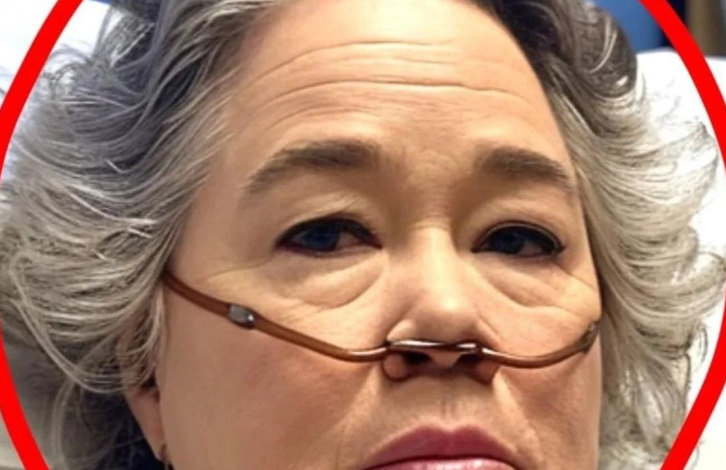
There are moments in life when even the strongest individuals are forced to pause and face something far greater than themselves. For Kathy Bates—an actress celebrated for her commanding presence and award-winning performances—that moment didn’t happen just once, but twice.
For years, audiences have admired Bates for her strength, talent, and ability to embody unforgettable characters. Yet behind that powerful image lies a deeply personal struggle—one she has only recently begun to share more openly. What she revealed has surprised and moved many.
In a heartfelt and candid conversation, Bates opened up about her battle with cancer, explaining that her journey didn’t end with her first diagnosis. While many were aware that she had overcome ovarian cancer nearly a decade ago—a fight that changed her life in every possible way—few knew that she would face another devastating challenge.
Just weeks before the interview, Bates received life-altering news: she had been diagnosed with breast cancer.
There was no dramatic buildup to her revelation. No carefully crafted statement. Instead, she spoke with raw honesty, describing the moment as immediate, overwhelming, and deeply frightening. It wasn’t something distant—it was a reality that struck all at once.
“You think American Horror Story is scary?” she said, referencing one of her most iconic roles. “You should’ve been in that room with me.”
In that single remark, the line between fiction and reality disappears. The performances, the scripts, the characters—they all fall away, leaving only a woman confronting a life-threatening diagnosis for the second time.
Cancer is often described as a battle, but for those who experience it, it’s far more complex. It brings uncertainty, emotional weight, and a constant reminder of how fragile life can be. For Bates, surviving ovarian cancer once might have felt like reaching the finish line—but instead, it became just one chapter in a much longer story.
What makes her journey so compelling is not just what she’s faced, but how she faces it. She doesn’t deny the fear or attempt to soften the truth. She speaks openly about the shock, the emotional toll, and the difficulty of hearing that word—“cancer”—again.
Nine years after her first diagnosis, she had every reason to believe that chapter of her life was behind her. She had earned that sense of closure. But life doesn’t always follow the paths we expect.
Hearing that diagnosis a second time isn’t simply starting over—it’s reliving everything: the hospital visits, the waiting, the uncertainty, the quiet moments filled with fear.
And still, she stands.
Her story resonates not because she’s a celebrity, but because it reflects something deeply human. Illness does not discriminate. It does not consider success, recognition, or past victories. It arrives uninvited and changes everything.
What truly defines a person isn’t the diagnosis—but how they respond to it.
Bates has never tried to appear invincible. Instead, she shows what real strength looks like: acknowledging fear while continuing forward. Speaking honestly instead of hiding behind silence. Letting others see the reality, not just the polished surface.
There’s also something powerful in the way she shares her experience. She doesn’t exaggerate it, nor does she minimize it. She simply tells the truth. And that honesty is what makes people listen.
Her words carry weight because they come from lived experience. When she speaks about fear, it’s not abstract. When she talks about cancer, it’s not theoretical—it’s something she has faced, twice.
For many, this revelation changes how they see her. She is no longer just a figure on a screen, but someone navigating the same fears and uncertainties that millions face every day.
It also highlights an important truth: surviving cancer once doesn’t guarantee it won’t return. The idea of being “finished” with it is comforting—but not always accurate.
That reality can be difficult to accept. It challenges the way people think about recovery. Sometimes, healing isn’t a clear ending—it’s ongoing. Sometimes, it takes unexpected turns.
And sometimes, like in Bates’ case, it becomes part of a larger story of resilience.
There’s no denying the emotional and physical toll of facing a second diagnosis. It demands strength that often goes unseen.
But one thing is clear—Bates refuses to let fear define her.
She continues to speak openly, to share her experience, and to face her situation head-on. That alone is powerful. Not everyone has the strength—or the willingness—to do so.
Her story is a reminder of life’s unpredictability. One moment everything feels steady; the next, everything shifts.
And yet, even in uncertainty, there is space for courage.
Kathy Bates doesn’t present herself as flawless or untouchable. She presents herself as human—someone facing something incredibly difficult with honesty and determination.
That is what makes her story linger.
Not because it is dramatic, but because it is real.
Not because it is easy, but because it isn’t.
In a world where struggles are often hidden, her openness stands out.
Her journey is still unfolding. But one thing is certain—she is not stepping back.
And that, more than anything, is what people will remember.