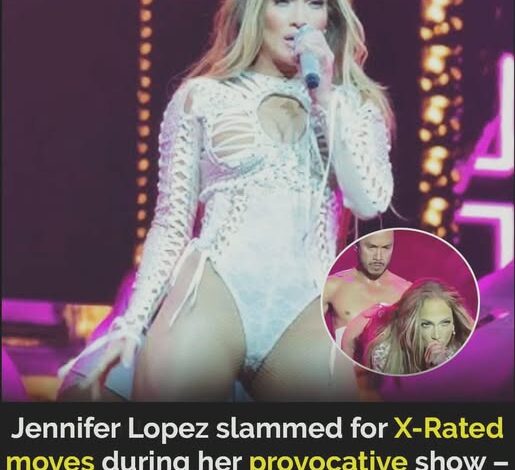
The lights at Washington’s 2025 World Pride Music Festival were almost overwhelming, flooding the massive stage in flashes of silver, crimson, and electric blue. Thousands of voices rose together into one enormous roar, while the music hit so hard it seemed to shake the ground beneath the crowd.
Then Jennifer Lopez stepped into the spotlight.
Within moments, the internet had already begun choosing sides.
At fifty-five, Lopez did not walk onto that stage dressed to disappear.
She arrived to command attention.
Every entrance, every movement, every costume change carried the confidence of a performer who knows people will stare no matter what she wears, and who has long since stopped apologizing for being impossible to ignore.
That confidence became the center of the conversation almost immediately.
Throughout the performance, Lopez moved through a series of bold, theatrical stage looks that were designed not merely to fit the festival atmosphere, but to dominate it. One of the most talked-about outfits was a shimmering silver bodysuit covered in rhinestones, created by The Blonds. With sharp lines, a plunging neckline, and sculpted contours, the look highlighted the physical discipline Lopez has maintained across decades in the entertainment industry.
Under the stage lights, the costume seemed almost liquid, throwing silver reflections across the crowd with every step.
Later, she appeared in a sleek black patent leather catsuit designed by Rey Ortiz. The look featured illusion-style cutouts along the hips and legs, creating a visual balance between futuristic armor and classic pop spectacle. It amplified the larger-than-life performance style Lopez has built her career around.
Then came one of the night’s most dramatic transformations: a sequined, flame-inspired ensemble that turned the stage into something like a moving inferno. Dancers circled around her while fire-colored lighting shot upward, making the entire performance feel theatrical, intense, and deliberately unforgettable.
Inside the festival, many fans responded with the kind of excitement Jennifer Lopez has inspired for decades.
To them, this was classic J.Lo.
Fearless.
Glamorous.
Physical.
High-energy.
Unapologetically committed to spectacle.
Pride celebrations have long embraced bold fashion, theatrical self-expression, sensuality, and visibility as part of their cultural language. For many people in the crowd, Lopez’s performance did not feel out of place at all. It felt aligned with the spirit of the event: loud, expressive, celebratory, and defiant.
Online, however, the reaction split almost instantly.
What began as discussion about costumes quickly became a larger argument about age, gender, celebrity, and who is allowed to remain visible.
Jennifer Lopez at fifty-five occupies a uniquely charged space in modern pop culture. She is still famous, still physically confident, still openly sensual, and still unwilling to step quietly into the background simply because society often expects women to become less noticeable as they age.
That tension fueled much of the debate.
Supporters rushed to defend her, arguing that the backlash revealed a familiar double standard. They pointed out that male performers often continue presenting themselves as sexual, rebellious, shirtless, or romantically desirable well into their sixties and seventies without provoking the same level of outrage.
Older male rock stars are praised for “still having it.”
Older male actors continue leading romantic films opposite much younger women.
Older male celebrities who project confidence are often called timeless, charismatic, or legendary.
Women over fifty, however, are frequently met with a different set of expectations.
Be quieter.
Be softer.
Be less sexual.
Age gracefully.
Stop asking to be seen.
To Lopez’s defenders, the criticism said less about rhinestones or bodysuits and more about a culture that remains uncomfortable with women refusing to age invisibly.
Social media filled with comments defending her:
“She looks incredible.”
“If I looked like that at 55, I’d wear it too.”
“She has earned the right to wear whatever she wants.”
“People are mad because she refuses to disappear.”
Some fans admired something even deeper beneath the glamour. In an industry increasingly shaped by extreme cosmetic alteration and heavily filtered celebrity images, they argued that Lopez still appears recognizably human beneath the makeup, lighting, and stage styling.
Yes, she is polished.
Yes, she clearly invests enormous effort in fitness, fashion, and beauty.
But to many supporters, she has not erased herself in pursuit of an artificial version of youth. That distinction mattered to viewers who see aging in Hollywood as an impossible performance. Women are pressured to remain young forever, then criticized if the work required to maintain that illusion becomes too visible.
Lopez exists inside that contradiction constantly.
That may be one reason reactions to her remain so emotionally intense.
The criticism was just as forceful.
Detractors accused her of relying too much on provocation and spectacle. Some called the outfits desperate. Others said the performance felt overly sexualized regardless of her age. Again and again, the same phrase appeared:
“Act your age.”
That phrase may be the most revealing part of the entire controversy.
Because beneath it is a question people rarely answer honestly:
What is the correct age for glamour?
For sexuality?
For ambition?
For being looked at?
And who gets to decide?
For many critics, the discomfort was not really about a silver bodysuit or black leather catsuit. It was about seeing a woman over fifty continue to behave as though desirability, performance power, and public confidence still fully belong to her.
That unsettles certain cultural expectations.
Modern society often treats female aging as a gradual retreat from visibility. Jennifer Lopez refuses that retreat completely.
And she has refused it for most of her career.
From the beginning, Lopez built her public identity around ambition, movement, glamour, discipline, and sensuality. She danced hard. Trained hard. Worked across music, film, fashion, television, beauty, and business while remaining under constant inspection.
Few entertainers have spent as many consecutive decades being watched, judged, praised, mocked, and analyzed through the lens of appearance.
Perhaps that is why people rarely respond to her neutrally.
Some see empowerment.
Some see insecurity.
Some admire the discipline required to perform at that level at fifty-five.
Others resent the unrealistic beauty standards celebrity culture helps maintain.
Jennifer Lopez becomes a mirror for larger feelings about aging, gender, beauty, fame, and power.
The World Pride setting intensified the symbolism. During the show, Lopez addressed LGBTQ+ fans directly, thanking them for their support and celebrating community, diversity, love, and freedom. Pride performances have historically embraced flamboyance, bold fashion, theatricality, and unapologetic visibility because those forms of expression once carried real social risk.
For many attendees, Lopez’s refusal to shrink herself fit naturally within that atmosphere.
The controversy also followed another widely discussed moment from the 2025 American Music Awards, where Lopez performed a choreographed medley that included kisses with both male and female dancers. Critics again accused her of manufacturing attention through provocation. Supporters argued that theatrical sexuality and performative inclusivity have long been part of pop culture.
Yet what remains striking is not simply that Jennifer Lopez still creates controversy.
It is that she still creates enough emotion to dominate the conversation.
Many celebrities eventually fade into familiarity. The public stops reacting so strongly. Their presence becomes predictable.
That has never really happened with Lopez.
Beneath every debate about her outfits, performances, or choices is a larger cultural discomfort:
society still struggles with women who refuse to become smaller as they age.
Jennifer Lopez seems to understand that perfectly.
And judging by the lights, the music, the costumes, the spectacle, and the confidence she carried onto the World Pride stage, she has no intention of making herself easier for anyone else to digest.
Not now.
Not at fifty-five.
And perhaps not ever.