Karoline Leavitt Announces Surprising Career Shift Toward Nationwide Free Speech College Tour Following Reflective “Regrets” Statement Amid Backlash Debate and Renewed Political Attention as Her Role Expands Beyond the White House Into Youth Activism and Ideological Conversations Across America

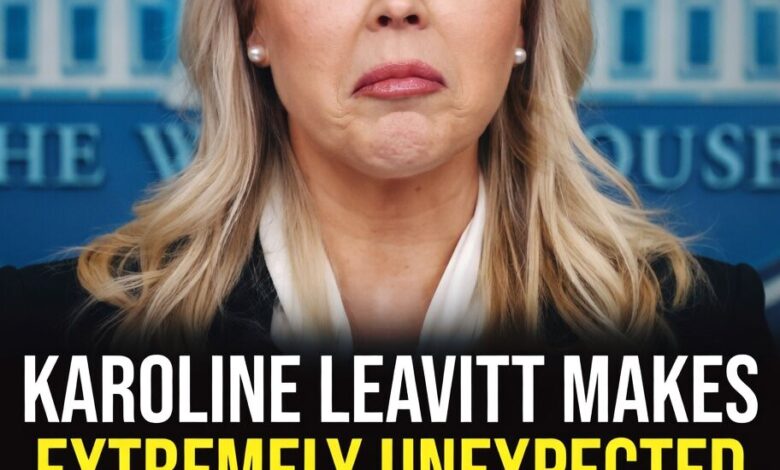
The political scene in the United States is no stranger to sudden shifts, controversial announcements, and public figures redefining their roles. Yet even in this unpredictable environment, Karoline Leavitt’s latest move has captured widespread attention, sparking both curiosity and debate. Following a reflective social media post about personal “regrets,” Leavitt is now taking on a new public-facing role—one that stretches beyond her White House duties and directly into the nation’s college campuses.
Her choice to join a nationwide speaking tour focused on free speech is more than a side engagement. It marks a shift in how political figures communicate, influence, and connect with younger generations. At a time when ideological divides are deeply entrenched and debates over expression, identity, and power dominate public discourse, Leavitt has placed herself at a critical cultural and political crossroads.
From the White House Podium to College Campuses
As White House Press Secretary, Leavitt holds one of the most visible and scrutinized positions in American politics. Her words are examined closely, her appearances carefully managed, and her statements carry weight far beyond the briefing room.
Stepping into the “This is the Turning Point USA Tour” represents a move into a less controlled and more personal arena. The tour, connected with Turning Point USA, brings discussions about free speech to college campuses—a landscape often charged with ideological tension.
The tour will launch at George Washington University, with Leavitt as its first featured speaker, before expanding nationwide. It reaches students actively forming their political identities and engaging in debates about the nation’s future.
This transition—from government spokesperson to campus speaker—reflects a broader trend in politics. Public officials are increasingly expected not just to inform, but to inspire, influence, and participate in cultural conversations. For Leavitt, this could be a way to engage directly with younger audiences, bypassing traditional media filters.
Honoring a Legacy and a Movement
The tour also carries a deeper emotional and political significance. It builds on the legacy of Charlie Kirk, whose passing has prompted reflection on political violence and free speech. Erika Kirk has since taken a leadership role in continuing Turning Point USA’s mission, and the tour aims to honor that legacy while promoting dialogue.
Supporters view the initiative as a symbol of resilience—a refusal to be silenced in the face of loss. Critics, however, question its motives and messaging, seeing it as politically charged rather than purely educational.
The “Regrets” Post
Leavitt’s decision comes shortly after a widely discussed social media post in which she shared values she described as “things people will never regret”—prayer, gratitude, forgiveness, and human connection.
While some viewed the post as a heartfelt reflection, others questioned its timing and intent, interpreting it as an attempt to soften her public image ahead of the tour. This contrast underscores a key reality of public life today: personal expression and political identity are deeply intertwined, and even introspective moments are often politicized.
Free Speech in Higher Education
Free speech remains a contentious issue on college campuses. While some argue that open dialogue is under threat—citing canceled events, protests, or marginalized viewpoints—others contend that discussions about free speech must consider responsibility, misinformation, and the potential harm of rhetoric.
Leavitt’s participation places her at the center of this debate, where support and opposition are likely to be intense. Her challenge is to promote dialogue rather than deepen existing divisions.
Politics, Culture, and the Modern Public Sphere
This development highlights how politics and culture are increasingly intertwined. Previously, political communication relied on formal channels—press releases, briefings, and policy statements. Today, public figures engage directly with audiences through live events and social media, participating in broader cultural conversations.
This approach offers accessibility and immediacy but also increases the potential for controversy and misinterpretation. Leavitt’s tour is emblematic of this shift: a blend of political advocacy, cultural participation, and personal expression.
Strategic Move or Personal Commitment?
It’s unclear whether Leavitt’s involvement is primarily strategic or personal—or both. Politically, connecting with college students can expand her influence and reach future voters. Personally, the themes she emphasized in her social media reflections—faith, gratitude, and human connection—align with the tour’s messaging, suggesting an authentic interest in fostering dialogue.
Looking Ahead
As the tour begins, its impact is uncertain. Will it encourage meaningful discussion or deepen polarization? Will Leavitt’s presence elevate her profile or invite further criticism?
Regardless, the initiative offers a glimpse into the evolving dynamics of political engagement, particularly among younger audiences navigating a complex media and ideological landscape.
Conclusion
Karoline Leavitt’s move into this new public role illustrates the fluidity of modern politics, where public figures operate across government, media, and cultural platforms. Her participation in the Turning Point USA tour highlights both the opportunities and challenges of engaging with college audiences on free speech and civic discourse.
Whether viewed as bold, strategic, or controversial, it underscores an ongoing reality: public dialogue is evolving, and those who shape it must navigate an increasingly complex terrain of voices, values, and expectations.