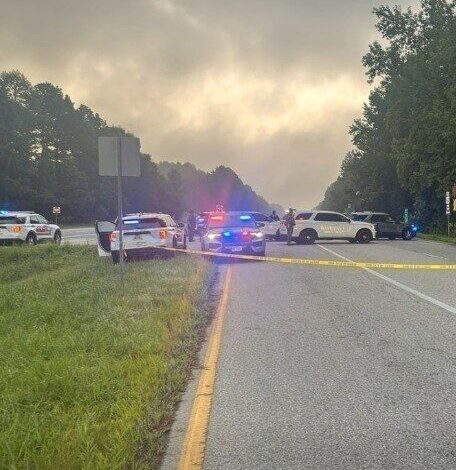
It shifted so quickly that people barely had time to register the change. One moment, the street was moving through its usual routine—morning commuters, shop doors unlocking, the low, familiar hum of traffic. The next, that same stretch of city had been abruptly carved out and isolated, transformed into a tightly controlled zone marked by barricades, flashing lights, and lines of officers holding the perimeter.
There was no gradual buildup, no slow escalation that hinted at what was coming. The transition was immediate and absolute, as if an invisible switch had been flipped. Within minutes, access points were blocked, movement was redirected, and the normal flow of the area was cut off entirely. What had been open and accessible just moments before was now sealed with precision.
Officials responded with urgency, delivering a message that left little room for interpretation: stay away. There was no attempt to soften the directive or downplay the seriousness. The warning carried a tone that was direct and unmistakable, signaling that whatever was unfolding inside that boundary was being treated as a high-risk situation. Even approaching the area out of curiosity was discouraged in the strongest possible terms.
As the containment expanded, the atmosphere changed with it. The neighborhood lost its sense of familiarity and took on a different weight—tense, controlled, and uncertain. Police vehicles filled intersections, their lights casting sharp pulses of color across buildings and sidewalks. Specialized units arrived in coordinated waves, moving with focus and discipline, reinforcing the sense that this was not a standard response.
Inside the restricted zone, the usual rules no longer applied. Streets that once carried steady traffic were abruptly emptied or redirected, creating confusion at the edges of the perimeter. Public transit was interrupted without warning, leaving passengers stranded mid-journey and unsure of what was happening beyond the barriers. The city’s rhythm didn’t stop entirely, but it fractured, rerouted around a center that had suddenly become inaccessible.
For those living nearby, the experience felt unreal. From behind partially drawn curtains or from the edges of sidewalks held back by tape, they could only catch glimpses—officers communicating in short, urgent exchanges, vehicles repositioning, personnel moving with deliberate intent. The ordinary sounds of the city faded into the background, replaced by a quieter, more uneasy tension punctuated by sirens and radio chatter.
Authorities described the area as a secured zone, emphasizing that only trained teams were permitted inside. The level of coordination suggested that this was not a simple incident with a quick resolution, but something more complex—something that required control, patience, and careful management. Every movement inside the perimeter appeared calculated, as if the situation could shift at any moment.
What made it all the more unsettling was the absence of clear information. Officials offered little detail, citing the need to protect the operation. That silence left space for speculation, but the visible response spoke loudly on its own. The scale, the urgency, and the strict containment all pointed to one conclusion: this was a serious and evolving situation, one being handled with caution because the stakes were far from ordinary.