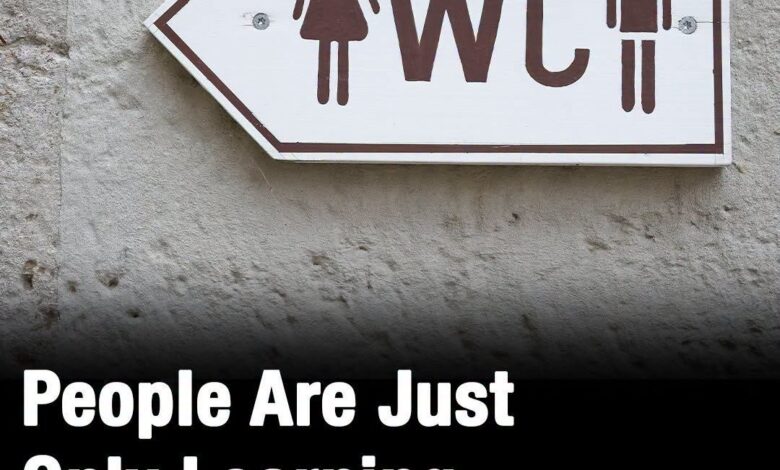
Have you ever walked past a public bathroom sign marked “WC” and wondered what those two letters actually mean? If so, you are definitely not alone. Around the world, people have paused in airports, restaurants, hotels, train stations, and shopping centers, looking at that small sign and trying to decode what seems like a strangely formal label for a very ordinary place.
The answer is simple, though the history behind it is a little more interesting. “WC” stands for “water closet,” a term used to describe a small room or compartment containing a toilet. In many modern public spaces, especially places that welcome international travelers, WC is used as a clear and compact way of identifying a restroom, bathroom, washroom, toilet, lavatory, or whatever name people happen to use in their part of the world.
Of course, once you begin thinking about the names we give this room, none of them make perfect sense.
A bathroom may not contain a bath. A restroom is not usually a place where anyone rests. A washroom may contain a sink, but people are not exactly going there to wash clothes. And “water closet” sounds even stranger if you imagine an actual closet full of water. Yet all of these terms developed from different habits, cultures, and moments in history, and each one reveals something about how people have tried to speak politely about one of the most basic human needs.
That confusion became the subject of a funny viral moment in 2020, when a couple named Shelby and Dylan shared a TikTok video about the different words Americans and Canadians use for the same room. In the video, Dylan walks past a sign that says “washroom” and jokingly asks, “What in the world is a washroom?” He then wonders what people are supposed to be washing in there before admitting that the only thing he washes in a restroom is his hands.
Off camera, Shelby points out the obvious flaw in his argument: “Do you rest in a restroom?”
Dylan pauses and concedes the point. Neither term, when taken literally, makes much sense. That is exactly why the conversation amused so many people online. The comment section quickly filled with people comparing the words they use: bathroom, restroom, washroom, toilet, loo, lavatory, and WC. One person joked that when they asked for the “washroom” at Disneyland, they were sent toward a laundromat. Another warned, “Wait until he finds out about water closets.”
The term “water closet” has been around for a long time. According to dictionary definitions, it refers to a room or compartment with a toilet, or to the toilet and its connected plumbing fixtures. The name comes from a time when indoor plumbing was becoming more common and toilets were often kept separate from bathing areas. In other words, the “bathroom” was originally where a person bathed, while the “water closet” was where the flushing toilet was located.
Before indoor toilets became common, especially before the late 19th and early 20th centuries, many people used outdoor facilities such as outhouses. Indoor plumbing was once a luxury, usually found first in wealthier homes. When water closets became more widely installed, they represented a major change in comfort, hygiene, and household design. At first, the toilet might be placed in a small separate room. Later, as plumbing systems became more advanced and homes were designed more efficiently, toilets, sinks, and bathtubs were often combined into one room.
That is how the modern bathroom developed. What we now think of as a normal bathroom—a toilet, sink, and bathtub or shower in one space—was not always the standard arrangement. Combining everything into one room was practical, especially in smaller homes, because it simplified plumbing and saved space. But it also changed the way people talked about the room. In some places, “bathroom” became the polite word for the whole space, even when no bath was involved. In other places, “toilet” remained the most direct term. Elsewhere, “WC” or “lavatory” became more common.
Today, WC is especially useful because it is short and widely recognized. You may see it on signs in airports, train stations, restaurants, tourist areas, and hotels. Even if people speak different languages or use different everyday words for the room, many travelers understand that WC points them toward the toilet. It has become a kind of international shorthand.
Still, the name can sound odd to people who did not grow up using it. Some Americans may wonder why it is called a water closet if it is not really a closet. People from other countries may wonder why Americans ask for a bathroom when they clearly are not planning to take a bath. Canadians often use “washroom,” which may sound strange to those who prefer “restroom.” In the United Kingdom and other places, people may say “loo,” “toilet,” or “lavatory.” Each term feels normal to the people who grew up with it and slightly funny to those who did not.
Online discussions about the subject often show just how many different names exist for the same essential space. Some people prefer “washroom” because at least handwashing actually happens there. Others prefer “restroom” because it sounds more polite than saying “toilet.” Some like the directness of “toilet” because everyone knows exactly what it means. Others find “WC” practical, especially in public places where signs need to be simple and understood by many people.
The truth is that no single term is perfect. Each one is shaped by culture, politeness, history, and habit. What sounds normal in one country may sound amusing, old-fashioned, or confusing in another. But that is part of what makes language interesting. Even the most ordinary room in a building can carry a long history of technology, manners, and cultural differences.
So the next time you see the letters WC outside a public bathroom, you will know they stand for “water closet.” It is simply another name for the room that holds a toilet, often with a sink nearby. It may sound formal or old-fashioned, but it comes from the history of indoor plumbing and has survived because it is short, recognizable, and useful around the world.
Whether you call it a bathroom, restroom, washroom, loo, lavatory, toilet, or WC, the purpose is the same. The names may change from place to place, but everyone eventually needs to find one.
What do you call it where you live? And does “WC” make sense to you, or does it sound even more mysterious than “restroom” and “bathroom”?