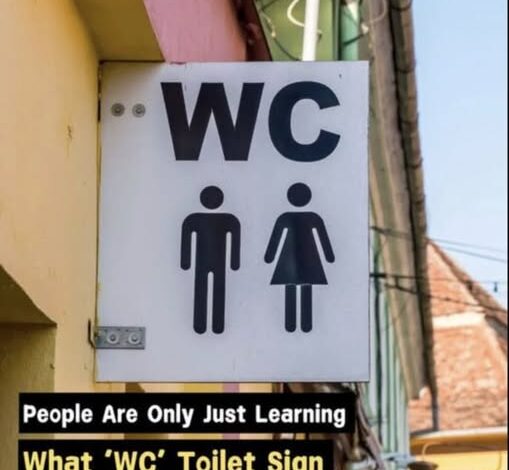
The familiar “WC” sign—commonly seen in airports, train stations, and older European buildings—remains one of the most recognizable yet often misunderstood symbols in public spaces. Most travelers instinctively know it points toward a restroom, yet many are unaware of the historical meaning behind the abbreviation. Rather than being a random design choice, “WC” is actually a linguistic holdover from a major shift in sanitation and architecture that took place more than a century ago. Understanding why this abbreviation still appears in 2026 requires looking back to the early days of indoor plumbing and the evolution of the modern bathroom.
The letters “WC” stand for “water closet.” In the late nineteenth century, this term referred to a small enclosed room specifically designed to house a flush toilet. At the time, particularly in Victorian Britain and early urban America, bathing and toilet functions were considered entirely separate activities. Homes were often designed with two different rooms: a bathroom, which contained a bathtub for washing, and a water closet, a much smaller space dedicated solely to waste disposal. This separation reflected both social customs about privacy and practical concerns about odors associated with early plumbing systems.
As plumbing technology improved in the early twentieth century, these separate spaces gradually merged into the single-room bathroom layout that is now standard in most homes. Municipal sewer systems expanded, sanitation practices improved, and indoor toilets became common rather than luxurious. Even though the architectural distinction between bathroom and water closet largely disappeared, the abbreviation “WC” remained in use—especially in public signage where its simplicity proved useful.
Language surrounding bathrooms has always been shaped by politeness and cultural habits. Many modern terms are technically inaccurate but persist because they soften the subject. For example, the American term “restroom” suggests a place for resting, while “washroom” implies washing. In public spaces, however, neither description fully reflects the primary function of the facility. The word “bathroom” itself is often misleading when used for public restrooms, since most do not contain a bathtub at all. These linguistic workarounds illustrate how societies tend to rely on indirect expressions when referring to basic bodily functions.
Regional variations add another layer of complexity. In Canada and parts of the United States, “washroom” is the most common term. In the United Kingdom, people might refer to the “loo” or the “lavatory.” French speakers use “toilette,” a word that has influenced many languages worldwide. Amid all of these regional differences, “WC” has remained remarkably consistent. Because it is short and easily recognizable, it functions as a universal sign that travelers can quickly understand regardless of language barriers.
From a design standpoint, the abbreviation’s endurance makes practical sense. Two simple letters can be read quickly from a distance and fit neatly on directional signage. For this reason, architects and designers frequently pair “WC” with universally recognized pictograms that indicate restroom facilities. Together, the symbol and abbreviation create a clear message that works across cultures and languages—an essential feature in international travel environments.
The history of the “water closet” also reflects broader developments in public health. The adoption of indoor plumbing and effective sewage systems dramatically improved sanitation and reduced the spread of diseases such as cholera in growing urban populations. What may seem like a mundane sign today actually represents a major milestone in the development of modern cities and living standards.
Even as architecture and technology continue to evolve, the “WC” label persists. Contemporary restroom designs may incorporate features like touchless fixtures, eco-friendly water systems, and gender-inclusive layouts, but the basic abbreviation often remains unchanged. For designers and planners, it still offers one of the most efficient ways to identify a restroom space without requiring translation.
Ultimately, the continued presence of “WC” signs offers a small but fascinating glimpse into how language, architecture, and public health history intersect. What began as a technical description of a tiny room containing a flush toilet has evolved into a universal symbol understood around the world.
So the next time you spot those two letters in an airport corridor or on a street sign abroad, you are seeing more than just directions to a restroom. You are encountering a piece of linguistic and architectural history—one that connects modern travelers to the long story of sanitation, urban development, and the everyday conveniences we often take for granted.