My 13-Year-Old Daughter Set up a Small Table in the Yard to Sell the Toys She Crocheted – Then a Man on a Motorcycle Pulled up and Said, ‘I’ve Been Looking for Your Mom for 10 Years’

Five years ago, hope sounded like my daughter laughing over breakfast.
Now, it looks like her sitting quietly at the table, looping yarn around her fingers, brow furrowed in focus.
She calls it crocheting. I call it her way of trying to keep our world from falling apart—one tiny stitched animal at a time.
My name is Brooklyn. I’m forty-four, a widow, and for the past year, I’ve been fighting cancer.
My husband, David, died when our daughter Ava was just two. He left behind a small house, a mountain of bills, and a child who still smelled like baby shampoo.
Back then, his family showed up right away. For a week, the house was filled with casseroles, hushed conversations, and paperwork I barely understood.
“Just sign here,” my mother-in-law kept saying, her voice calm but distant. “We’ll handle everything.”
I signed because I was grieving, exhausted, and too overwhelmed to question anything.
That was eleven years ago.
After that, they disappeared. No calls, no birthdays, nothing. It was like we’d never existed to them.
When I got sick, I told myself we’d manage somehow. Insurance barely covered the treatments, and every day felt like trying to survive a storm with nothing but a broken umbrella.
Ava is thirteen now. She notices everything—the way I wince, the food I leave untouched, the days I can barely get out of bed.
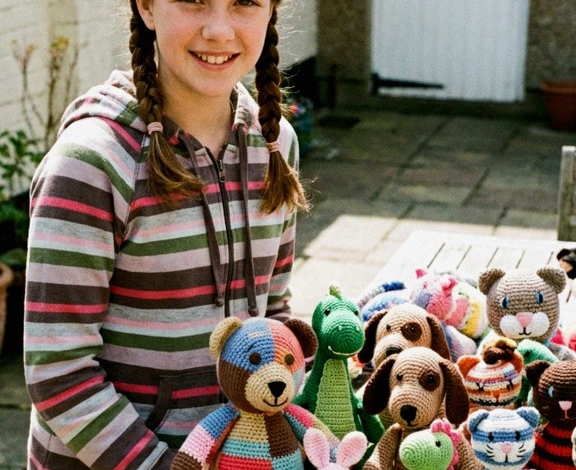
One afternoon, after chemo, I came home to find her sitting on the rug, carefully stitching something together.
“Did you make that?” I asked, lowering myself onto the couch.
She smiled and held up a bright orange fox. “It’s for you. I wanted it to look happy.”
I laughed softly. “It does.”
She beamed, then pulled out more—little animals in all shapes and colors. “Do you think other people would want them too?”
“I think they would,” I said, meaning it.
A few days later, I woke up to the sound of something scraping outside. When I looked out the window, Ava was setting up an old folding table in the yard.
She arranged her handmade toys in neat rows and propped up a sign written in purple marker:
Handmade by Ava – For Mom’s Medicine.
I stepped outside, wrapping my sweater tighter. “Sweetheart… what is this?”
“I want to sell them,” she said gently. “So I can help you.”
My chest tightened. “You don’t have to do that.”
“I want to,” she said, hugging me. “It makes me feel like I’m helping.”
And she was.
Neighbors started stopping by. Some bought toys, others just gave what they could. People who barely spoke to us before suddenly showed kindness I hadn’t expected.
By evening, the sky had turned soft shades of pink and gold.
Then I heard it—a low rumble.
A motorcycle pulled up near the yard. The rider stepped off, scanning the scene before approaching the table.
“Hi,” Ava said bravely. “Would you like to buy one? I made them.”
He picked up a small bunny, studying it. “You made all of these?”
She nodded proudly.
He smiled faintly. “Your dad would’ve loved these.”
Ava blinked. “You knew my dad?”
Something in my chest tightened.
I stepped forward. “Ava, honey, why don’t you go inside for a minute?”
She hesitated, then nodded.
When she was gone, the man removed his helmet.
I froze.
“Marcus?” I whispered.
He nodded.
Anger rose before I could stop it. “You don’t get to just show up here.”
“I know,” he said quietly. “But you need to hear the truth.”
I crossed my arms. “Your parents told me you left. That you didn’t want anything to do with us.”
“They lied,” he said.
The word hung heavy between us.
“I tried to find you,” he continued. “They told me you moved. Said you didn’t want me around.”
My stomach dropped.
“And that’s not the worst of it,” he added.
Inside, he sat across from me, glancing at the medical bills scattered across the table.
“They stole from you,” he said finally.
I shook my head. “I signed everything.”
“Not this,” he said, sliding a folder toward me.
Inside were documents—signatures that weren’t mine.
“They forged your name,” he said. “The life insurance David left? They took it.”
The room spun.
“I was barely holding myself together,” I whispered. “And they—”
“I know,” he said.
Ava walked in quietly. “Mom?”
I pulled her close. “It’s okay, baby. This is your uncle Marcus.”
He looked at her gently. “Your dad was my brother. And I should’ve been here a long time ago.”
Over the next few weeks, everything changed.
With Marcus’s help, we took legal action. The truth came out—every forged signature, every stolen dollar.
When we finally faced my in-laws, they tried to justify it.
“You weren’t capable,” my mother-in-law said coldly.
I stared at her. “I was grieving. And you took advantage of that.”
For the first time, she had no response.
When it was over, we didn’t just get the money back—we got something more important.
Proof.
Proof that we hadn’t imagined the betrayal. Proof that Ava’s future didn’t have to be built on loss.
That night, as I tucked her in, she whispered, “Does this mean you’re going to get better?”
I brushed her hair back. “It means we don’t have to be so afraid anymore.”
Later, Marcus and I sat on the porch as the sun dipped below the horizon.
He handed me a crooked wooden birdhouse.
“It’s not great,” he admitted.
I smiled through tears. “It’s perfect. David would’ve loved it.”
For the first time in years, I felt something I hadn’t allowed myself to feel in a long time.
Hope.
Not loud or bright—but steady, quiet, and real.
And somehow, it started with a little girl, a handful of yarn, and the belief that even small things can hold a broken world together.