My 6-Year-Old Son Gave All His Savings to Help Our Elderly Neighbor – The Next Morning, Our Yard Was Filled with Piggy Banks, and Patrol Cars Were Everywhere

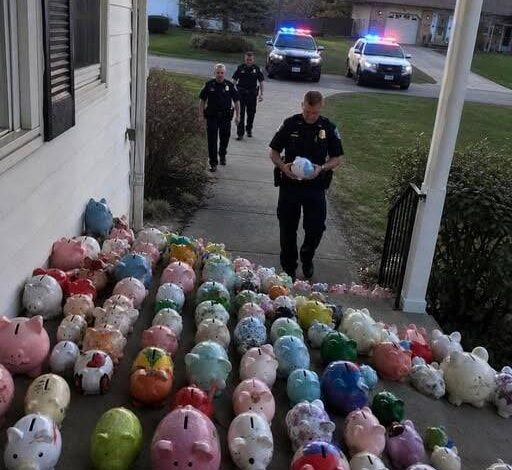
By the time the final piggy bank was emptied onto the church basement floor, the story had become about far more than an unpaid electric bill.
It was no longer only about an elderly woman sitting alone in a dark house.
It had become a mirror held up to the whole community.
And none of us were completely comfortable with what we saw.
At first, people talked about it as charity.
Poor Adele.
Someone should help.
How terrible that this happened.
But as neighbors began placing coins, envelopes, grocery cards, blankets, and folded bills onto plastic tables beneath the flickering fluorescent lights, another truth quietly surfaced beneath all that generosity.
Adele had spent decades helping us.
We had simply stopped noticing.
The shut-off notice lying unopened beside her kitchen sink was not where her hardship began. It was only the first part of her struggle that the rest of us could finally see. Long before the power company taped warnings to her door, before her pantry shelves thinned, before winter crept into rooms too cold for comfort, Adele had already become one of those people a community slowly absorbs into the background.
Everyone knew her.
That was the painful part.
She had worked in the elementary school cafeteria for thirty-two years. Generations of children had passed through her lunch line with sticky fingers, unfinished homework, loose shoelaces, and small stories that busy adults often missed.
Adele noticed them.
She remembered food allergies before some teachers did.
She slipped extra fruit onto trays when she suspected a child had skipped dinner.
She kept peanut butter crackers tucked in her apron pocket for the quiet boy whose parents were always “between jobs.”
She paid for milk cartons herself when lunch accounts ran low.
Because kindness was so natural to her, people eventually began treating it like part of the building.
Reliable.
Constant.
Expected.
Like electricity.
That was what unsettled me most later, once I had enough time to understand the story properly. Communities can normalize the emotional labor of good people so thoroughly that those people stop being seen as human beings and start being treated like functions.
Adele became “the lunch lady.”
“The sweet widow.”
“The woman with the flower boxes.”
Not a person aging alone.
Not a woman whose husband had been gone nearly fifteen years.
Not someone quietly cutting pills in half and stretching groceries because prices had outgrown her pension.
Just Adele.
Steady.
Helpful.
Invisible.
She might have stayed invisible much longer if not for Oliver.
My son was only eight when he first noticed that her porch had been dark for three nights in a row.
Children notice things adults teach themselves to overlook. Their sense of the world is still immediate. They have not yet learned the dangerous habit of assuming someone else will eventually handle another person’s suffering.
“Why are Miss Adele’s lights off?” he asked as we drove home from basketball practice.
“Maybe she’s having a tough month,” I said absentmindedly.
Oliver kept looking out the car window until her house disappeared behind us.
The next evening, he asked again.
The night after that, he said, “Shouldn’t somebody check on her?”
I wish I could say I acted right away.
I did not.
Adults become very skilled at delaying compassion.
Busy.
Tomorrow.
Someone else probably knows.
I am ashamed now of how quickly I reached for those excuses without even recognizing them as excuses. Not because I was cruel. That almost makes it worse. I was simply moving through life with enough momentum that concern became something I planned to return to later.
But children do not understand “later” the way adults do.
To Oliver, if someone was cold tonight, then helping tomorrow was already late.
So on Saturday morning, before I could invent another reason to wait, he stood in the kitchen holding his dinosaur piggy bank against his chest.
“We’re going now,” he said.
There was no drama in his voice.
Only certainty.
And somehow that certainty dismantled every excuse I had built around my own inaction.
When we knocked on Adele’s door, it took almost a full minute before we heard movement inside. When she finally opened it, the house smelled faintly of dust and canned soup. She wore two sweaters under an old cardigan, though the room behind her still felt freezing.
At first, she looked more embarrassed than frightened.
Many people from her generation were taught to treat needing help as a personal failure rather than evidence that life had become too heavy. Pride can survive hardship in stubborn ways.
“Oh, sweetheart, I’m fine,” she said quickly when Oliver asked why her lights were off.
But children hear weakness differently than adults.
Oliver stepped forward and held out his piggy bank with both hands.
“You fed my mom when she forgot her lunch money in third grade,” he said seriously. “She told me.”
Adele’s face changed.
She did not collapse into dramatic tears.
She did not make a scene.
Something simply softened around her eyes, as if loneliness itself had finally been named out loud.
In that moment, she was no longer “Miss Adele from the cafeteria.”
She was a tired woman standing in a cold, dark house, trying not to let an eight-year-old see how ashamed she felt.
The story spread through town faster than gossip.
Kindness moves differently than scandal. It travels through recognition instead of outrage.
One parent mentioned it at church. Someone else posted quietly in the neighborhood group. Then the memories began coming.
Someone remembered Adele staying late after school to help their daughter read.
Someone else remembered sandwiches slipped onto lunch trays during layoffs.
A football coach remembered her paying anonymously for winter gloves through the school office.
A nurse remembered Adele bringing soup after surgery.
A cashier admitted that Adele once covered her groceries when her debit card failed in front of a long line.
Every memory carried the same quiet confession.
She helped us.
And we forgot to ask whether she was all right afterward.
By Sunday afternoon, donations covered three folding tables in the church basement.
Cash.
Gift cards.
Blankets.
Groceries.
Handwritten notes.
One elderly man arrived carrying an extension cord and a space heater before anyone even asked for one. Teenagers volunteered to shovel snow and repair steps. The pharmacist quietly arranged refills for Adele’s prescriptions through a charitable account.
But the contributions that moved everyone most came from children.
Coins.
Allowance money.
Wrinkled dollar bills.
Tiny sacrifices from people too young to understand economic systems, but old enough to understand loneliness.
By the time the last piggy bank was emptied beside the others, the room no longer felt like charity.
It felt like repentance.
Every donation seemed to say what many of us could not quite say aloud.
You mattered more than we realized.
We should have noticed sooner.
Thank you for feeding us when no one else was looking.
I watched Adele sit in that crowded basement surrounded by people she had once cared for quietly, and for the first time in years, she looked overwhelmed not by hardship, but by recognition.
Not pity.
Recognition.
That difference matters.
Because what wounds many elderly people most is not poverty alone. It is invisibility. It is the terrible feeling that once their usefulness fades, so does everyone’s attention.
Communities celebrate youth loudly while older people often disappear slowly into the background until a crisis forces everyone to remember they exist.
Adele’s dark porch forced us to face that failure.
Later that evening, after volunteers restored her electricity and replaced the spoiled groceries, Oliver sat beside Adele on her couch while she held his hand carefully between both of hers.
The television glowed softly again.
Warm light filled the living room.
Outside, snow drifted beneath the porch lamps that had finally come back on.
Watching them together, I realized that what disturbed me most was not how close Adele had come to being forgotten.
It was how ordinary the forgetting had become.
There was no villain.
No single cruel decision.
Only distraction.
Schedules.
Bills.
Phones buzzing.
People assuming someone else was checking in.
Modern life teaches emotional outsourcing dangerously well.
We tell ourselves we will call tomorrow.
We assume someone closer has already noticed.
We say we are just busy right now.
Eventually, busy becomes moral camouflage.
An alibi that lets us avoid seeing how convenience can slowly erode responsibility.
That morning, we did not simply pay Adele’s electric bill.
We restored proof that community still existed beneath everyone’s exhaustion.
The lights coming back on meant something deeper.
Attention returning.
Memory returning.
Human connection returning.
And the most beautiful part was that none of it began with politics, organizations, or public campaigns.
It began because one little boy looked at a dark porch and refused to accept indifference as normal.
Long after the casseroles were eaten and the local paper moved on, I kept thinking about something Mrs. Donahue whispered as she dropped fifty dollars into the donation jar.
“Kindness spreads faster than people realize,” she said.
She was right.
By the end of the week, neighbors were checking on one another more often. Elderly residents found sidewalks shoveled before storms. The school began a quiet outreach program for retired cafeteria workers and custodians living alone.
Something had shifted.
Not dramatically.
Maybe not permanently.
But enough.
Enough to remind us that communities do not collapse all at once. They fade gradually when people stop noticing each other’s suffering in time.
Maybe they heal the same way.
Through small acts repeated often enough to reconnect what isolation has pulled apart.
That night, after I tucked Oliver into bed, I asked him why helping Adele had mattered so much.
He looked confused by the question.
“She was cold,” he said simply. “And nobody was helping her.”
Children often mistake simplicity for obvious truth because they have not yet learned how adults complicate morality to protect comfort.
As I turned off his bedroom light, I understood something both heartbreaking and hopeful.
My son had not inherited kindness from the world around him.
He had reminded the world it still existed.
THE END.