My Classmates Mocked the Prom Dress My Grandmother Made for Me—Then a Hidden Note Changed Everything

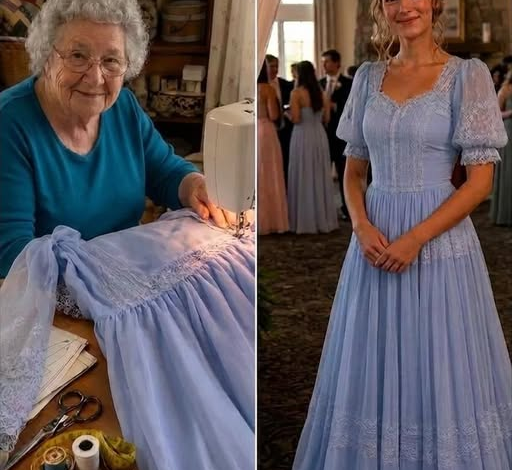
Some memories become more precious with time, not because they are perfect, but because they carry the love of someone who made them possible.
For Emily, prom night was supposed to be one of those memories.
As the date approached, nearly everyone at school seemed to be talking about dresses. Girls compared colors, brands, prices, alterations, and accessories. Some had ordered expensive gowns months in advance. Others posted pictures online from boutiques, standing in front of mirrors while friends voted on which dress looked best. The excitement was everywhere, but for Emily, the choice had never been about wearing the most expensive dress in the room.
All she wanted was to make her grandmother proud.
Her grandmother, Evelyn, had raised her with a kind of quiet strength that shaped nearly every part of Emily’s life. Evelyn was patient, gentle, and steady, the kind of woman who could turn scraps of fabric into something beautiful and a bad day into something bearable. She had always believed that handmade things carried more than thread and cloth. They carried time, intention, and love.
So when Emily told her she wanted to wear something special to prom, Evelyn did not suggest a shopping trip or a designer gown. Instead, she opened an old wooden chest in her sewing room and pulled out a length of blue fabric that shimmered softly in the light.
It was not flashy. It was not modern in the way Emily’s classmates might have expected. But it was beautiful in a way that felt almost timeless. The color reminded Emily of evening skies just before sunset, deep and calm and full of quiet promise.
Evelyn smiled when she saw Emily touch the fabric.
“This has been waiting for the right moment,” she said.
For weeks, Evelyn worked on the dress. She measured carefully, sketched ideas, cut patterns, and sewed late into the evening even though her hands often trembled from pain. Her health had been fragile for some time, and Emily worried whenever she saw her grandmother pause to catch her breath or press a hand against her side. But Evelyn refused to stop.
“This dress is not just for prom,” she told Emily one night. “It is for the girl walking into that room.”
Every stitch seemed to carry something personal. The neckline was modest but elegant. The skirt flowed softly when Emily turned. The seams were careful, the hem delicate, and the small details almost invisible unless someone looked closely. It was not the kind of dress designed to shout for attention. It was the kind that asked to be understood.
On the night of prom, Emily stood in front of the mirror while Evelyn adjusted the final clasp.
For a moment, neither of them spoke.
Emily saw herself in the dress and felt a rush of emotion. She looked different, but not like someone pretending to be glamorous. She looked like herself—only stronger, softer, and somehow more certain.
Evelyn placed both hands gently on Emily’s shoulders.
“When you walk into that room,” she said, “do not shrink yourself for anyone. You belong there as much as anyone else.”
Emily nodded, trying not to cry.
“I mean it,” Evelyn continued. “Hold your head high. Some people will only see what something costs. Others will see what it means. Be proud of what you carry.”
Emily hugged her grandmother tightly before leaving, holding those words close.
At first, the night felt magical. The gymnasium had been transformed with strings of lights, silver decorations, music, and tables covered in glittering centerpieces. Students posed for pictures, laughed in groups, and adjusted corsages and ties. Emily stepped inside with nervous excitement, feeling the blue fabric move around her like a piece of her grandmother’s love.
Then the whispers began.
They started softly, just a few comments behind her.
“What is she wearing?”
“Is that vintage or just old?”
“It looks like something from somebody’s attic.”
Emily tried to ignore them. She told herself not to listen. She reminded herself of Evelyn’s words. But the comments grew louder when a group of girls near the refreshment table noticed her. One of them laughed openly, and soon others joined in.
The girl leading the teasing, Vanessa, was wearing a sleek designer dress that everyone had been complimenting all evening. She looked Emily up and down with a smirk.
“Did your grandma make that?” Vanessa asked.
Emily hesitated.
“Yes,” she said quietly.
That only made the group laugh harder.
Someone called the dress outdated. Someone else said it looked homemade in the worst way. Another joked that Emily had shown up dressed for a school play instead of prom. The words cut deeper than Emily expected. Not because she believed them, but because they were mocking something sacred to her.
They were laughing at Evelyn’s work.
They were laughing at the weeks her grandmother had spent sewing through pain.
They were laughing at the love Emily had been so proud to wear.
Her face burned. She turned away quickly, afraid that if she stayed where they could see her, she would cry in front of everyone. The music seemed too loud, the lights too bright, the room too crowded. She walked toward the far side of the gym and slipped behind a decorated column near a quiet corner.
For a few minutes, she stood there alone, trying to breathe.
She wanted to leave. She wanted to call Evelyn and ask to come home. She wanted to disappear from the room and from every cruel stare that seemed to follow her.
Then, as she smoothed the skirt with trembling hands, her fingers brushed against something near the hem.
Emily froze.
There was a small seam she had not noticed before, hidden carefully inside the lining. At first, she thought it was part of the construction, but when she touched it again, she felt the edge of a tiny pocket.
Curious and confused, she slipped her fingers inside.
There was something folded within it.
Emily carefully pulled out a small note and an old photograph.
Her breath caught when she saw the handwriting.
It was Evelyn’s.
The note began with her name.
“My dear Emily,” it read, “if you have found this, then maybe the night is not going exactly as you hoped. Maybe someone has made you feel small. Maybe you are wondering if this dress belongs in that room. So let me tell you the truth before anyone else convinces you otherwise: you are not wearing a dress made from scraps. You are wearing a story.”
Emily’s eyes filled with tears as she continued reading.
Evelyn wrote that the blue fabric had not come from a store. It had been given to her many years earlier by a woman named Clara, a young mother who had once fallen on hard times. Clara had been struggling to pay rent, feed her daughter, and keep her life from falling apart after her husband abandoned the family. Evelyn, who barely had much herself at the time, had helped her quietly. She brought meals, repaired clothes, watched Clara’s little girl when Clara needed to work, and helped her find steady employment.
Months later, when Clara was finally back on her feet, she gave Evelyn the blue fabric as a thank-you gift. It was the most beautiful thing she owned, originally meant for a dress she had never had the chance to make. Evelyn had tried to refuse it, but Clara insisted.
“She told me kindness should not end with the person who receives it,” Evelyn wrote. “It should travel. So I saved the fabric, waiting for the day it could become something worthy of that promise.”
Emily unfolded the photograph.
It showed a younger Evelyn standing beside a woman Emily did not recognize. The woman was holding a little girl in her arms. All three of them were smiling, and the woman’s hand rested on the same blue fabric that now formed Emily’s prom dress.
Emily stared at the picture, feeling the embarrassment inside her slowly shift into something else.
Pride.
The dress was not outdated. It was not cheap. It was not something to be ashamed of.
It was a piece of history.
It was proof of kindness returned.
It was a promise kept across generations.
Emily folded the note carefully and pressed it against her heart. Then she looked across the room at the students still laughing, whispering, and glancing in her direction.
This time, she did not look away.
A little later, when the principal invited students to gather for the prom court announcements, Emily found herself standing near the center of the room. Vanessa and her friends were nearby, still smiling as if they had won something by making her feel small.
Emily did not plan to speak. But when one of the teachers complimented her dress and asked if there was a story behind it, the room quieted just enough for Emily to answer.
“Yes,” she said, her voice shaking at first. “There is.”
She pulled the note and photograph from the hidden pocket and held them carefully in her hands.
She told them about her grandmother. She told them how Evelyn had made the dress while battling health problems, sewing every seam with love. She told them about the hidden pocket, the message, and the blue fabric that had been saved for years. Then she told them about Clara, the young mother her grandmother had helped long ago, and how the fabric had been given as a gift of gratitude.
As Emily spoke, the mood in the room changed.
The whispers stopped.
People leaned in.
Some looked ashamed. Others looked touched. A few students wiped their eyes.
Then Emily held up the photograph.
Vanessa, who had been standing near the front with her arms crossed, suddenly went pale.
“Wait,” she said quietly.
Her voice was different now. No sarcasm. No cruelty.
She stepped closer and stared at the picture.
“That’s my mom.”
The room went completely silent.
Vanessa reached for the photograph with trembling hands. She looked at the woman standing beside Evelyn, then at the little girl in her arms.
“That’s my mother,” she repeated. “And that baby is me.”
No one moved.
Vanessa’s face changed as understanding settled over her. The dress she had mocked was made from fabric her own mother had given in gratitude. The grandmother she had laughed at was the woman who had once helped keep her family from falling apart. The story she had dismissed as old-fashioned was connected directly to her own life.
Her eyes filled with tears.
“I didn’t know,” she whispered.
Emily looked at her for a long moment. Part of her wanted to stay angry. Part of her wanted Vanessa to feel every bit of humiliation she had caused. But then she thought of Evelyn’s note. Kindness should not end with the person who receives it. It should travel.
Vanessa lowered her head.
“I’m sorry,” she said. “I’m so sorry.”
This time, everyone heard her.
The rest of the night changed after that. Students who had laughed earlier came up to Emily and apologized. Some complimented the dress, but now they did it differently. They were not just admiring the fabric or the way it fit. They were honoring what it carried.
Vanessa spent much of the evening sitting quietly, holding the photograph and asking Emily questions about Evelyn. Later, she called her mother, who cried when she heard the story. She remembered Evelyn immediately. She remembered the meals, the help, the kindness, and the blue fabric she had given away with gratitude and hope.
By the end of the night, Emily no longer felt like the girl who had hidden in the corner trying not to cry.
She felt like someone who had carried something precious into the room and finally understood its full weight.
When she returned home, Evelyn was still awake, sitting in her chair near the window.
Emily rushed to her and placed the photograph and note in her lap.
“You knew?” Emily asked softly.
Evelyn smiled.
“I hoped you would find it only if you needed it.”
Emily knelt beside her grandmother and rested her head against her knee.
“They laughed at it at first,” she admitted.
Evelyn gently touched her hair.
“And then?”
Emily looked up, tears shining in her eyes.
“Then they understood.”
Evelyn nodded, as if that had been enough.
Years later, Emily would remember many things about that night: the music, the lights, the sting of the laughter, the silence that followed the photograph, and the look on Vanessa’s face when she recognized her mother. But most of all, she would remember the feeling of standing in that room wearing a dress that was more than a dress.
It was a lesson.
A legacy.
A reminder that true beauty is not always found in price tags, trends, or approval from others. Sometimes it is found in the stories sewn quietly into the things we love. Sometimes it is hidden in a pocket near the hem, waiting for the moment we need to remember who we are.
Emily had gone to prom hoping to make her grandmother proud.
By the end of the night, she realized Evelyn had given her something far greater than a beautiful dress.
She had given her courage.
And she had shown everyone in that room that kindness, once given, can echo through generations, returning in ways no one expects.