My Dad Left My Mom With 10 Kids for a Younger Woman From Church – 10 Years Later, He Called Mom Asking to Be a Family Again, but I Taught Him a Lesson!

It was an ordinary Tuesday afternoon—the kind usually filled with errands, laundry, and quiet routines—when my phone lit up with my mother’s name. She should have been in class at nursing school, so the call immediately felt unusual. A voicemail notification appeared, followed by a text that made my stomach drop.
“He called,” the message read. “Your father. Can you come over?”
The man she was referring to—Henry—had been absent from our lives for ten years. Once, he had been a respected church preacher, known for sermons about faith, family, and the blessings of children. But when my mother was eight months pregnant with their tenth child, Henry decided that the life he preached about was no longer the life he wanted.
He left behind twenty-five years of marriage and ten children for a twenty-two-year-old singer from the church choir. He claimed God was guiding him toward a “new season” of happiness. Then he packed a suitcase, quoted a few verses, and walked out the door. My mother was left with swollen feet, a broken heart, and ten children to raise—while he trusted that somehow God would provide in his absence.
When I arrived at the house, my mother was sitting quietly at the kitchen table, staring down at her phone as if it might shock her if she touched it again. Her eyes were red, but her voice remained calm.
“He wants to come back,” she said softly.
Apparently, the “new season” hadn’t lasted. The choir singer was gone, and Henry had suddenly become aware of his mistakes. A bitter laugh escaped me before I could stop it. Mistakes felt like too gentle a word for what he had done. He hadn’t simply made mistakes—he had destroyed the life we knew.
My mother, always capable of grace even when she shouldn’t have to be, said that everyone deserves forgiveness. I told her forgiveness might free the soul, but inviting the man who burned down the house to move back in wasn’t exactly wisdom.
On the wall behind her hung ten framed school photos. They formed a timeline of the years Henry had missed.
Those years weren’t easy. My mother worked exhausting overnight cleaning jobs while raising us alone. There were food stamps, endless bills, and nights when sleep was a luxury she couldn’t afford. But little by little, she also built something stronger than what Henry had left behind. Between raising ten children, she slowly worked toward a nursing degree—class by class, semester by semester.
Looking at those photos, I made a decision.
If Henry wanted to see what “home” looked like now, then I would show him.
I picked up my mother’s phone and texted him back.
“Come to a family reunion dinner on Sunday at 7. Everyone will be there. Wear your best suit.”
His reply came almost instantly, filled with gratitude about the “second chance” he believed he had been given.
Sunday evening arrived with a strange tension in the air.
My mother stood in front of the mirror wearing a simple navy dress, looking calm and dignified. She looked like the professional woman she had worked so hard to become.
What she didn’t know was that the “family dinner” wasn’t a dinner at all.
It was her nursing school honors ceremony.
I wanted Henry to see exactly what his absence had created. I wanted him to see the woman he had called weak standing stronger than ever—and the family he assumed would collapse thriving without him.
I met him in the parking lot outside the college.
He looked older than I remembered. Smaller, too. His suit hung awkwardly on his shoulders as if time had slowly worn him down.
Confusion crossed his face when I led him toward the auditorium instead of a restaurant. Inside, a large banner welcomed guests to the Nursing College Graduation and Honors Ceremony.
“I thought this was a family event,” he said stiffly.
“It is,” I replied. “This is our family now. Sit down and watch.”
He took a seat behind us as the ceremony began.
Eventually, the dean stepped forward to present the “Student of the Decade” award.
The large screen lit up with photos of my mother’s journey.
Images flashed across the screen—her cleaning office buildings in the middle of the night with textbooks nearby, studying at the kitchen table surrounded by ten children and stacks of notes. The dean spoke about a woman who had managed to raise ten kids while maintaining one of the highest academic records in the program.
I heard Henry shift uncomfortably behind me.
When my mother—Maria Alvarez—was called to the stage, the entire auditorium erupted with applause.
All ten of us cheered loudly, our voices filling the room that had once been empty of his presence. My mother walked across the stage with quiet pride, her shoulders straight and her head high.
Later, when I stepped up to speak, Henry grabbed my wrist from behind and whispered urgently.
“Don’t bring up our past.”
I gently pulled my arm away.
He had created that past. I was only telling the truth about it.
From the podium, I looked directly at him.
I told the audience about the man who once preached about the blessing of children before abandoning them. I spoke about the nights our mother worked until dawn and the sacrifices she made for us. And I said something that had lived inside my heart for years.
“We want to thank the man who walked out,” I said. “Because his absence showed us something important. He wasn’t the backbone of this family. She was.”
For a moment, the room was completely silent.
Then the audience stood up in applause.
The “blessing” Henry had once talked about from the pulpit had come true—but not because of him.
After the ceremony ended, he approached my mother in the lobby. He talked about how God had changed him and how he wanted to repair what he had broken.
My mother listened patiently, but there was a quiet certainty in her expression.
“I forgave you years ago,” she told him. “But forgiveness doesn’t mean you get to come back.”
Ten years of absence couldn’t be undone with apologies. Too many birthdays, illnesses, graduations, and ordinary moments had passed without him.
He looked around the busy lobby, watching our family laugh and take photos together.
“That’s it?” he asked quietly.
“That’s it,” she answered.
He walked away toward his car, leaving alone for the second and final time.
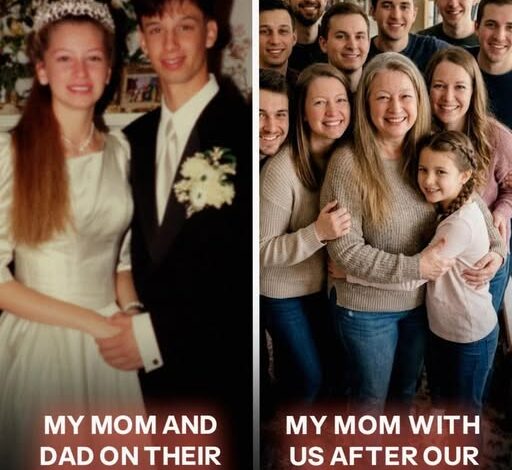
Inside the auditorium, a photographer called us together for a family picture.
We gathered around our mother—the center of everything that held us together.
For years, I had thought of myself as the daughter of a man who walked away.
But when the camera flashed, I realized something far more important.
I was the daughter of a woman who stayed.
And that was more than enough.