THE POPE BREAKS HIS SILENCE AND DELIVERS A STUNNING REBUKE TO TRUMP AFTER BEING BRANDED WEAK IN A SCATHING PUBLIC TIRADE

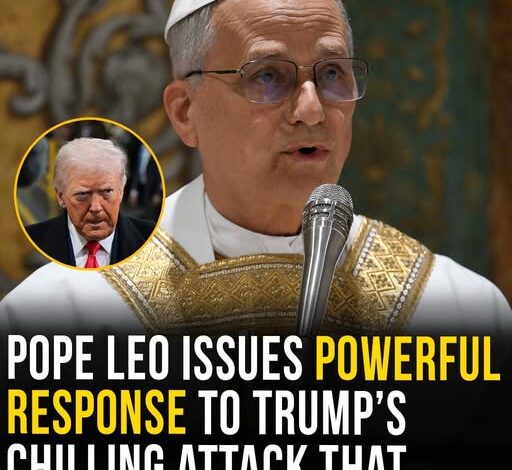
In 2026, the already delicate relationship between the United States presidency and the centuries-old authority of the Vatican has reached an intense and highly visible moment of conflict. After a series of sharp and highly public criticisms from President Donald Trump—who labeled the Pope as “weak on crime” and a threat to global stability—Pope Leo XIV has issued a response that few anticipated. In a political climate often fueled by rapid-fire reactions and escalating rhetoric, the Pope’s reply stood out not for its aggression, but for its restraint. Rather than engaging in a public exchange of accusations, Leo XIV reframed the entire conversation, shifting it away from politics and toward a deeper moral and humanitarian perspective.
The conflict began when President Trump launched a pointed critique of the Pope’s views on international diplomacy, particularly his calls for ceasefires in ongoing Middle Eastern conflicts. Trump portrayed these positions as dangerously naive, suggesting that an emphasis on peace and negotiation signaled weakness and encouraged adversaries. He argued that such an approach undermines security and fails to acknowledge the realities of modern geopolitical threats. His remarks cast doubt on the relevance of spiritual leadership in matters of global conflict, especially when it resists the use of force. As the statements circulated, many expected the Vatican to respond in kind—with a firm and possibly confrontational rebuttal.
Instead, what emerged from the Vatican was something entirely different.
Pope Leo XIV chose not to engage in a direct argument at all. In a statement that felt less like a political response and more like a reflection of core principles, he made it clear that he would not participate in a public dispute. He rejected the framing of the issue as a contest of strength or authority. For him, the Gospel was not a tool to be wielded in political debates, nor something to be used to validate national agendas. It was, he emphasized, a call to peace that transcends political cycles and personal attacks. By refusing to match the tone of his critic, the Pope subtly asserted that his role operates outside the arena of political rivalry.
At the center of his message was a persistent focus on the human cost of war. While political discourse often revolves around strategy, power, and outcomes, Leo XIV redirected attention to the individuals affected by these decisions. He spoke about civilians caught in conflict zones—the children growing up surrounded by destruction, the families displaced from their homes, and the countless lives reduced to statistics. His words emphasized that behind every policy decision are real people enduring lasting consequences. In contrast to rhetoric centered on dominance and security, he defined strength as the willingness to protect and value human life, especially in its most vulnerable forms.
The Pope also made it clear that he would continue to speak out against violence, regardless of criticism. He defended dialogue and international cooperation as essential tools for a world that possesses unprecedented destructive power. His stance was not aligned with any political faction but rooted in a broader moral responsibility. He suggested that true leadership requires standing apart from shifting political alliances and remaining committed to principles that prioritize dignity and compassion. This approach, while quiet in tone, carried a firm and unmistakable conviction.
This exchange highlights a deeper clash between two fundamentally different worldviews. On one side is a perspective that sees global affairs through the lens of power, competition, and strength, where compromise can be interpreted as weakness. On the other is a vision centered on shared responsibility and collective well-being, where cooperation and empathy are seen as essential to long-term stability. By refusing to engage in confrontation, Leo XIV positioned himself not as an opponent in a political battle, but as a moral counterpoint to it.
The situation has also reignited discussion about the place of faith in modern governance. While some view strong, forceful leadership as necessary in uncertain times, the Pope’s response serves as a reminder that moral authority often operates beyond immediate political concerns. His insistence on not using religious teachings as a political tool was a subtle critique of how faith can sometimes be drawn into partisan conflicts. He emphasized that the message of peace is not a sign of weakness, but a principle that should remain constant regardless of external pressure.
As reactions continue to unfold, the impact of this exchange is being felt beyond the immediate figures involved. World leaders and observers alike are now navigating the space between competing narratives—one demanding strength through action, the other calling for reflection and restraint. In maintaining his composure, the Pope has reinforced an image of leadership grounded in consistency rather than reaction. His response has offered a point of reflection for those questioning the direction of global discourse.
Ultimately, this moment underscores the power of how leaders choose to respond under pressure. While one side relied on forceful language to assert authority, the other relied on calm conviction to convey its message. Pope Leo XIV’s approach suggests that, in a world driven by spectacle and confrontation, choosing restraint can be a powerful statement in itself. Whether or not it influences policy decisions remains uncertain, but it has undeniably shifted the tone of the conversation.
In the end, this chapter may be remembered less for the criticisms that sparked it and more for the response that followed. It stands as an example of two contrasting approaches to leadership—one rooted in assertion, the other in principle. And in that contrast, it invites a broader question: in moments of tension, is true strength demonstrated through dominance, or through the ability to remain grounded in one’s values?