My Son Gave His Umbrella to a Pregnant Stranger in the Rain – The Next Morning, 47 Umbrellas Appeared on Our Lawn, Each With a Numbered Box That Made My Heart Stop

For months after Darren died, the blue umbrella sat by our front door like a silent guardian. It was scuffed around the handle, one of the metal ribs bent slightly from years of use, but to Eli it was priceless. It had been his father’s umbrella—the one he carried on rainy mornings when he walked Eli to school, the one he held over both their heads when they raced through summer storms laughing. After the funeral, Eli claimed it as his own. He carried it everywhere, even when the forecast promised sunshine.
I understood why. In some small way, it felt as though the umbrella still connected him to the father he missed every day.
So when I got the call from the school telling me Eli had given it away, my heart sank.
Apparently, he’d been waiting for the Route 47 bus when a sudden downpour swept through town. Most people scattered for cover, but one woman remained stranded on the bench. She was soaked, shivering, and struggling to protect a stack of grocery bags. Without hesitation, Eli walked over, pressed the umbrella into her hands, and climbed onto the bus without it.
By the time he came home and told me the story, the umbrella was gone.
I wish I could say I reacted gracefully.
Instead, I cried. Not because Eli had done something wrong, but because losing that umbrella felt like losing Darren all over again. It seemed irrational, even to me. It was only an object. Yet grief has a way of attaching itself to ordinary things until they become sacred.
Eli listened quietly while I stumbled through my feelings.
Finally, he looked down at the floor and said, “Dad would have wanted her to have it.”
There wasn’t much I could say after that.
The woman from the bus stop, whose name was Jenelle, spent days trying to find the little boy who had helped her. She remembered his kindness but knew almost nothing else. Eventually she posted a thank-you message on Facebook, hoping someone in town might recognize him.
The post was heartfelt, sincere, and written with the kind of honesty people rarely share online anymore.
What happened next surprised everyone.
Thousands of people shared it.
Comments poured in from strangers who were touched by the story. Local groups picked it up. Then regional news pages. Before long, people all over the country were reading about a boy who had handed away his only shelter during a storm.
The attention arrived faster than we could process it.
Packages began appearing on our porch.
The first contained a blue umbrella and a handwritten note.
Then came another.
And another.
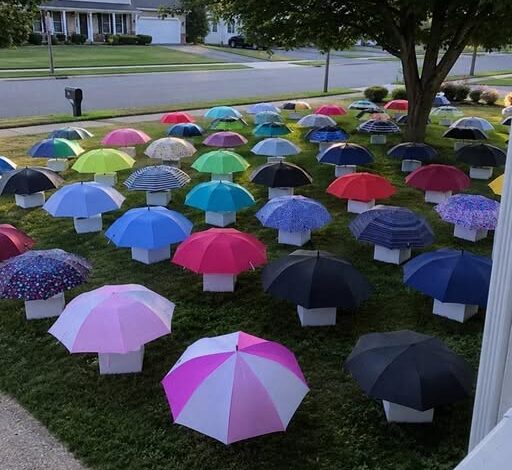
By the end of the month, forty-seven umbrellas had arrived—one for every route number on the bus line where Eli had met Jenelle.
But the umbrellas weren’t what affected us most.
Tucked inside many of the boxes were letters.
Some came from parents who wished their children had grown into people like Eli. Some came from people who had once received unexpected kindness from strangers and never forgotten it. Others came from individuals carrying regrets they had never voiced before.
There were gift cards from people who knew what it was like to struggle.
There were notes of apology from adults who admitted they had become cynical and wanted to believe in goodness again.
One letter simply read:
“Your son reminded me of the person I used to be. I’m trying to become that person again.”
I cried reading that one.
For a while, it felt overwhelming. We were grateful, but our lives had suddenly become public property. Reporters called. Organizations reached out. Everyone wanted interviews, photographs, and heartwarming stories.
We quickly realized we needed boundaries.
We declined most requests.
We kept our home private.
We protected Eli’s childhood from becoming a headline.
Then we sat down together—me, Eli, Jenelle, and Mr. Collins, the Route 47 bus driver who had witnessed the whole thing—and talked about what to do with everything people had sent.
Forty-seven umbrellas were far more than one family needed.
The notes deserved to be preserved.
The generosity deserved a purpose.
That’s when the idea emerged.
A few weeks later, a bright blue stand appeared beside the Route 47 bus stop.
Across the front were simple words:
Route 47 Rain Rack
Inside were umbrellas, ponchos, gloves, hand warmers, and bus passes. Anyone caught in bad weather could take what they needed. No forms. No questions. No payment.
Just help.
People began contributing almost immediately.
A local hardware store donated supplies.
Neighbors left extra umbrellas.
Students added handmade signs reminding people to take only what they needed and leave something behind if they could.
The rack became something bigger than any of us expected.
It became a community habit.
A reminder that kindness could be practical.
A reminder that small acts mattered.
A reminder that one person’s decision to help another could ripple outward in ways nobody could predict.
Several months later, Jenelle arrived at our house carrying a familiar blue umbrella.
She had spent weeks tracking it down through lost-and-found departments, transit offices, and community groups until she finally located the original one Eli had given away.
When she handed it back to him, he smiled in a way I hadn’t seen since before Darren died.
The umbrella came home.
We dried it carefully and placed it back beside the front door.
Not because it was valuable.
Because it was ours.
Today, another blue umbrella hangs from the Route 47 Rain Rack, ready for whoever needs it next.
Darren’s umbrella stays with Eli.
One is for sharing.
The other is for remembering.
And somewhere along the way, I finally understood something I had been missing ever since my husband died.
His greatest gift to our son was never the umbrella.
It wasn’t an heirloom, a possession, or anything that could be lost or found.
It was the example he set every day without realizing it.
The patience he showed.
The generosity he practiced.
The quiet belief that other people mattered.
Those things had taken root inside Eli long before either of us noticed.
Now, every time I watch my son stop to help someone, every time I see him choose kindness when it would be easier to look away, I see Darren there too.
Not in the umbrella.
Not in the memories.
But in the way Eli moves through the world—unafraid to carry someone else’s burden, willing to stand in the rain if it means another person gets to stay dry.