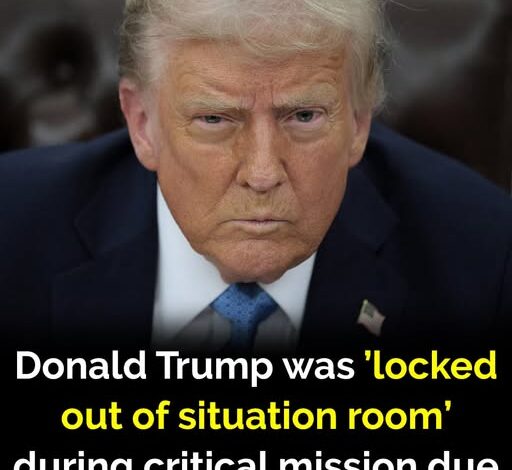
Donald Trump ”locked out of situation room” during critical mission due to inappropriate behavior

Inside the tightly guarded corridors of the West Wing, what was unfolding became more than a military operation—it turned into a defining moment of leadership under pressure. While elite special operations units worked in hostile terrain and intelligence teams sifted through incomplete and rapidly shifting data, senior officials gathered in the Situation Room, tracking developments with intense focus. Screens flickered with live feeds, maps, and satellite imagery, each update carrying the weight of a life hanging in the balance.
The president, according to those familiar with the process, was not continuously present in the room but was briefed at key intervals. Advisors carefully chose when and how to relay updates, aware that tone and timing could influence not just decision-making, but the overall atmosphere of the response. In a situation where clarity and composure were critical, aides reportedly worked to maintain a steady flow of information while managing the broader political and emotional dynamics surrounding the moment.
On the ground, the situation remained uncertain and dangerous. The downed pilot, injured and isolated, had survived in rugged terrain for more than a full day, relying on training and instinct while awaiting extraction. Weather conditions, enemy presence, and the unpredictability of the landscape complicated every step of the rescue effort. Each movement required precision, coordination, and a willingness to adapt to rapidly changing circumstances.
Back in Washington, the tension was palpable. Officials weighed risks not only to the pilot, but to the personnel involved in the rescue mission. Every decision—whether to advance, delay, or reroute—carried potential consequences. Intelligence updates were incomplete, and assumptions had to be tested against real-time evidence. The operation became a delicate balance between urgency and caution, where acting too quickly or too slowly could prove equally dangerous.
When the rescue team finally reached the pilot—trapped in a remote mountain crevice and physically weakened—the moment marked a turning point. The extraction was executed with precision, bringing an end to more than 24 hours of uncertainty. The pilot’s recovery was quickly framed as a success story, highlighting the capabilities of U.S. military coordination, technological support, and the resilience of those involved.
Yet the implications of the event extended beyond the immediate outcome. Within policy and defense circles, the episode sparked deeper reflection about how high-stakes decisions are made under pressure. Reports suggested that internal dynamics—particularly concerns about how information was received at the highest level—played a role in shaping communication strategies during the crisis.
At the same time, public rhetoric surrounding the broader conflict added another layer of complexity. Strong statements about potential escalation, including threats directed at critical infrastructure and warnings of widespread consequences, intensified scrutiny of the administration’s approach. For some observers, the contrast between the precision of the rescue mission and the tone of external messaging raised questions about consistency, strategy, and the role of leadership in moments of global tension.
In the end, the rescue itself stood as a testament to discipline, training, and coordination under extreme conditions. But the broader story—how it was managed, communicated, and perceived—continued to resonate. It highlighted not only the risks faced in distant conflict zones, but also the pressures within decision-making environments where every word and action can carry far-reaching consequences.