He arrived as the kind of contestant no one expected to remember.
On paper, there was nothing especially dramatic about him. He was a soft-spoken carpenter, more comfortable around lumber, tools, and measurements than studio lights, cameras, and applause. He did not enter the room with the polished confidence of someone chasing fame. He did not seem built for television in the obvious way. To the producers, he may have looked like another pleasant face in the rotation, someone who would smile, spin the wheel, guess a few letters, and quietly disappear back into ordinary life once the taping ended.
But something changed as the game unfolded.
At first, viewers saw his nerves. They saw the careful way he listened, the hesitation before each guess, the small flashes of uncertainty that made him feel real. Then they saw his wit. They saw the quickness beneath the modest exterior, the way he began to read the board not just with logic, but with instinct. Every puzzle he solved seemed to chip away at that first impression, revealing a man who was not flashy, but deeply present. He was easy to root for because he seemed surprised by his own success.
And when he got something right, his whole face changed.
There was no practiced celebration, no exaggerated performance for the crowd. Just a burst of disbelief and joy, the expression of someone who had stepped into a dream and suddenly realized he might belong there after all. The audience felt it. They began to lean toward him, not just physically, but emotionally, willing him forward with every spin, every letter, every small victory. By the time he reached the Bonus Round, he was no longer forgettable. He had become the person everyone wanted to see win.
Then came the final puzzle.
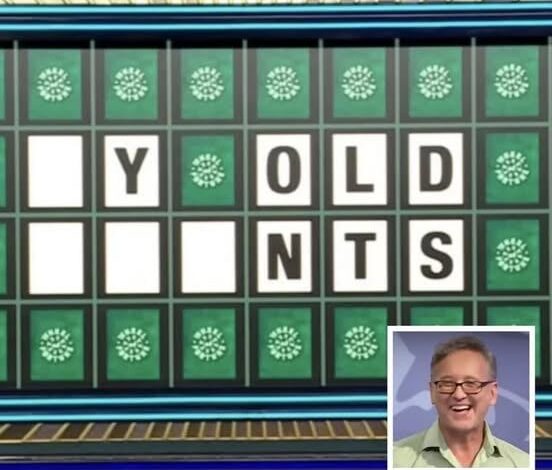
The phrase on the board was so painfully ordinary that it almost seemed unfair. It was the sort of answer that should have appeared instantly, the kind of everyday wording people use without thinking. But under the pressure of the clock, with the lights burning and the room holding its breath, ordinary things can turn cruel. The simplest phrase can become unreachable. The mind, crowded by panic, begins to betray itself.
As the seconds drained away, the studio seemed to shrink around him. The letters were there. The answer was somewhere close. But the more he searched for it, the farther it seemed to move. Panic narrowed his world to static. The crowd could feel it too, that strange agony of knowing a solution exists but watching it slip just beyond someone’s grasp.
And then time ran out.
When the answer was finally revealed, he could have collapsed into frustration. He could have hidden his face, cursed his luck, or let disappointment swallow the moment whole. No one would have blamed him. The prize had been within reach, and losing it on a phrase so simple only made the sting sharper.
But he did something else.
He laughed.
Not a bitter laugh, not one meant to cover embarrassment, but a deep, disbelieving laugh at the absurdity of it all. He clapped for the game that had just beaten him. He acknowledged the loss with a kind of generosity that instantly transformed the moment. What might have been remembered as a painful mistake became something warmer, stranger, and far more lasting.
In that reaction, viewers saw character. They saw a man who could be disappointed without becoming small, who could lose without turning the moment ugly. His laughter carried more grace than any perfect answer could have. It reminded people that dignity is often revealed not in victory, but in the instant after defeat, when there is no prize left to protect and no performance left to maintain.
The clip spread across timelines and living rooms because it was about more than a game show. It was about the fragile, human space between hope and humiliation. It was about trying hard, falling short, and still finding enough lightness in yourself to smile. The money faded into the background. The missed phrase became secondary. What remained was the way he handled it.
And that is why people remembered him.
He came in as a quiet carpenter who seemed destined for a polite, early exit. He left as something else entirely: a reminder that the world may replay your losses, but it will also remember how you carried them. The prize fades. The answer disappears. The applause moves on.
But how you lose never does.