Pete Hegseth’s Subtle Reaction Draws Attention as Donald Trump Credits Him for Pushing Iran War Strategy During High-Stakes Discussion, While Military Movements, Rising Tensions, and Economic Ripples Continue to Shape the Expanding Conflict Across the Middle East and Beyond

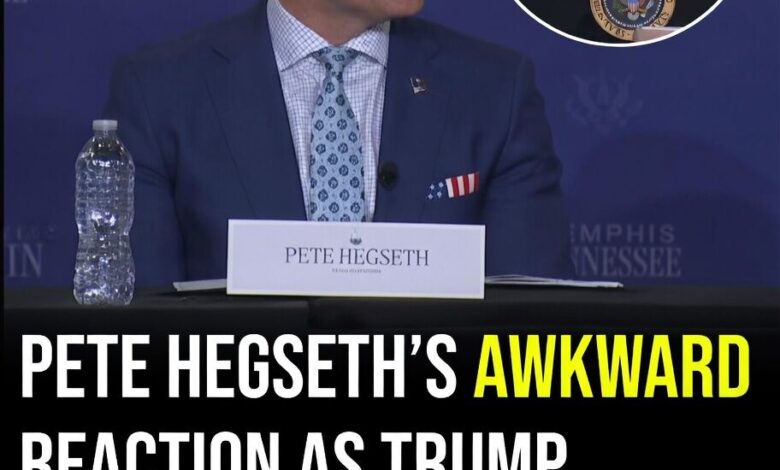
The moment took place during what was meant to be a routine public discussion, but it quickly became one of the most closely analyzed exchanges tied to the ongoing tensions involving Donald Trump and Pete Hegseth. At a Memphis Safe Task Force roundtable in Tennessee on March 23, Trump reflected on internal deliberations that had occurred as instability in the Middle East intensified.
As he spoke, Trump described gathering key advisers to assess what he framed as an escalating threat, focusing particularly on Iran’s nuclear ambitions and its long-standing influence in the region. The broader context included weeks of reported military strikes and rising geopolitical tension. Yet despite the gravity of those issues, what ultimately captured attention was not a policy detail, but a brief, unscripted reaction.
A Subtle but Striking Exchange
During his remarks, Trump turned directly toward Hegseth and recalled how early discussions had unfolded. He stated that Hegseth had been among the first to support decisive action, quoting him as arguing that allowing Iran to develop nuclear weapons was simply not an option.
The comment shifted the spotlight abruptly.
For a moment, Hegseth responded with a small, almost reflexive smile—an expression that appeared natural but fleeting. As Trump continued speaking and moved on, that expression quickly disappeared. In its place came a more controlled, neutral demeanor.
It was a subtle shift, but in a highly managed public setting, even small changes in expression can stand out. Observers quickly picked up on the contrast, turning the moment into a focal point of discussion.
Context Behind the Reaction
Hegseth’s role in the administration has been closely tied to messaging around the conflict. Known for his direct communication style, he has consistently framed military actions as necessary and decisive, emphasizing strength and clarity in confronting adversaries.
Trump’s public attribution of early support carried added weight because it suggested something beyond messaging—it positioned Hegseth as part of the internal decision-making process. That distinction matters, particularly in situations where responsibility and influence are closely scrutinized.
The brief reaction, therefore, wasn’t just about body language. It reflected the intersection of public narrative and behind-the-scenes involvement, a line that is often carefully managed in political environments.
A Broader and Escalating Situation
Beyond that moment, the larger geopolitical situation continues to evolve rapidly. Reports indicate that the United States, in coordination with Israel, has carried out strikes targeting infrastructure, military assets, and key figures associated with Iran.
These developments have contributed to a highly volatile regional environment, where actions in one area can quickly trigger responses elsewhere. References to high-level figures, including Ali Khamenei, underscore the seriousness of the situation and the level at which decisions are being made.
Military Readiness and Deployment
At the same time, preparations for potential escalation appear to be underway. According to reports, approximately 1,000 troops from the 82nd Airborne Division are expected to deploy to the Middle East.
The 82nd Airborne is widely recognized for its rapid-response capabilities. Its involvement often signals readiness for fast-moving and unpredictable scenarios. While specific mission details have not been fully disclosed, the deployment itself suggests that planners are preparing for a range of contingencies.
Economic Ripple Effects
As military activity intensifies, the economic consequences are becoming increasingly visible. Analysts have pointed to the vulnerability of global energy routes, particularly the Strait of Hormuz, which plays a crucial role in oil transportation.
Any disruption—or even the threat of disruption—can have immediate effects on global oil prices. Those changes, in turn, ripple outward, influencing inflation, transportation costs, and broader financial markets.
In the United States, these pressures are already being felt. Mortgage rates have climbed to around 6.22%, reflecting broader concerns about inflation and economic stability. What begins as a geopolitical conflict quickly translates into everyday financial realities for households.
Balancing Strategy and Economics
Trump has also addressed the economic dimension directly. In earlier remarks, he referenced temporarily easing restrictions on Iranian oil exports, a move that briefly affected market dynamics before prices resumed their upward trend.
This approach highlights the challenge of balancing military objectives with economic stability. Prolonged instability can carry costs far beyond the battlefield, affecting global markets and domestic conditions alike.
At the same time, not all strategic goals have been fully defined or achieved, leaving uncertainty about the long-term direction of the conflict.
Messaging and Leadership
Throughout these developments, Hegseth has remained a prominent voice in articulating the administration’s stance. Drawing on his background as both a military veteran and media figure, he has adopted a firm and assertive tone, emphasizing strength and resolve.
He has also acknowledged the financial scale of ongoing operations, suggesting that additional funding may be required and that Congress could play a role in sustaining military efforts.
A Small Moment Within a Larger Story
In the end, the exchange between Donald Trump and Pete Hegseth stands out not because of its length, but because of what it reveals. A brief shift in expression became a window into the dynamics of leadership, decision-making, and public communication.
It serves as a reminder that even in moments dominated by large-scale events—military action, geopolitical tension, economic impact—small, human reactions can capture attention and shape perception.
Behind that single interaction lies a far more complex and ongoing story, one defined by decisions that extend well beyond a stage or a microphone. As the situation continues to unfold, the political, military, and economic dimensions remain tightly intertwined—each influencing what comes next in a rapidly changing global landscape.