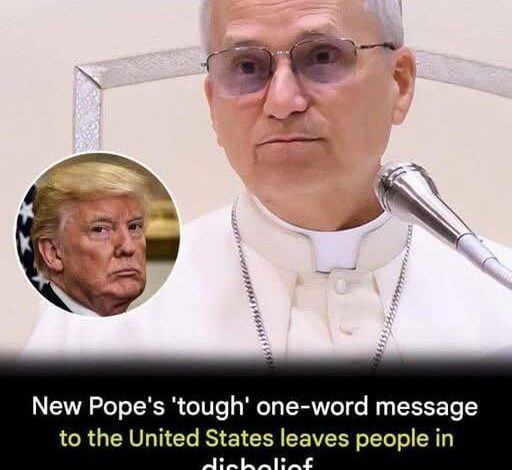
In a moment that quickly echoed across both the digital world and the corridors of international diplomacy, Pope Leo XIV delivered a response that was as brief as it was striking. When asked if he had a message for the United States amid the turbulence of early 2026, the pontiff answered with a single word: “Many.” That lone response—quiet, deliberate, and unexpected—has since sparked widespread discussion among theologians, political commentators, and everyday observers about the meaning and power of simplicity in public communication.
At a time when global leaders often rely on lengthy speeches, carefully constructed press releases, and intricate political phrasing, Leo XIV’s response stood out precisely because it refused to elaborate. The brevity of the statement did not diminish its impact; if anything, it amplified it. In a world saturated with commentary, a single word delivered with intention can feel like a challenge—an invitation to pause and reflect rather than consume yet another stream of explanation.
The moment unfolded during a brief interaction with reporters who asked the Pope whether he wished to send a particular message to the United States, given the political tensions and international crises currently surrounding the nation. Instead of offering a detailed statement or diplomatic phrasing, Leo XIV simply replied, “Many.” The answer was neither dismissive nor evasive. Instead, it conveyed the sense that the issues facing the country—and the world—are too numerous and too complex to be reduced to a single talking point.
For many observers, the choice of that word suggested a recognition of the layered challenges confronting modern societies. The United States, like many nations, is navigating a landscape shaped by political polarization, rapid technological change, and global instability. By choosing a word that implies multiplicity and depth, the Pope appeared to acknowledge that no single message could adequately address the breadth of concerns at hand.
The response also reflected something distinctive about Leo XIV himself. Born Robert Francis Prevost, he became the first American to lead the Roman Catholic Church when he was elected on May 8, 2025. His background combines several worlds: he spent years serving as an Augustinian missionary in Peru, where he worked closely with marginalized communities, and later gained administrative experience within the Vatican’s central leadership. That combination of pastoral and institutional experience has shaped a papacy that often emphasizes reflection, dialogue, and moral clarity.
His choice of the name Leo was itself a signal about the direction he hoped to take the Church. The name recalls Pope Leo XIII, a 19th-century pontiff who addressed the upheavals of the Industrial Revolution through his landmark encyclical Rerum Novarum. That document laid the groundwork for modern Catholic social teaching by confronting questions of labor rights, economic justice, and the responsibilities of governments and employers during a period of rapid industrial transformation.
Leo XIV has suggested that the world is now entering another moment of similar upheaval—one defined not by factories and railroads but by artificial intelligence, digital communication, and technological disruption. Much like Leo XIII addressed the ethical questions of industrialization, the current Pope has expressed interest in guiding discussions about how technology should serve humanity rather than reshape it without moral consideration.
Throughout his first year as pontiff, Leo XIV has shown a willingness to speak directly about social issues while resisting easy ideological labels. He has advocated strongly for the protection of migrants and displaced people, drawing from his missionary experiences in Latin America and his own multicultural background. At the same time, he has emphasized traditional Catholic teachings on human dignity and the value of life, positioning himself outside the familiar political divisions that often dominate public debate.
This balanced approach has led many observers to describe his leadership style as thoughtful rather than partisan. Instead of framing moral questions strictly in political terms, he frequently returns to broader principles—human dignity, solidarity, and responsibility for the vulnerable.
The Pope’s brief message also arrived during a period of significant international tension, particularly in the Middle East. Escalating military exchanges involving several regional powers have raised fears of a wider conflict, and Leo XIV has repeatedly called for restraint and dialogue. In recent public prayers and diplomatic remarks, he has warned that continued escalation could lead to suffering on a scale that affects far more people than the immediate participants in the conflict.
In that context, the word “Many” can be interpreted not only as a reflection on America’s internal challenges but also as a reminder that global decisions have consequences for countless individuals beyond the political leaders making them. Wars, sanctions, and diplomatic standoffs rarely remain confined to governments—they ripple outward, affecting families, communities, and entire regions.
Another dimension of the moment lies in the way it spread. Within hours, the single-word response circulated widely across social media platforms, news outlets, and commentary forums. In an age when digital communication often amplifies every statement instantly, the Pope’s brevity became part of the story itself. People debated its meaning, created commentary threads, and discussed what the word might represent.
Interestingly, Leo XIV has been outspoken about the challenges posed by the modern digital ecosystem. He recently announced that the theme for the 2026 World Day of Social Communications would be “Preserving Human Voices and Faces.” The theme addresses concerns about deepfakes, automated content, and AI-generated misinformation, which many experts worry could blur the line between authentic communication and manufactured messages.
The Pope has acknowledged the enormous potential of technology while cautioning that human judgment and responsibility must remain central in public discourse. Communication, in his view, should never become purely mechanical or detached from genuine human experience.
In that sense, the spontaneity of the “Many” response felt distinctly human. It wasn’t a scripted statement or a prepared talking point. It was a brief, personal reply that allowed listeners to interpret its meaning for themselves.
Public reactions to the moment suggest that many people are hungry for that kind of authenticity. In a political culture often filled with lengthy explanations and carefully managed narratives, a short answer can sometimes carry more weight than a long speech. It invites reflection rather than dictating conclusions.
For some Americans, the word has become a prompt to think about the numerous issues shaping their country—political divisions, economic uncertainty, technological change, and the responsibilities that come with global influence. For others, it simply demonstrates the Pope’s distinctive communication style: thoughtful, understated, and intentionally open-ended.
As Leo XIV prepares for upcoming international engagements—including planned visits and speeches in Europe and beyond—his early months as pontiff continue to reveal a leadership style that blends tradition with contemporary awareness. He often speaks about compassion and responsibility while encouraging societies to examine their own choices honestly.
In the end, the attention surrounding that single word reflects something larger than a clever soundbite. It shows how a brief moment of reflection can resonate across cultures and political boundaries.
In a world overflowing with commentary, sometimes the most powerful message is the one that leaves space for people to think. And with one simple word, Pope Leo XIV managed to do exactly that.