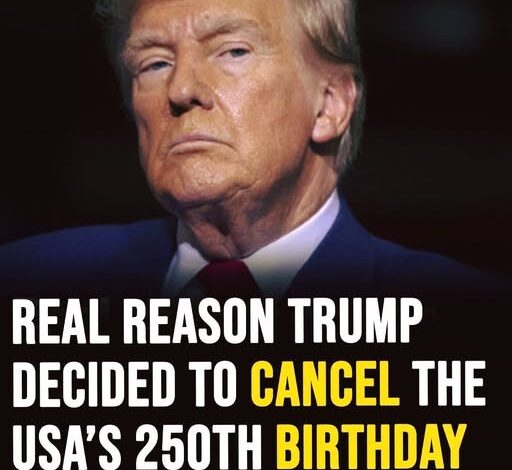
What makes the story fascinating isn’t the concert lineup.
It never really was.
At its core, the controversy surrounding Freedom 250 is not about who performs on stage, what songs are played, or how the schedule is ultimately arranged. Those details matter in a logistical sense, but they are not what captured public attention.
What captured attention was what the debate revealed.
A generation ago, a national anniversary celebration might have been discussed primarily through a narrow cultural lens: fireworks, televised performances, historical reenactments, and civic pride presented in a relatively unified narrative. Disagreements existed, of course, but they rarely defined the event itself before it even occurred.
Today, the situation is different.
Before a single stage is built or a single note is played, the meaning of the event is already being negotiated in public.
The Freedom 250 celebration was originally framed as a large-scale national commemoration marking 250 years since the founding of the United States. Like many milestone anniversaries, it was designed to blend entertainment, historical reflection, tourism, and public gatherings into a multi-city cultural moment.
In its earliest form, it sounded familiar. Almost traditional.
A series of concerts. Exhibitions. Public ceremonies. Cultural programming meant to reflect on the nation’s long and complicated history.
But as planning details began to surface, the conversation shifted.
Not because of what was confirmed—but because of what was uncertain.
Reports about performers reconsidering participation introduced the first layer of instability. In large productions, this is not unusual; artists routinely evaluate scheduling conflicts, creative direction, and organizational alignment. But in the current cultural climate, even standard logistical uncertainty becomes interpretive.
People began asking not only who is performing, but why they might or might not participate.
And that question quickly expanded beyond entertainment.
It became symbolic.
Because in modern public life, symbolism tends to arrive faster than facts.
The debate widened further after public remarks suggested that portions of the planned concert series could be reshaped into a more politically oriented rally-style event. The proposal reframed the celebration in a way that immediately altered how different audiences interpreted its purpose.
For supporters, this direction represented something energetic and affirming—an unapologetic expression of national identity, confidence, and visibility. To them, large-scale public gatherings are inherently political in the broadest sense, and separating celebration from national messaging is neither realistic nor necessary.
For critics, however, the suggestion highlighted a familiar concern: that cultural spaces originally intended to be shared and inclusive were increasingly becoming extensions of political identity and partisan expression.
Neither interpretation exists in isolation.
They overlap, compete, and reinforce each other.
And that overlap is precisely what makes events like Freedom 250 so complex.
What began as a discussion about performers gradually evolved into a broader national conversation about public space itself.
Who gets to shape it?
Who gets represented within it?
And what does participation mean when every appearance can be interpreted through a political lens?
These are not new questions, but they are more visible than ever.
Artists, in particular, find themselves at the intersection of these pressures. Participation in national events has always carried multiple layers of meaning—professional opportunity, cultural visibility, personal expression, and sometimes ideological alignment. But in the current environment, even neutral participation is rarely interpreted as neutral.
Choosing to appear can be read as endorsement.
Choosing to withdraw can be read as resistance.
Choosing silence is often interpreted as a statement of its own.
As a result, decisions that were once primarily logistical have become narrative-driven.
Every choice becomes part of a larger story whether the participant intends it or not.
And that is what gives Freedom 250 its broader significance.
The event has become less about entertainment and more about interpretation.
Less about programming and more about meaning.
Less about celebration and more about identity.
At the same time, it is important not to lose sight of what the anniversary actually represents.
Two hundred and fifty years is not a symbolic milestone that arrives often. Very few nations reach it in recorded history, and even fewer do so in a way that carries continuous political, cultural, and social evolution over that entire span.
It represents generations of transformation—conflict, expansion, innovation, internal disagreement, reform, and reinvention. Any commemoration of such a milestone inevitably carries more weight than a standard public festival.
That weight is part of the reason the conversation has become so expansive.
Because people are not only debating the structure of events.
They are debating the meaning of national memory itself.
What is being remembered?
Who is included in that memory?
And how should it be expressed in a society that no longer shares a single, unified cultural narrative?
These questions do not have clear answers.
They rarely do.
As planning for Freedom 250 continues, adjustments are expected. Performers may still be added. Others may step away. Programs may be revised, expanded, or reframed entirely. Large-scale national events are fluid by nature, especially when they span multiple cities, institutions, and stakeholder groups.
But the evolution itself is part of the story now.
Because Freedom 250 is no longer just a calendar event waiting to happen.
It has already become a reflection of the present moment.
A snapshot of how public meaning is constructed in real time—through disagreement, interpretation, and constant negotiation between culture and politics.
And perhaps that is the most important takeaway of all.
National celebrations have never been purely about the past.
They are about how a nation chooses to see itself in the present while looking backward.
The debate surrounding Freedom 250 shows a country actively engaged in that process—sometimes comfortably, often contentiously, but always visibly.
And by the time the anniversary arrives, whatever form the concerts, rallies, exhibitions, and ceremonies ultimately take, they will not only commemorate 250 years of history.
They will also reflect the ongoing conversation about what that history means right now.
Not just as memory.
But as identity still being written.