What began as an ordinary morning on the farm turned into the kind of story people in town would repeat for years.
All I wanted was to start my day the way I always did: feed the cattle, open the barn, check the equipment, and get through the morning chores before the heat settled in. But when I stepped outside, I stopped cold.
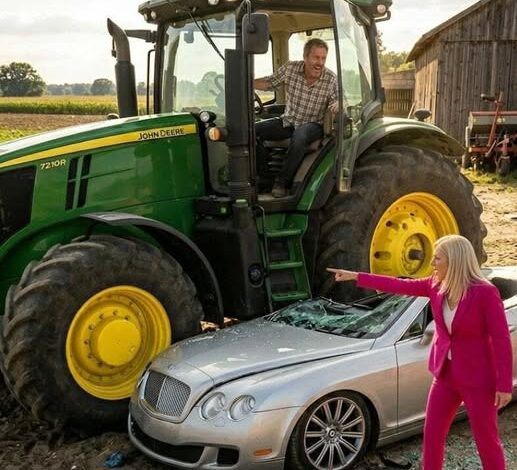
A car was parked directly across my access road.
Not near it.
Not slightly in the way.
Directly across it, blocking the barn doors and cutting off the route I needed to reach my livestock.
My cattle could not get through. My tractor could not move where it needed to go. Feed delivery was impossible. And the longer I stood there staring at that car, the faster my patience began to disappear.
The car belonged to Karen.
Everyone around town knew Karen. She was the kind of person who always needed control, always had a complaint ready, and somehow managed to turn the smallest disagreement into a public performance. If there was a rule to twist or an argument to start, Karen usually found her way into the middle of it.
But this time, she had gone too far.
This was not a petty fence-line argument or one of her usual neighborhood power plays. This was my farm. My animals. My work. My responsibilities. Cattle do not wait because someone wants to prove a point.
At first, I tried to handle it calmly.
I walked over to her fence and called out, keeping my voice as steady as I could.
“Karen, I need you to move your car. You’re blocking access to the barn.”
She barely looked at me. She stood there with her arms crossed, wearing the smug expression of someone who had been waiting for this exact moment.
“You can wait,” she said coldly. “I’m tired of your tractor tearing up the edge of my property.”
I stared at her, trying to process the sheer arrogance of it.
“The cattle need feeding now.”
She shrugged.
“Not my problem.”
That was when I noticed a couple of neighbors drifting closer. One was pretending to check his mailbox. Another leaned against a fence like he had suddenly discovered a deep interest in road gravel. Everyone knew Karen loved a scene, but even they seemed surprised she had decided to block a working farm entrance.
I tried again.
“Karen, I’m asking you nicely. Move the car.”
She smirked.
That was all.
No apology. No hesitation. No sign that she understood or cared what she was interfering with.
Something in me changed then.
It was not rage. It was not some wild burst of temper.
It was certainty.
The work had to be done.
I turned, walked back to the tractor, and climbed into the seat.
The whole fence line went quiet.
When the engine roared to life, Karen’s smug expression slipped for the first time that morning. The neighbors stopped pretending not to watch. Every eye was on the tractor as I eased it forward slowly.
Very slowly.
The front loader moved toward the blocked entrance until it reached the bumper of Karen’s car. I stopped just short, gave her one more chance, and looked over at her.
Her eyes widened.
“You wouldn’t dare!”
I kept my voice calm.
“I asked you three times.”
Then I nudged forward just enough for the loader to touch the bumper.
Not hard. Not violently. Just enough for metal to meet metal and make the message clear.
That was when Karen exploded.
She started shouting about lawsuits, property damage, harassment, and “abuse of power,” as if she had not intentionally blocked access to livestock that needed care. Her voice carried down the road, and by then even more neighbors had gathered.
One of them quietly called the sheriff.
Within twenty minutes, two patrol cars rolled up beside the property, and suddenly Karen had an audience she had not planned on.
She launched into her performance immediately.
“He threatened me!” she cried, pointing at the tractor. “He tried to ram my car!”
The sheriff listened patiently, then turned to me.
“What’s going on?”
I explained it plainly. Her car was blocking my farm access. My cattle were behind the barn. I had asked her multiple times to move. She refused.
A deputy looked past us toward the barn.
“Your cattle are back there?”
“Yes, sir.”
He nodded slowly, and I saw the situation change in his face.
Because blocking access to a farm is not just rude. When animals are involved, it can become serious very quickly. Livestock need food, water, and care on schedule. You do not get to interfere with that because you are angry about a property line.
The sheriff turned to Karen.
“Ma’am, you need to move the vehicle.”
Her mouth dropped open.
“But it’s near my property!”
“That does not give you the right to block farm access,” he said. “Move the car.”
For once, Karen had nothing clever to say.
With half the neighborhood watching in complete silence, she marched to her car, yanked the door open, and backed away from the gate.
The moment the road cleared, I drove through to the barn.
The cattle were fed.
The chores got done.
The farm kept moving.
But the story did not end that morning.
At the next town council meeting, people finally began speaking up. One neighbor talked about Karen threatening to report him over a mailbox placement. Another mentioned years of petty complaints and intimidation. Someone else described how she had used her position on the community board to pressure people she disliked.
Once one person spoke, others followed.
The pattern became impossible to ignore.
A few weeks later, Karen lost her position on the local community board. Not because of one blocked driveway, but because people had finally stopped pretending her behavior was harmless.
I did not feel victorious.
Mostly, I felt relieved.
The barn doors stayed open. The cattle were cared for. My work was respected again. And for the first time in a long while, Karen learned that control has limits.
Sometimes standing your ground is not about pride.
It is not about revenge.
It is about protecting the people, animals, and responsibilities that depend on you every single day.