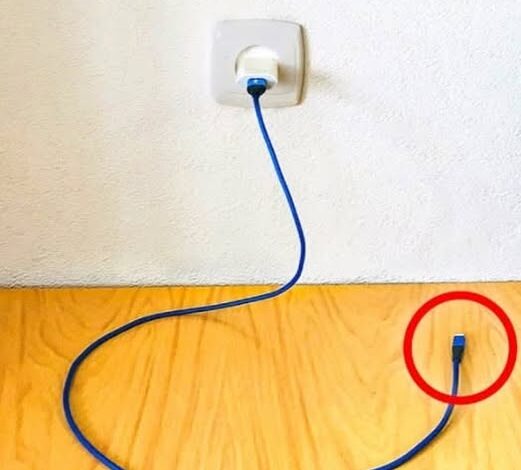
That small charger sitting in the outlet might look harmless, almost invisible in your daily routine—but it’s not as passive as it seems. Even when it’s not actively charging anything, many adapters continue to draw a trickle of power. It’s minimal, easy to ignore, but over time that constant draw creates heat. Inside, components slowly age: insulation can become brittle, tiny connections can weaken, and the overall stability of the device starts to erode in ways you’ll never see until something goes wrong.
What makes it risky isn’t one dramatic moment—it’s the accumulation. A charger that’s been quietly wearing down for months or years can become vulnerable. Then one small power surge, something that would normally pass unnoticed, might be enough to push it past its limit. That’s when overheating, melting plastic, or even a fire can begin. It doesn’t announce itself in advance. It just reaches a tipping point.
And the risk isn’t only internal. On the outside, that same charger can become a physical hazard, especially in a home with children or pets. A dangling cable at the wrong height is an invitation—something to grab, chew, or pull. What looks like harmless curiosity can turn into contact with a live connection. Even a slightly loose plug, the kind people ignore because it “still works,” can create tiny electrical arcs inside the outlet. Those sparks are small, but in the wrong conditions—near dust, fabric, or dry materials—they can escalate into something far more serious.
The unsettling part is how ordinary it all feels. There’s no alarm, no warning light, no clear signal that something is building toward a problem. Just a device sitting there, doing what it always does—until it doesn’t.
The fix, though, is simple and immediate. Unplug it when you’re done. That small habit breaks the chain before it has a chance to form. It removes the constant strain, eliminates the hidden heat, and takes away the risk entirely. It’s a one-second decision that quietly protects everything around it—your space, your safety, and the people who share it.