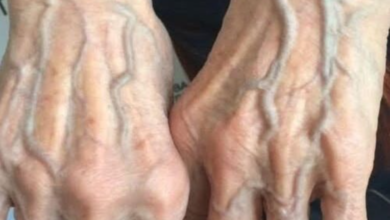
That small, circular scar—often faint now with age—is more than just a curious mark on the skin. It’s a lasting imprint from one of humanity’s greatest public health victories: the defeat of smallpox.
For those born before the early 1970s, the smallpox vaccine was a nearly universal childhood experience. It wasn’t a quick, single injection like most modern vaccines. Instead, it was administered using a bifurcated (two-pronged) needle that repeatedly punctured the skin, introducing the vaccine in a way that triggered a strong immune response. In the days that followed, a blister would form, then a scab, and finally a distinct, round scar—evidence that the body had successfully built protection.
At the time, that mark carried real meaning. Smallpox was not a distant or abstract threat—it was one of the deadliest diseases humanity had ever faced, killing roughly a third of those infected and leaving many survivors permanently scarred or blind. Entire communities lived with the fear of outbreaks that could spread quickly and devastate populations.
What changed the course of history was a coordinated global effort led by organizations like the World Health Organization. Through widespread vaccination campaigns, careful tracking, and rapid containment of outbreaks, the disease was gradually pushed back until, in 1980, it was officially declared eradicated worldwide—the first and only human disease to be eliminated on a global scale.
Today, most younger generations have never seen a case of smallpox. For them, it exists only in textbooks or historical accounts. The urgency, the fear, and the scale of the threat have largely faded from everyday awareness.
But for those who carry that small, round scar, the memory is still there—quiet but significant.
You might notice it in passing: on a grandparent’s arm, on a stranger’s shoulder at a train station, in old family photographs. It rarely draws attention now, yet it connects millions of people across countries and cultures. It is a shared symbol of a time when the world came together to confront something deadly—and succeeded.
In a way, those scars are like living artifacts. They remind us not only of what was endured, but of what was achieved through science, cooperation, and persistence.
The disease may be gone, but the lesson remains: some of the greatest victories in human history are not marked by monuments or celebrations, but by the quiet absence of something that once caused immense suffering—and the subtle traces left behind on those who helped bring it to an end.