Spain’s Prime Minister Pedro Sánchez Issues a Firm and Uncompromising Four-Word Response to President Donald Trump’s Threat to Cut Off All Trade with Spain After Madrid Refused the Use of Its Military Bases for Iran Operations, Marking One of the Strongest Public Rejections of a U.S. President by a European Leader in Years

U.S.–Spain Relations Strained After Sánchez Rejects Trump’s Trade Threat
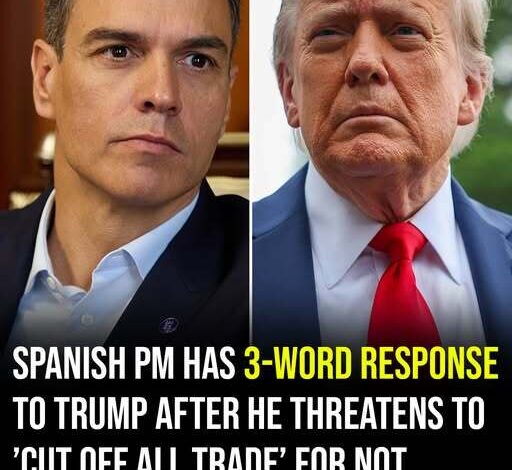
Relations between the United States and Spain intensified dramatically this week after Spanish Prime Minister Pedro Sánchez delivered a firm response to President Donald Trump’s warning that he could suspend trade between the two countries. The exchange represents one of the sharpest diplomatic disputes between Washington and Madrid in recent years and comes amid escalating global tensions following the recent U.S. and Israeli strikes on Iran.
The disagreement stems from Spain’s decision not to allow American forces to launch military operations against Iran from U.S. bases located on Spanish territory. Those installations operate under bilateral agreements that strictly regulate how they can be used. Spanish authorities have emphasized that any activities conducted from these bases must comply with international law, the United Nations Charter, and the specific terms of the defense agreements between the two countries.
This position has placed Spain at odds with the Trump administration, which has been seeking stronger support from allies after the February 28 military strikes on Iran.
Trump Criticizes Spain and Threatens Trade Action
In public statements, President Trump expressed frustration with Spain and several European partners for refusing to align with U.S. policy. He described Spain as “unfriendly,” criticized its leadership, and revealed that he had asked Treasury Secretary Scott Bessent to explore options for cutting economic ties.
Trump also claimed he has the legal authority to halt trade between the United States and Spain and suggested he could implement such measures immediately if he chooses.
Sánchez Responds With a Four-Word Message
Spain’s response was swift and direct. Speaking from the prime minister’s residence at La Moncloa, Pedro Sánchez defended Spain’s stance and summarized his position in four words:
“No to war.”
Sánchez explained that Spain will not support or enable actions it considers destabilizing, unlawful, or contrary to its national interests. He also criticized what he described as attempts by some leaders to use international conflict to distract from domestic political challenges.
According to Sánchez, opposing the strikes on Iran does not mean defending Iran’s government. Instead, he said the decision reflects Spain’s commitment to diplomacy, international legality, and global stability.
Background: Iran Strikes Spark Global Reactions
International tensions escalated after coordinated U.S. and Israeli attacks on Iran on February 28. The operation came after the collapse of nuclear negotiations and reportedly resulted in the death of Iran’s Supreme Leader, Ayatollah Ali Khamenei, along with several senior officials.
Casualty figures remain disputed. Iran’s Red Crescent reports at least 555 deaths, while the U.S.-based Human Rights Activists News Agency estimates 742 fatalities, including 176 children.
The military action has divided international opinion. Some governments support decisive steps to prevent Iran from advancing its nuclear program, while others warn that the strikes risk escalating an already volatile situation.
Spain has been among the countries openly critical of the operation, describing it as “dangerous and unjustified.”
Spain Emphasizes Legal Limits on U.S. Bases
Spanish Foreign Minister José Manuel Albares reiterated that U.S. bases located in Spain — particularly Naval Station Rota and Morón Air Base — cannot be used for offensive military operations without explicit authorization consistent with existing agreements and international law.
“The bases are not being used, and will not be used, for anything outside the agreements with the United States or the principles of the U.N. Charter,” Albares stated.
Defense Minister Margarita Robles echoed this view, stressing that any military activity launched from Spanish territory must have broad international backing.
Trump Escalates Rhetoric
President Trump responded sharply to Spain’s refusal to cooperate. Speaking from the Oval Office, he criticized Spain’s government and suggested the country had failed to support the United States during a critical moment.
“Spain has been terrible,” Trump said. “I told Scott to cut off all dealings with Spain… They were unfriendly. Spain has absolutely nothing that we need, other than great people.”
Trump added that he could end trade relations “tomorrow — or even today.”
Trade between the two countries is significant. In 2025, Spain exported about $26 billion worth of goods to the United States, including pharmaceuticals, olive oil, aerospace components, vehicles, and machinery. The United States exported roughly $21 billion to Spain, mainly agricultural products, industrial equipment, and medical technology.
However, European leaders have pointed out that Spain’s membership in the European Union means any trade dispute could quickly expand into a broader conflict with the EU.
European Leaders Respond
Germany’s Chancellor Friedrich Merz, who recently met with Trump, reminded reporters that Spain’s trade relationships fall under European Union frameworks.
“Spain is part of the European Union,” Merz said. “Any trade measures must respect European agreements and international law.”
European diplomats have largely framed Spain’s position as consistent with its longstanding support for multilateral diplomacy and international legal frameworks.
Why Spain Took a Firm Position
Several factors explain Spain’s strong response:
Legal obligations: Spain’s defense agreements with the United States restrict how American bases on Spanish territory may be used.
Domestic politics: Sánchez leads a coalition government that prioritizes diplomacy, U.N. cooperation, and international law.
Public opinion: Spanish voters generally oppose involvement in foreign military conflicts without U.N. approval.
European alignment: Spain’s stance broadly reflects views shared by several EU members, including Germany, Ireland, Belgium, and Austria.
Potential Consequences of a Trade Dispute
Threatening to cut trade with an EU country would be an unusual step for a U.S. president. Spain is an important NATO ally and hosts key American military facilities in the Mediterranean.
A breakdown in economic relations could have wider implications for:
- NATO cooperation
- EU–U.S. trade relations
- Mediterranean security coordination
- broader transatlantic diplomacy
Economists warn that any unilateral U.S. trade restrictions could trigger retaliation from the European Union, potentially leading to tariffs or legal disputes.
What Comes Next
Despite the escalating rhetoric, diplomatic channels between Washington and Madrid remain open. Spain has stated that it will continue honoring its treaty obligations but will not support military actions it considers unlawful or destabilizing.
Analysts expect several possible developments:
- The United States may delay any immediate trade action
- Spain will continue emphasizing international law and diplomacy
- The European Union will closely monitor the situation
- NATO may attempt to ease tensions behind the scenes
For now, both governments appear determined to defend their positions while avoiding a complete rupture in relations.