A MOTHERS WORST NIGHTMARE COMES TRUE AFTER SHE SPOTS HER DECEASED SONS SKINNED BODY ON DISPLAY AT A FAMOUS LAS VEGAS MUSEUM AND THE TRUTH BEHIND THE THINKER SPECIMEN WILL HAUNT YOU FOREVER

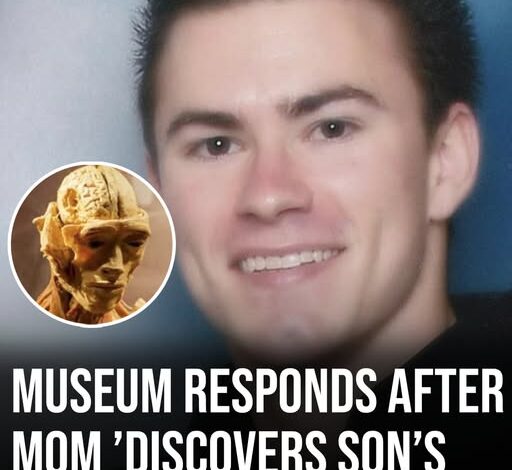
The line between life and death is often seen as something sacred—a final moment that brings closure to those left behind. But for Kim Erick, the loss of her son marked the start of a long and haunting ordeal. In 2012, her 23-year-old son, Chris Todd Erick, was found dead in his bed at his grandmother’s home in Midlothian, Texas. Authorities concluded that his death was caused by an undiagnosed heart condition leading to two heart attacks. Kim, however, never accepted that explanation.
Her grief quickly became entangled with suspicion. Chris’s father and grandmother arranged for his body to be cremated almost immediately, before Kim had time to fully process what had happened. She was given a necklace said to contain his ashes, but something about the situation didn’t sit right with her. She felt, deep down, that the truth was being hidden.
That feeling intensified when she later obtained photographs from the scene of his death. To her, the images suggested signs of trauma that had not been mentioned in official reports. She became convinced that her son had suffered for hours before dying, rather than passing peacefully. Even after a homicide investigation in 2014 found no evidence of foul play, Kim remained certain that key details had been overlooked—or deliberately concealed. She also began to question whether the ashes she had been given truly belonged to her son.
Years later, an unexpected moment would push her suspicions even further. While visiting a museum in Las Vegas, she came face-to-face with an exhibit that she believed changed everything. On display was a plastinated human figure known as “The Thinker,” part of the Real Bodies exhibition. The preserved specimen, posed to display muscles and skeletal structure, immediately struck her as familiar. Kim believed she recognized a distinctive fracture on the skull—one she claimed matched her son’s medical history. In that moment, she became convinced that the figure on display was actually Chris.
The accusation quickly drew public attention and led to a heated dispute. Kim began demanding DNA testing to confirm the identity of the specimen. The exhibition organizers, Imagine Exhibitions Inc., strongly denied her claims. While expressing sympathy, they stated there was no factual basis for the allegation. According to them, “The Thinker” had been sourced legally from China and had been part of the exhibit since 2004—years before Chris’s death.
They also pointed to the process of plastination itself, which can take up to a year to complete. From their perspective, it would have been impossible for Chris’s body to have been processed and included in the exhibit within the timeframe Kim suggested. Archived images of the display from the early 2000s were presented as supporting evidence. Still, for Kim, these explanations did little to ease her doubts. Shortly after her claims became public, the figure was removed from the Las Vegas exhibit, which only deepened her suspicions. She believed it had been relocated and ultimately lost track of it, feeling as though her son had been taken from her all over again.
In July 2023, a disturbing discovery added another layer to the story: hundreds of piles of unidentified cremated remains were found scattered in the Nevada desert. For Kim, this represented a potential lead. She called for forensic testing, hoping traces of chemicals used in plastination might connect the remains to her son. Her search for answers has become relentless, driven by the belief that he was failed by the system and that she must continue fighting on his behalf.
The case has also sparked broader ethical questions about the display of human bodies in exhibitions and how transparently those remains are sourced. While the museum maintains that all specimens are legally obtained and unidentifiable, the emotional impact on a grieving mother remains profound. For Kim, every anatomical display is a painful reminder of what she believes was taken from her.
Authorities have not reopened the case, and the exhibition continues to stand by its account. “The Thinker” remains at the center of a deeply contested narrative—seen either as a scientific display or, in Kim’s eyes, as evidence of something far more disturbing. Her journey underscores how, without closure, grief can evolve into a lifelong search for truth. The mystery surrounding her son’s death and the exhibit persists, leaving many to question where the boundary lies between scientific study and respect for the dead.