The 55-Year Betrayal, My Grandmother Served Her Church Her Entire Life, But When She Fell Ill, They Ghosted Her, Now Her Final Will Has Left The Pastors Shaking In Their Boots

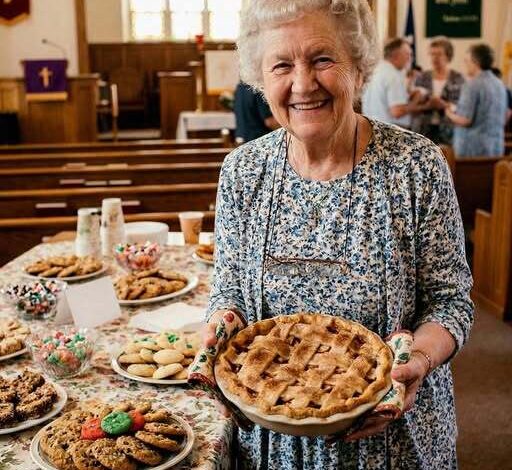
In the quiet, stained-glass rhythm of small-town faith, my grandmother was more than a member of the church—she was its quiet foundation. For fifty-five years, she showed up in ways that rarely made announcements but always made a difference. She arrived before sunrise to bake pies for fundraisers, stayed long after services to clean up without being asked, and spent countless afternoons guiding restless children through Sunday school with patience that never seemed to run out.
She was the one people called when life broke open.
She sat in kitchens with newly widowed women, saying little but offering everything. She remembered names, birthdays, and small details that made people feel seen. Long before anyone spoke of organized “support systems,” she had already built one with her own hands—meal by meal, visit by visit, kindness by kindness.
For more than half a century, the church called her a saint.
And I believed it too.
Until the day she needed that same grace in return—and discovered how fragile it really was.
Her decline came quickly, without warning. What should have been a routine procedure in early 2026 turned into complications that left her weak, then immobile. When the doctor said she would never walk again, it felt like the ground shifted beneath us.
Everything changed overnight.
I put my life on hold—left college, moved into her home, and became her full-time caregiver. But the house she loved was no longer a sanctuary. It had become a maze of barriers: a bedroom she couldn’t reach, a bathroom too narrow for a wheelchair, steps at the front door that cut her off from the outside world.
Still, she held onto hope.
And she placed that hope in the place she had always trusted most—the church.
I stood in the kitchen as she called Pastor Thompson. Her voice was gentle, hopeful, almost apologetic as she asked for something so small: a ramp, a little help rearranging the house so she could live safely downstairs.
What came back was polite—but empty.
“We’ll see what we can do.”
“We’ll check the schedule.”
Nothing came of it.
Days turned into weeks. Weeks into months.
No visits. No help. No follow-up.
Each time a car slowed outside, her eyes would lift with quiet anticipation—only to dim again when it passed by.
The moment that broke something in her didn’t come with anger. It came with realization.
One Sunday morning, I found her crying softly over her Bible. She was reading about love—about how it is proven through action, not words.
That’s when she understood.
The community she had served for fifty-five years had quietly decided she no longer mattered—because she could no longer give.
She passed away two weeks later.
Peacefully, in her sleep.
But I knew her heart had broken long before her body gave out.
The final wound came when I called Pastor Thompson about the funeral.
He didn’t come.
A week later, I sat in the estate attorney’s office, still carrying grief I hadn’t had time to process. To my surprise, both Pastor Thompson and Pastor Barnes were there, composed but expectant.
They believed, naturally, that the church would receive something generous.
After all, she had always been a giver.
And they were right.
But my grandmother had also been wise.
Before any inheritance could be distributed, Mr. Klein, the attorney, unfolded a letter she had written.
Her voice filled the room once more—steady, clear, and unflinching.
She wrote about her final months. About the silence. About every unanswered request. About the loneliness of realizing that the place she had poured her life into had nothing left for her when she needed it most.
The room grew heavy.
Then came the condition.
The inheritance was not a gift—it was a test.
To receive even a portion of it, the pastors themselves were required to complete acts of service. Not delegate. Not organize.
Do.
They had to build ramps, assist the disabled, deliver meals—personally. And if they failed within ninety days, every dollar would go elsewhere.
The reaction was immediate—shock, discomfort, resistance.
They were leaders, after all.
Not laborers.
But she wasn’t finished.
Hidden in a storage closet at the church was a locked chest.
Expecting something valuable, they agreed to open it during Sunday service.
I was there when they did.
The room was full.
The lid creaked open.
And instead of wealth, there were signs of a life spent serving: worn gloves, a flour-dusted apron, a small toolbox, containers once filled with food.
At the bottom was a notebook.
I stepped forward and read.
Page after page recorded quiet acts of kindness:
“Soup delivered.”
“Step repaired.”
“Flowers arranged.”
Fifty-five years of love—written simply, without expectation of recognition.
The room fell silent.
Because in that moment, everyone understood the truth.
The church hadn’t built her.
She had built the church.
I placed the gloves into Pastor Thompson’s hands.
“She kept these ready in case someone needed her,” I said. “I think she believed you would too.”
What followed was not instant redemption—but something slower, more honest.
They had no choice but to begin.
To show up.
To do the work.
And as they did, something unexpected happened.
Others joined.
Not for the money.
But because the notebook had awakened something they couldn’t ignore.
Over those ninety days, the church changed. Not just in action, but in spirit. A volunteer network formed. A support fund was created. People began to see each other again—not as obligations, but as neighbors.
One member later said my grandmother had shamed them into becoming the church again.
But I don’t think it was shame she intended.
It was truth.
She understood something they had forgotten.
That faith isn’t found in sermons or titles.
It lives in small acts. In showing up. In doing the work when no one is watching.
Her final gift was not money.
It was something far more lasting.
She gave them back their purpose.
She gave them back their community.
She gave them back their soul.