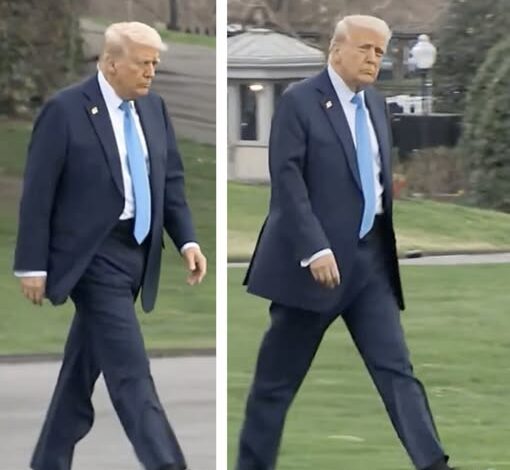
In the digital era, the ability of a single photograph to spark widespread debate is more powerful than ever—and few public figures attract that level of attention quite like Donald Trump. In the spring of 2026, a set of images showing the former president walking toward Marine One has ignited a wave of online speculation. What might once have been dismissed as a routine moment—an official heading toward a helicopter—has instead evolved into a lightning rod for discussion, interpretation, and controversy. Across social media, every detail in these photos has been scrutinized, turning a simple sequence of images into a kind of public inkblot test, where viewers project their own conclusions onto what they see.
The reaction to these images cannot be separated from the broader context surrounding Trump’s age and health. At 79, he remains one of the oldest figures to hold such a prominent role in American politics, and that fact alone has intensified public interest in his physical condition. Earlier in April 2026, rumors briefly circulated online suggesting an emergency visit to Walter Reed National Military Medical Center. Although officials quickly denied those claims, the episode revealed how quickly speculation can spiral in the absence of verified information. By the time the Marine One photos surfaced, the public was already on high alert, primed to analyze even the smallest visual cue for hidden meaning.
For supporters, the images are interpreted in an overwhelmingly positive light. Many point to what they describe as a slimmer appearance and a more energetic stride, framing these details as evidence of improved health and renewed vitality. Comment sections have filled with praise, with some suggesting that Trump appears stronger and more disciplined than in previous years. To this group, even the fit of his clothing—particularly his typically loose suits—signals progress, reinforcing the idea that he has embraced a healthier lifestyle. They see in these images a leader who continues to defy expectations and maintain an intense pace well into his late seventies.
However, not everyone shares that interpretation. Critics and skeptics caution against drawing conclusions based solely on photographs. They argue that changes in appearance, especially at an advanced age, should be approached with nuance rather than assumption. From this perspective, what one viewer sees as weight loss or improved fitness, another might interpret as a sign of fatigue or decline. They emphasize that photography can be misleading—angles, lighting, posture, and even fabric can distort reality. Without official medical disclosures, they argue, any claims about health remain speculative at best. For them, the intense focus on these images reflects a broader tendency to prioritize visual impressions over substantiated facts.
This heightened interest in Trump’s physical condition is also shaped by his long-standing public image. For years, he was associated with indulgent eating habits, particularly his well-known fondness for fast food. Stories about his preference for meals from chains like McDonald’s and KFC became part of his persona, as did the frequently referenced “Diet Coke button,” which reportedly allowed him to request a drink at any time. Yet in recent years, a different narrative has begun to surface—one suggesting a shift toward more structured habits, influenced in part by Melania Trump. Reports have hinted at efforts to adopt healthier routines, adding another layer to the ongoing speculation about his current appearance.
In the absence of clear, verified information, social media has filled the gap with a wide range of theories. Some suggest the use of modern weight-loss treatments, while others speculate about undisclosed health issues. These ideas often spread rapidly, gaining traction despite lacking evidence. At the same time, Trump himself has consistently projected confidence in his physical condition, frequently asserting that he possesses exceptional stamina. He has often contrasted his own energy with that of his political opponents, making the current scrutiny of his health all the more intense and, to some observers, ironic.
The enduring fascination with these Marine One images lies in their symbolic flexibility. They are no longer just photographs; they have become tools for storytelling. Depending on the viewer’s perspective, the same image can represent strength and resilience or vulnerability and decline. In today’s fragmented media landscape, visuals are easily repurposed to support competing narratives, each shaped by personal beliefs and biases. The “details” that people claim to notice—whether it’s posture, movement, or facial expression—often say as much about the observer as they do about the subject.
This phenomenon reflects a broader trend in modern public life: the constant visual monitoring of prominent figures. In an age where images circulate instantly and endlessly, public figures are subjected to a kind of ongoing “visual audit,” where every appearance is analyzed and debated. The discussion surrounding these photos is less about definitive conclusions and more about perception—how people interpret what they see and why.
As of now, there has been no official change in messaging from Trump’s team, and his schedule of public appearances continues as planned. The reality of his health remains private, shielded by the boundaries of personal and medical confidentiality. This lack of concrete information ensures that speculation will persist, fueled by curiosity and amplified by digital platforms.
In the end, the conversation surrounding these images highlights a deeper truth about modern fame and politics. Once a person becomes a symbol, their image often takes on a life of its own, shaped more by public perception than by objective reality. Whether these photos depict a man in peak condition or simply reflect the natural aging process, their impact lies in how they are interpreted. They have captured attention, sparked debate, and reinforced the idea that in today’s world, what people believe they see can carry as much weight as the truth itself.
As the political climate continues to intensify in 2026, it’s likely that these images—and others like them—will remain subjects of close examination. Not because they provide clear answers, but because they offer a canvas onto which a divided audience can project its expectations, concerns, and beliefs. In that sense, the story is far from over.