My Future DIL Handed Me a Mop in Front of 20 Guests at Her Bridal Shower and Told Me to ‘Earn My Meal’ – The Gift I Pulled Out of My Purse Made the Whole Room Gasp

I went to my future daughter-in-law’s bridal shower expecting the usual—small talk, polite smiles, maybe a little awkwardness.
What I didn’t expect was to leave wondering if my son truly knew the woman he planned to marry.
My name is Daryl.
When my husband died, Daniel was only eight. One day I had a partner, a family, stability—and the next, I was alone, trying to figure out how to keep our lives from falling apart. I took whatever steady work I could find. Cleaning offices, schools, clinics. If it needed scrubbing or emptying, I did it.
So when Daniel called me six months ago and said, “Mom, I’m going to propose to Emily,” I broke down right there, standing over a bucket and mop.
Emily had always been… civil. Never warm. There was always a hint of judgment in her tone, little comments about “moving up” or “doing better.” Still, I told myself relationships take time. When the invitation to her bridal shower came, I saw it as a chance to build something better.
Looking back, I should’ve trusted my instincts the moment I opened that envelope.
At the shower, she stood beneath a decorative arch, dressed in soft pink. When she saw me, she gave a brief smile that didn’t quite reach her eyes.
“Well, you made it,” she said.
“I wouldn’t have missed it,” I replied, handing her my gift.
She barely held it before setting it aside carelessly.
No hug. No thank you. Nothing.
Then she clapped her hands to gather everyone’s attention.
“Before we eat,” she announced, “let’s have a little fun.”
She picked up a glass, turned, and deliberately dropped it. It shattered loudly across the floor.
The room went silent.
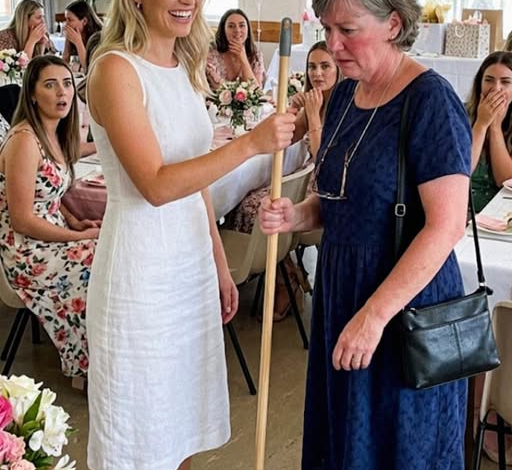
She walked over, picked up a mop from nearby, and held it out—to me.
“Since you didn’t contribute much,” she said sweetly, “you can at least work for your meal. You should be used to this.”
Every eye in the room shifted toward me.
For a moment, I couldn’t move.
Then I looked at her—really looked.
And I saw it.
Not nerves. Not awkward humor.
Satisfaction.
She meant it.
Something inside me went still.
Instead of taking the mop, I set my purse down and reached inside. I pulled out a small silver key tied with an old blue ribbon.
“This,” I said, holding it up, “was supposed to be your wedding gift.”
She frowned. “What is that?”
“It’s a key to a condo. Daniel and I have been saving for it—for your future together.”
A few guests gasped softly.
My voice trembled at first, then steadied.
“I’ve spent nearly two decades cleaning floors. Working extra shifts. Giving up comforts. Every dollar I could spare went toward giving my son a better start in life.”
She stared at me, confused.
“But gifts,” I continued, closing my hand around the key, “belong with people who value them.”
I picked up my coat and walked out.
I didn’t cry until I reached my car—and when I did, it wasn’t gentle. It was the kind that shakes you.
That evening, Daniel called.
“Mom… what happened?” he asked.
I told him.
He hesitated. “Emily said it was a misunderstanding.”
“A misunderstanding?” I repeated. “Did she tell you she handed me a mop and told me to earn my meal?”
Silence.
“No,” he admitted.
“Did she tell you she set it up in front of her guests?”
Another pause.
Then, “Are you sure that’s how she meant it?”
That question hurt more than anything else.
“I know the difference between a joke and disrespect,” I said quietly.
The next morning, Emily showed up at my door uninvited.
No smile this time. Just irritation.
“You embarrassed me,” she said.
I almost laughed. “I embarrassed you?”
“Yes. Bringing up that condo and then taking it back in front of everyone—that was cruel.”
“That gift was for Daniel,” she added.
“It was for both of you,” I said. “And I’m no longer certain you deserve it.”
She dismissed it. Called it a joke. Said I didn’t understand “her world.”
Then she crossed a line.
She claimed Daniel thought I didn’t fit into their life.
That was enough.
I told her to leave.
After she did, I called my son and asked him to come over—alone.
When he arrived, I told him everything.
He listened quietly. When I finished, he admitted he’d noticed her behavior before—small comments, subtle digs—but chose to ignore them.
“Because it was easier,” he said.
I placed the key on the table.
“This isn’t about property,” I told him. “It’s about what it represents. I wanted you to build a life with someone kind.”
He understood.
That night, he went to see her.
Later, he told me what happened.
He asked her directly if she’d humiliated me.
She tried to brush it off as a joke.
When he pressed, she admitted it—and made it worse by doubling down.
At one point, she said, “Your mother walked in like she belonged there.”
That was the moment everything became clear to him.
He took off his ring and ended the engagement.
When he came to my house that night, he looked exhausted.
“It’s over,” he said.
Weeks passed.
The wedding was canceled. People talked. One guest even reached out to apologize—and confirmed the whole thing had been planned.
But Daniel changed.
Not out of guilt—out of understanding.
One afternoon, we met at a small diner he used to love as a kid. After we sat down, he slid a small box across the table.
Inside was a simple keychain engraved with:
“For the home you taught me to deserve.”
I cried right there.
“I don’t want that condo,” he said, “until I’ve built a life worthy of it.”
That meant more than anything else.
The silver key is still with me, tied to that same blue ribbon.
Maybe one day I’ll give it to him.
But one thing I know for sure:
A person can spend their life doing humble work and still carry more grace than someone dressed in luxury.
And my son finally understands that.