In a time overwhelmed by constant noise—political arguments, endless commentary, and voices competing to be heard—it took just one word to cut through it all.
One word from the Vatican.
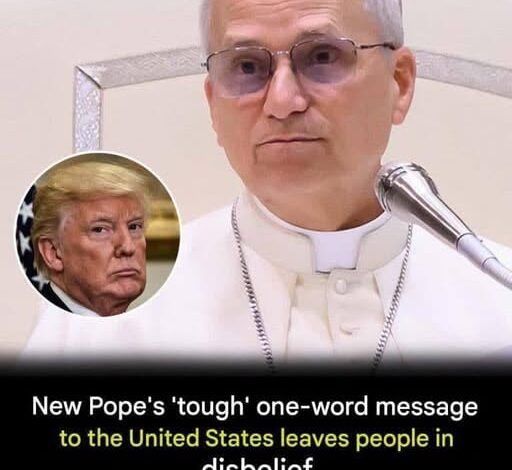
Pope Leo XIV, the first pontiff born in Chicago, has never been known for soft or evasive language. His voice has often carried clarity where others choose caution. But this time, it wasn’t a speech or a statement that captured attention.
It was a single response.
When asked to describe the state of the American soul, he paused—and said only:
“Many.”
At first, the word feels incomplete.
Almost too simple.
But the longer it lingers, the more it unfolds.
It isn’t vague—it’s layered.
It holds within it a quiet inventory:
Many divisions.
Many injustices.
Many voices unheard.
Many lives shaped by systems that overlook them.
It speaks to the weight of a nation carrying contradictions—promise and struggle existing side by side.
And for those already feeling that tension, the word didn’t confuse.
It clarified.
What gave it power wasn’t just its brevity—but who said it.
Pope Leo XIV isn’t a distant observer trying to interpret America from afar. He understands its cadence—its neighborhoods, its contradictions, its quiet resilience. His perspective is shaped not only by theology, but by lived familiarity.
He has spoken before on issues of immigration, dignity, and the moral cost of indifference. He has challenged leaders to look beyond policy and into consequence.
So when he said “Many,” it wasn’t dismissal.
It was recognition.
A recognition that behind statistics are people.
Behind debates are lives.
Behind systems are choices.
And yet, he didn’t leave the moment there.
After that single word—after the weight of it had settled—he offered something else:
“God bless you all.”
Four words that shifted the tone without erasing the message.
Critique remained.
But so did care.
That balance defines his approach.
He does not speak to condemn for the sake of condemnation.
He speaks to call attention—to invite reflection, to ask for accountability, to challenge without dehumanizing.
In his view, truth and compassion are not opposing forces.
They belong together.
And that is what has allowed the word to travel so far.
Across social media, in conversations between strangers, at dinner tables where uncertainty and concern already lived—“Many” continues to echo.
Not as a conclusion.
But as a beginning.
Because the word doesn’t close the conversation.
It opens it.
It asks people to look closer.
To notice what has been overlooked.
To consider what responsibility looks like—not in theory, but in practice.
Pope Leo XIV is not standing at a distance, offering commentary.
He is stepping into the conversation.
As a guide.
As a witness.
As someone who believes that even a fractured nation is still capable of choosing something better.
And perhaps that’s the quiet message beneath it all:
That when a society finally sees itself clearly—without distraction, without deflection—it is left with a choice.
Not between perfection and failure.
But between indifference and mercy.
Between fear and responsibility.
“Many” is not just a diagnosis.
It is an invitation.
To see more.
To care more.
And ultimately—to become something more than what we’ve been willing to accept.