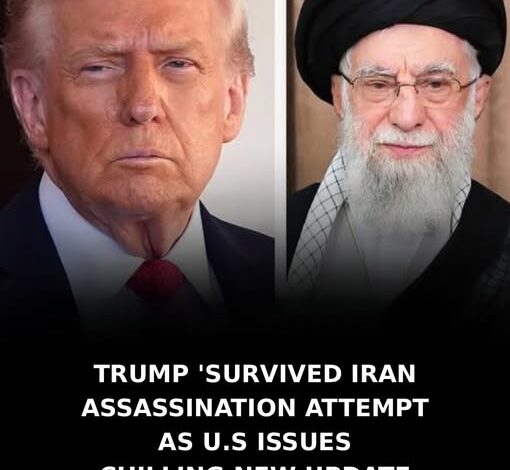
The briefing delivered a striking claim: U.S. officials alleged that a covert cell linked to Iran had been preparing a plot targeting former President Donald Trump and that the group was disrupted during a recent American operation. If accurate, the statement dramatically expands the meaning of the current confrontation. What might otherwise be seen as a strategic clash over missiles, regional influence, and military positioning suddenly takes on a far more personal dimension. The suggestion that assassination planning had entered the equation reframes the conflict as something that reaches beyond conventional military objectives and into the realm of direct threats against political figures.
Once such an assertion is voiced publicly by a senior defense official, it becomes difficult to contain its implications. Even in the absence of independent verification, the claim alone can reshape international perceptions and political narratives. Intelligence briefings are often cautious by design, but when they include allegations of assassination plots, the language carries extraordinary weight. Allies and adversaries alike begin recalculating their assumptions about the scope of the conflict, wondering whether the confrontation has quietly expanded beyond the battlefield.
For supporters of the administration, the statement reinforces the argument that Iran represents an active and immediate security threat. If Tehran or groups linked to it were willing to sponsor or support a plot against a former American president, they argue, then strong military action becomes easier to justify in the name of deterrence and protection. In this interpretation, the disruption of such a plot would represent a defensive success rather than an escalation.
Critics, however, urge caution. They point out that early claims emerging from rapidly evolving military situations can sometimes be incomplete or politically influenced. Without independent confirmation or publicly available evidence, some analysts worry that the allegation could intensify tensions even if its details remain unclear. In modern conflicts, narratives can spread quickly and shape policy responses before the full facts are known.
At the same time, reports of joint U.S. and Israeli military activity against Iranian missile infrastructure suggest that the confrontation itself is far from over. Military planners have reportedly focused on disabling key launch sites, logistics networks, and radar systems believed to support Iran’s missile capabilities. Such operations, if sustained, indicate a campaign designed not only to send a warning but to significantly weaken Iran’s ability to project force in the region.
New deployments in surrounding areas have also drawn attention from defense observers. Additional aircraft, surveillance assets, and naval units have reportedly been positioned to support potential follow-on strikes or to protect allied forces. These movements are often described by officials as precautionary, but they also signal that commanders are preparing for a prolonged period of heightened tension.
One particularly ambitious objective mentioned by analysts is the possibility of establishing air dominance over parts of Iranian territory. Achieving that goal, however, would be far from straightforward. Iran has spent decades investing in layered air-defense systems, hardened facilities, and dispersed missile sites specifically designed to complicate foreign air campaigns. Even technologically advanced air forces face challenges when confronting dense radar networks and mobile launch platforms.
Military experts caution that promises of quickly controlling Iranian airspace may underestimate these obstacles. Iran’s strategy relies heavily on asymmetry and unpredictability, meaning responses could come in forms that extend beyond traditional battlefield engagements. Retaliation might involve regional militias, cyber operations, maritime disruptions, or strikes through allied groups operating across the Middle East.
Statements from Donald Trump himself have further intensified the atmosphere. He has repeatedly referenced threats against his life, portraying the alleged plot as part of a broader pattern of hostility from Iranian-linked actors. His remarks have resonated strongly with supporters who see them as confirmation that the conflict carries deeply personal stakes as well as geopolitical ones.
Officials within the administration have hinted that the recent actions may represent only the opening phase of a wider strategy. While they have avoided providing specific operational timelines, their language suggests that additional measures remain under consideration. Such ambiguity is common in military planning, but it also contributes to uncertainty about how far the confrontation might ultimately extend.
For global observers, the situation highlights the fragile boundary between deterrence and escalation. Strategic strikes aimed at weakening an adversary’s capabilities are often intended to prevent further aggression. Yet those same actions can provoke retaliation that expands the conflict beyond its original scope. Each new revelation, claim, or military movement has the potential to shift that balance.
Diplomats in several capitals have quietly expressed concern that communication channels between Washington and Tehran remain extremely limited. In past crises, back-channel discussions sometimes helped prevent misunderstandings from spiraling into larger wars. Without those mechanisms operating effectively, even small incidents can carry disproportionate consequences.
Markets, governments, and international organizations are watching the situation closely for signs of where events might move next. Energy routes, regional alliances, and global security arrangements could all be affected if tensions continue to rise. At the same time, the information environment surrounding the conflict remains fluid, with competing narratives emerging from different sides.
For now, the story continues to unfold in fragments—briefings, official statements, satellite imagery, and reports from analysts attempting to piece together the broader picture. Whether the alleged assassination plot proves fully substantiated or remains disputed, its introduction into the public narrative has already altered the tone of the confrontation.
The coming days and weeks may determine whether the current campaign stabilizes into a contained strategic standoff or evolves into a more expansive conflict. As new details surface and military operations continue, the world remains alert to the next development—whether it appears in the form of another strike, another intelligence disclosure, or an unexpected diplomatic opening.