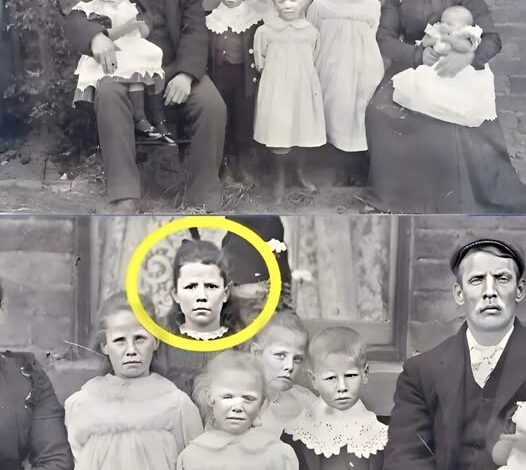
They should have burned it the moment they saw the date.
The archivist would later say that the first thing he noticed was how ordinary the photograph looked. A small girl, perhaps eight or nine, standing near the riverbank with her hands folded neatly in front of her. Her dress was simple, the kind worn by children in old portraits—lace collar, dark fabric, shoes polished to a careful shine. Her hair was tied back with a ribbon that had faded into a pale ghost of whatever color it once had been.
But the date stamped on the back was impossible.
The paper itself was unmistakably modern, the chemical sheen of recent processing still faintly visible under the archive lights. Yet the photograph claimed to have been taken in 1891, nearly forty years before any camera in that region could produce such clarity. Every detail of the girl’s face was sharp enough to study: the faint freckles across her nose, the slight tilt of her smile, the reflection of light in eyes that seemed far too aware of the lens pointed at her.
The town clerk laughed when he first saw it. A misprint, he said. Someone playing a joke.
They should have burned it then.
Instead, they catalogued it.
For two weeks the photograph sat quietly in Drawer C17 of the municipal archive, filed between census ledgers and church inventories. It should have stayed forgotten there. But the archivist kept returning to it, drawn by something he couldn’t explain. Each time he pulled the envelope out, he noticed another detail he was certain hadn’t been there before—the faint shadow of a house behind her, the suggestion of a path through the trees, the outline of the river bending just beyond the frame.
And the girl.
Maria.
Her name wasn’t written anywhere on the photograph, but somehow the archivist knew it. The certainty arrived the way old memories sometimes do: sudden, uninvited, and impossible to trace.
The trouble began the day he mentioned the name out loud.
At first the town reacted with confusion. No one knew any Maria connected to the archives, the river, or the photograph. The mayor insisted the town’s historical records had no such person listed. The church registry had no baptism under that name during the nineteenth century. The cemetery held no grave that matched.
But within days, something strange started happening.
People began remembering.
Not all at once, and not in the same way. The memories came like fragments drifting up from muddy water. A grocer claimed his grandmother once warned him never to walk near the river after dusk because of a girl who waited there. An old fisherman insisted he had heard the name Maria whispered by his father during a fevered night long before the man died.
Children were the first to say they recognized her.
A group of them gathered outside the archives one afternoon after someone had left a copy of the photograph pinned to the public notice board. They stared at it with quiet certainty.
“She’s the one who waves from the trees,” one boy said.
No one asked what he meant.
By the time the archivist realized the date couldn’t be a misprint, the town had already begun remembering differently. Conversations shifted in subtle ways. Stories that had once ended cleanly now trailed off into uneasy silence. People who had sworn they’d never heard the name Maria found themselves waking from dreams with it resting heavily on their tongues.
Old men who had outlived their secrets began spending long hours staring at the river.
The past, once comfortably blurred, was now in merciless focus.
Someone eventually noticed that the photograph wasn’t taken at the riverbank after all.
The girl was standing in front of a house.
It took several days of careful study to recognize the structure behind her—a low shape hidden in shadow, barely visible through the trees. The roofline matched a property that still stood on the northern edge of town, though the building itself had been renovated so many times its original form had nearly vanished.
The Henderson house.
A quiet place, mostly empty these days except for a caretaker who claimed the basement had been sealed since the 1920s. No one had questioned that story before. But once the photograph circulated, curiosity spread quickly.
Old blueprints surfaced in the county office.
Permits appeared that no one remembered issuing.
Testimonies that had once been vague became strangely precise.
There had been a room beneath the house, the documents suggested. Not a cellar, exactly—something smaller, reinforced, hidden behind a wall that did not appear on the public plans. The kind of space built for something that wasn’t meant to be found.
The photograph seemed to change the more people studied it.
Not visibly—not in a way anyone could prove. But each person who looked at it swore they noticed something new. A second window behind the girl. The faint outline of another figure standing deeper in the trees. Marks in the dirt that might have been footprints, or something dragged across the ground.
And Maria’s smile.
At first it looked like the polite expression of a child told to stand still for a camera.
But the longer you looked, the less it resembled politeness.
It looked like recognition.
As though she knew exactly who would be studying that photograph, more than a century later.
As though she had been waiting.
The town council eventually ordered the Henderson property opened for inspection. Officially it was just a safety matter—an outdated structure, possible hazards in the foundation. Unofficially, nearly half the town gathered along the road that morning, watching the workers pry open the sealed basement door.
No one from the archives attended.
The archivist stayed behind, staring at the photograph laid flat on his desk.
By then he had noticed the final detail.
In the lower corner of the image, near Maria’s shoe, the dirt looked freshly disturbed. Not like something from 1891, but like soil turned recently—dark, moist, uneven.
As if something beneath the ground had been moved.
The workers eventually found the hidden room exactly where the blueprints said it would be. The wall gave way with a hollow crack, revealing a small chamber lined with old stone and iron bolts set into the floor.
Whatever had been inside it was long gone.
No one ever spoke publicly about what they saw in that room. The official report listed nothing unusual—just structural decay and debris left by earlier renovations.
But something changed in the town after that day.
People stopped leaving children alone near the river.
Families began counting heads more carefully when dusk approached.
And the photograph of Maria was quietly removed from the archives, its envelope sealed and placed somewhere no visitor would ever find it again.
Still, from time to time, someone claims to see her.
Not in photographs.
In reflections.
In the dark glass of windows facing the river.
A small girl standing very still among the trees, smiling with the calm patience of someone who has already been remembered once—and knows she will be remembered again.