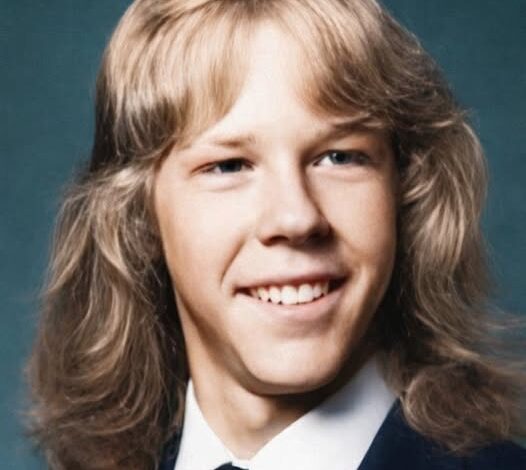
The image of a young James Hetfield feels almost surreal when placed beside the towering figure he would later become. In an old school portrait, he looks like any other quiet kid growing up in suburban America—soft expression, shy posture, and a faint, uncertain smile. There’s nothing in that photograph that hints at the thunderous force he would one day unleash on the world of heavy music. Yet hidden inside that gentle face was a future architect of one of the most influential bands in rock history: Metallica.
To truly understand Hetfield’s transformation, you have to look beyond the fame, the roaring crowds, and the iconic riffs. His early life was shaped by silence and emotional isolation. Raised in a strict household that followed the teachings of Christian Science, medical treatment was often avoided in favor of spiritual healing. For a child growing up in a modern world, that difference alone could create a feeling of separation from classmates and society.
But the defining moments of his youth came through personal loss. His parents’ divorce fractured the stability of his home at a young age, and not long afterward he faced an even deeper tragedy when his mother died of cancer. Because of the family’s religious beliefs, she declined medical treatment. For a young boy, watching someone he loved suffer while feeling powerless to help left a profound mark on his psyche. The experience didn’t just create grief—it planted anger, confusion, and a deep distrust of the world around him.
Where many people might have collapsed under that weight, Hetfield found an outlet.
Music became the language he used to process emotions he couldn’t put into words. When he picked up a guitar, the quiet boy from the school photo began transforming into something entirely different. Distortion, aggression, and speed became tools for survival. What began as a personal escape soon evolved into a musical identity.
That transformation accelerated in the early 1980s when Hetfield co-founded Metallica alongside drummer Lars Ulrich. Together they helped pioneer the sound that would come to define thrash metal—a genre built on blistering guitar riffs, relentless rhythms, and raw emotional power.
On stage, Hetfield became almost unrecognizable compared to the timid kid in that photograph. The hesitant smile disappeared, replaced by a fierce intensity. His stance—legs wide, guitar low—became one of the most recognizable silhouettes in rock music. When he shouted his trademark “Yeah!” across a stadium, it wasn’t just a vocal cue for the band. It was a declaration of power, a moment where vulnerability was transformed into strength.
One of the most remarkable elements of Hetfield’s musicianship is his guitar technique. His aggressive down-picking style is often considered one of the most physically demanding and precise methods in metal guitar playing. Songs like Master of Puppets, Enter Sandman, and The Unforgiven showcase both his rhythmic control and his ability to balance brutality with melody.
For Hetfield, this precision wasn’t just musical—it was psychological. In a life marked by chaos and loss, the strict discipline of rhythm offered a kind of control. Every riff, every beat, every perfectly timed chord became a way of imposing order on emotional turmoil.
Fans around the world connected deeply with that authenticity. The music of Metallica wasn’t polished pop—it was raw emotion turned into sound. Millions of listeners heard their own frustrations, fears, and struggles echoed in Hetfield’s voice.
Yet the story didn’t end with success. Like many artists who channel intense emotions into their work, Hetfield later faced personal battles of his own. He has spoken openly about struggles with addiction and the pressures that came with fame. Over time, therapy and recovery became part of his journey, leading him to reflect more honestly about the person behind the “rock monster” image.
This vulnerability added a new dimension to his legacy. The same man who once seemed invincible onstage began discussing mental health, personal growth, and the importance of confronting past trauma. For many fans, that honesty made him even more relatable and inspiring.
When we look back at that childhood photograph today, it feels less like a contradiction and more like a beginning. The quiet boy and the commanding frontman are not separate people—they are chapters of the same story. The pain and confusion of his youth didn’t disappear; they were transformed into art.
The thunder of Metallica songs echoing through stadiums around the world is, in many ways, the amplified voice of that young boy who once struggled to be heard.
And that is why the story of James Hetfield remains one of the most powerful narratives in rock history—not just a tale of fame, but a testament to resilience, creativity, and the extraordinary power of music to turn pain into something unforgettable. 🎸