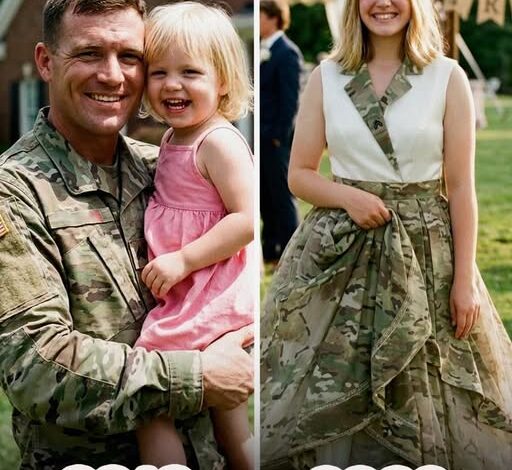
Prom night was never meant to be anything extraordinary for me—just another evening I planned to get through quietly, without standing out or expecting anything memorable. I had already made peace with that idea. But everything shifted the moment I descended the stairs wearing a dress I had sewn myself—from my late father’s army uniform.
That dress was never just clothing. Every stitch held a memory, a silent tribute to the man who had meant the world to me. It was my way of keeping him close, of refusing to let his presence disappear from my life. I knew not everyone would understand, but I hadn’t anticipated how cruel the reaction would be.
In the weeks leading up to prom, I worked on it in silence. After long days filled with responsibilities and chores, I would retreat to my room at night and sew. In those quiet hours, when the house finally settled, I felt closest to my father.
He had taught me how to sew when I was younger. Back then, it was just something we shared—simple projects, patient lessons, laughter woven into each moment. After he passed, those memories became something deeper. Sewing turned into a connection, a way to feel him beside me when everything else in my life had changed.
And so much had changed.
After he was gone, the house stopped feeling like home. My stepfamily made sure of that, in ways both subtle and obvious. I often felt like a stranger in a place where I was supposed to belong. I was left out of conversations, overlooked in decisions, and constantly reminded that I didn’t quite fit.
But the dress—that was mine.
Creating it gave me something no one could take from me. With every stitch, I felt like I was reclaiming a piece of myself. It wasn’t only about honoring my father—it was about rediscovering who I was when he was still here, and finding the strength to carry that version of myself forward.
Then prom night arrived.
I stood in front of the mirror, looking at the finished dress. The fabric that once formed my father’s uniform had been transformed into something entirely new—something meaningful. It fit me perfectly, not just physically, but emotionally. For the first time in a long while, I felt proud.
Then I went downstairs.
The reaction was immediate.
My stepmother’s face twisted into confusion and disapproval. My stepsisters openly laughed. Their comments came fast—sharp, dismissive, louder than necessary. They didn’t see the meaning behind it. To them, it was strange, even ridiculous.
Every word hit harder than I expected.
For a moment, I felt that familiar urge to shrink, to disappear, to let their opinions define me. But then I thought of my father—his voice, his encouragement, the way he always told me to stand tall no matter what.
So I didn’t move.
I stood there, holding onto that strength, even as their laughter filled the room.
Then, suddenly, there was a knock at the door.
It cut through everything.
The room went still.
My stepmother, clearly annoyed by the interruption, went to answer it. Outside stood a military officer in uniform, holding a folder. The mood shifted instantly. The laughter disappeared, replaced by a heavy silence.
He asked for me.
That alone was enough to quiet everyone completely.
I stepped forward, unsure but steady. He greeted me respectfully and handed me the documents. His voice was calm, but there was something serious beneath it—something that made it clear this moment mattered.
What he told me changed everything.
Before he passed, my father had made arrangements. He had planned for my future, making sure I would be protected and supported—ensuring I wouldn’t have to depend on people who didn’t truly care for me. The documents detailed security, stability, and opportunities he had carefully put in place without my knowledge.
In an instant, the atmosphere in the house transformed.
The same people who had mocked me now stood silent, their expressions uncertain, almost stunned. The way they saw me—the assumptions they had made—shifted completely.
But the biggest change wasn’t in them.
It was in me.
I realized that even though my father was gone, he was still looking out for me. He had understood what I might face and made sure I wouldn’t face it alone. His love hadn’t disappeared—it had simply taken another form.
When I left for prom that night, I wasn’t the same person who had come down those stairs.
I wasn’t trying to disappear anymore. I wasn’t defined by how others treated me or the space they gave me.
I walked out as someone who had found her strength.
The dress that had been mocked moments before now meant even more. It wasn’t just a tribute—it was a symbol. Of resilience. Of enduring love. Of an identity no one could take from me.
And for the first time in years, I felt something I had been missing.
I felt proud.
Not just of the dress—
but of myself, and the life I was finally ready to claim as my own.