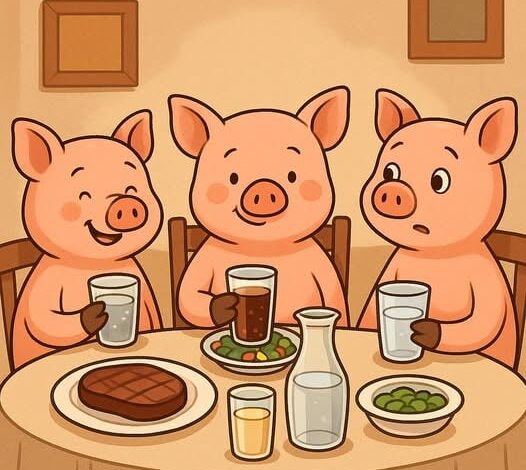
What stays with us after these stories fade isn’t simply their wit, but the quiet unease they leave behind. Beneath the humor, something more persistent takes root—a subtle recognition that the characters are not distant or exaggerated, but uncomfortably familiar. In the pig who feigns ignorance until the exact moment it becomes advantageous to reveal cunning, we catch a glimpse of our own carefully timed honesty. We think of the moments we’ve chosen silence over clarity, or played naive to avoid accountability, only to shift gears when it serves us. There’s a duality in how we move through the world: the courteous version we present outwardly, and the internal narrative shaped by self-interest, fear, or calculation. These stories expose that split without accusation, letting comedy do the work of revelation. The laughter they provoke feels incomplete, almost hesitant, because it carries the weight of recognition.
That same discomfort deepens in the farmer’s impossible situation. His attempt to resolve conflict by distributing payment evenly seems, on the surface, like a gesture toward fairness—measured, rational, even ethical. Yet it fails in a way that feels deeply familiar. It mirrors the kinds of solutions we often rely on in real life: policies designed to appear just, apologies crafted to smooth tensions, compromises that check every procedural box while leaving the underlying hurt untouched. We recognize the pattern of addressing symptoms instead of causes, of choosing what is manageable over what is meaningful. The farmer’s dilemma becomes less about the pigs and more about the human tendency to prioritize equilibrium over truth.
What makes these moments linger is not their resolution, but their refusal to resolve cleanly. The humor opens a door, but instead of closing it with a punchline, it leaves us standing in the doorway, confronted with questions we might prefer to avoid. How often do we disguise intention as confusion? How often do we accept shallow balance instead of confronting deeper imbalance? The stories don’t accuse or instruct—they simply reflect. And in that reflection, we are left to decide whether we’re willing to look more closely at the quiet contradictions shaping our choices, or whether we’ll, like the pig, wait for the safest moment to reveal what we already know.