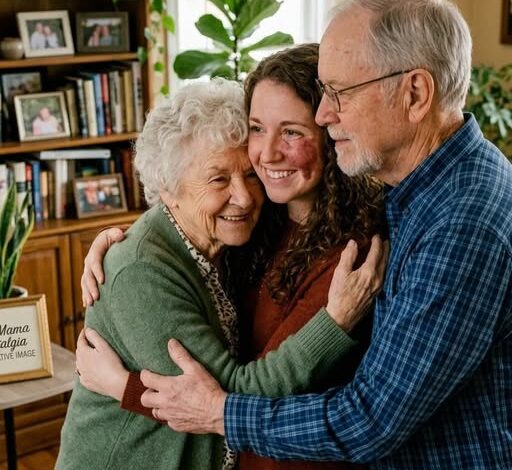
Margaret and Thomas had built a life defined by quiet routines and shared understanding, slowly coming to terms with the idea that parenthood might never be part of their story. After years marked by hope, disappointment, and acceptance, they believed they had reached a place of peace. But that sense of finality shifted the day a neighbor mentioned a young girl living in a children’s home—overlooked time and again because of a visible birthmark on her face. The story lingered with Margaret in a way she couldn’t ignore. When she brought it up to Thomas, he didn’t hesitate or dismiss it. Instead, he asked softly, “Do you want to meet her?” In that moment, something new began—something neither of them had planned, but both were ready to explore.
Their first meeting with Lily was quiet but powerful. At just five years old, she carried herself with a kind of awareness that spoke of experiences beyond her years. She watched them carefully, measuring every word and gesture. Her questions were direct—sometimes unexpectedly so—as if she needed to know whether they would be different from the others who had come and gone. Beneath her cautious exterior, there was a quiet resilience that immediately touched Margaret and Thomas. The adoption process was long and filled with uncertainty, but when the day finally arrived, Lily stepped into their home holding a small bag and a well-loved stuffed toy. She wasn’t sure what to expect—but Margaret and Thomas made sure she knew one thing without doubt: she was home, and she was theirs in every way that mattered.
Life as a family didn’t come without challenges. As Lily grew, she encountered moments that tested her confidence—unkind remarks, curious stares, and the internal struggle of feeling different. But Margaret and Thomas remained a constant source of reassurance. They never allowed her to believe that her worth was tied to her appearance. Instead, they encouraged her to see her strength, her intelligence, and her kindness as the defining parts of who she was. Slowly, Lily began to believe it too. She found her voice, standing up not only for herself but for others who felt unseen.
That strength eventually shaped her dreams. Inspired by her own journey, Lily set her sights on becoming a doctor—someone who could offer care, compassion, and dignity to others. The path wasn’t easy, but she pursued it with determination. Years later, she achieved that goal, proving that the limitations others once placed on her had never truly defined her potential.
Then, one day, a letter arrived—one that would open a new chapter in her understanding of her past. It was from her biological mother, a woman who had been young, afraid, and facing circumstances she couldn’t navigate at the time. The letter told a story not of indifference, but of struggle—of love that existed but couldn’t be expressed in the way Lily needed back then.
Reading it brought a mix of emotions—questions, sadness, and eventually, understanding. When Lily chose to meet her, it wasn’t about replacing what she had, but about completing a part of her story. The meeting didn’t erase the past, but it gave it context. It allowed her to see that her life had never been defined by rejection alone.
In the end, Lily came to understand something deeply important: she had always been surrounded by love—sometimes visible, sometimes hidden, but always present in one form or another.
Her story wasn’t one of abandonment.
It was one of love finding its way—patiently, imperfectly, but powerfully—until it reached her.