BAGGAGE HANDLER’S WARNING ABOUT RIBBONS ON LUGGAGE GOES VIRAL AS TRAVELERS LEARN THE DECORATIONS CAN BLOCK SCANNERS DAMAGE BAGS CAUSE MISROUTING AND DELAYS AND MAKE SUITCASES HARDER NOT EASIER TO IDENTIFY

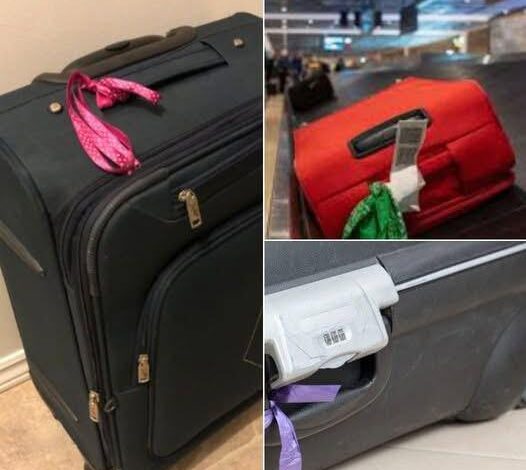
Many travelers develop small airport habits that seem practical or clever, and one of the most common is tying a colorful ribbon to a suitcase handle. The idea is simple: with so many nearly identical bags circling a baggage carousel, a ribbon makes a suitcase easier to recognize. However, baggage handlers who work within airport systems say this harmless-looking trick often creates far more problems than travelers realize.
In fact, many handlers have warned that ribbons are responsible for a surprising number of luggage delays, sorting errors, and damaged bags. What passengers see as a helpful identifier can interfere with the complex systems airports use to move thousands of suitcases every hour. The issue has recently gained attention online because it affects everything from scanning accuracy to conveyor operations and the likelihood that luggage arrives at the same destination as its owner.
Airport baggage handling relies heavily on automation. Modern sorting systems are designed to process enormous volumes of luggage quickly and efficiently. Each suitcase is tagged with a barcode that contains routing information for its journey. As bags move through the system, scanners read this code in fractions of a second and send the luggage along the correct conveyor path toward the appropriate flight.
Problems begin when something blocks or interferes with that barcode. According to baggage handlers, ribbons tied to suitcase handles are one of the most common obstacles. Loose fabric, bows, and decorative straps can swing or shift just as a scanner attempts to read the code. When the scanner cannot clearly detect the barcode, the system automatically rejects the bag.
A rejected bag is not simply paused in the system. Instead, it is diverted off the main conveyor line and sent to a separate area for manual handling. This means workers must physically inspect the luggage and determine its destination. While automated systems sort bags rapidly and accurately, manual processing takes far longer and introduces a greater chance of human error.
At busy airports, dozens or even hundreds of bags can accumulate in these manual sorting areas. Workers must process them quickly while managing staffing limitations and tight departure schedules. If a bag spends too long waiting to be sorted manually, it may miss its flight entirely. The passenger arrives at their destination only to discover their luggage did not follow them—even though it was checked in on time.
Handlers say the ribbon tied to the handle is often the reason the bag was removed from the automated system in the first place.
The complications do not end with scanning issues. Ribbons can also become entangled in the mechanical components of baggage systems. Conveyor belts, rollers, and sorting machinery move luggage through sharp turns and narrow channels at high speeds. Loose materials such as ribbons, cords, and decorative straps can easily catch in these moving parts.
When that happens, two outcomes are common. The ribbon may tear off completely, sometimes pulling at the handle, zipper, or stitching. In other cases, the ribbon remains stuck while the suitcase continues moving, causing the bag to twist or slam into machinery. This can lead to broken handles, torn seams, cracked shells, or other visible damage.
Passengers often assume the damage happened because airport staff handled the luggage carelessly. According to baggage handlers, however, these incidents are frequently triggered by items attached to the bag itself.
Another issue is that ribbons are not as reliable for identification as many travelers believe. During the journey, bags may undergo security inspections, conveyor turbulence, and repeated sorting impacts. Ribbons can easily come loose or detach entirely somewhere along the route.
Handlers say loose ribbons are regularly found tangled in machinery or swept from floors during routine cleaning. By the time the bag reaches baggage claim, the ribbon may already be gone. Travelers who relied on it to identify their suitcase are then left searching through dozens of similar bags.
Ironically, ribbons also fail at their original purpose because so many travelers now use them. On busy travel days, baggage handlers see countless suitcases decorated with bows, ribbons, shoelaces, or fabric strips. Instead of making a bag stand out, these decorations often blend together.
Passengers expecting a unique marker may watch several nearly identical suitcases pass by, each with similar ribbons attached. What was intended to make identification easier can actually create more confusion.
Security procedures introduce another complication. If airport security officers need to inspect a bag, they may remove anything that interferes with opening or screening the suitcase. Ribbons are frequently cut off or set aside during these checks and are rarely reattached afterward. Travelers usually learn about this only when they reach the baggage carousel and notice the ribbon has disappeared.
Because of these issues, baggage handlers recommend simpler and safer ways to identify luggage.
The first step is keeping the exterior of the suitcase clear of ribbons, straps, and loose decorations. The baggage tag should remain flat and fully visible so scanners can read the barcode easily from any angle. Old airline tags or leftover stickers should also be removed, as scanners can sometimes detect outdated codes and send bags to the wrong location.
Travelers who want their luggage to stand out are better off choosing suitcases with distinctive colors or patterns. Brightly colored luggage is easy to recognize and cannot detach during transit. Protective luggage covers with bold designs are another option, as long as they do not block the baggage tag.
Large identification tags placed away from the barcode can also help. When positioned on a different part of the bag, these tags allow both passengers and handlers to recognize the suitcase without interfering with the scanning system.
Technology offers additional solutions as well. Many travelers now place Bluetooth or GPS tracking devices inside their luggage. These small trackers allow passengers to monitor the location of their bag through a smartphone app. If luggage is delayed or sent to the wrong destination, travelers can immediately see where it is and report that information to airline staff.
Many baggage handlers consider internal trackers one of the most effective modern tools for luggage security.
The reason this warning gained so much attention online is that many travelers recognized their own experiences. People who had previously dealt with delayed or misrouted luggage began connecting their problems with the information shared by baggage handlers.
Some recalled arriving at baggage claim to discover their ribbon had vanished. Others described damaged bags or situations where airline staff explained that their luggage required manual sorting. A few travelers even reported seeing bags with tangled ribbons pulled off conveyor belts.
For baggage handlers, these situations are routine. They see the consequences every day as luggage catches on machinery, scanners fail to read tags, and bags are diverted unnecessarily.
Their goal is not to criticize passengers but to prevent avoidable problems. A suitcase that moves smoothly through the automated system is far more likely to reach its destination on time and without damage.
Airport baggage systems operate on precision and efficiency. They are designed to handle massive volumes of luggage quickly, and even small obstacles can disrupt that flow. A ribbon may seem insignificant, but in a system moving tens of thousands of bags per hour, even minor interference can create delays.
Every blocked scan or mechanical snag adds another complication. These small disruptions accumulate, affecting not just one traveler but entire flights.
Passengers rarely witness this chain reaction because they only see the final stage at baggage claim. Baggage handlers, however, watch it unfold throughout the system.
Understanding how airport sorting systems work allows travelers to make smarter choices. A suitcase without dangling items moves more smoothly through conveyors and scanners. Distinctive colors or patterns make identification easier without interfering with equipment. Internal tracking devices provide reassurance and visibility if problems arise.
These small adjustments can significantly reduce the risk of delays, damage, or lost luggage.
The widespread attention this warning received highlights how often small habits affect larger systems. Once travelers understand the mechanics behind baggage handling, many quickly stop using ribbons altogether.
The solution is straightforward: keep the suitcase exterior simple and streamlined, ensure the barcode is clearly visible, and use identification methods that do not interfere with airport equipment.
What began as a convenient trick has become a lesson in how complex airport operations really are. Travelers ultimately want the same outcome—luggage that arrives on time, intact, and at the correct destination.
Achieving that goal often requires working with the system rather than unknowingly disrupting it.
A clean suitcase surface, a visible baggage tag, and safe identification methods provide exactly that. Removing a ribbon may seem like a small change, but it can prevent larger problems such as delays, damage, or misrouted bags.
That is why baggage handlers continue sharing the warning. It helps travelers avoid frustrations that many people have experienced for years without realizing the cause.