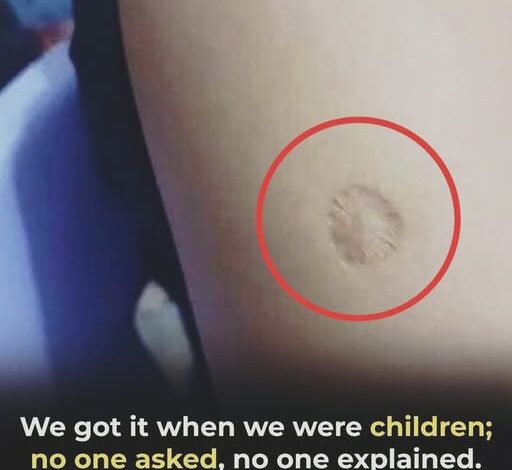
When I was young, I remember noticing an unusual round scar on my mother’s upper arm. It caught my attention because it did not look like an ordinary mark. It had a circular shape, with several tiny indentations surrounding a larger center, almost as if something had pressed a pattern into her skin many years before.
At the time, I had no idea what it meant. I only knew that it looked different from any scar I had seen before. Like many small mysteries from childhood, the memory eventually faded as life moved forward. School, friends, family routines, and ordinary days pushed that curious detail into the background.
Years later, the memory returned unexpectedly.
I was helping an elderly woman step down from a train when I noticed a scar on her upper arm that looked almost identical to my mother’s. It was in the same place, with the same round shape and the same distinctive pattern. Seeing it brought back that childhood memory immediately, along with the curiosity I had once felt.
I did not get the chance to ask the woman about it, but the image stayed with me for the rest of the day. Later, I called my mother and asked her about the scar I remembered seeing on her arm, and about the similar mark I had noticed on the woman at the train station.
Her explanation was simple, but it opened the door to a much larger history.

She told me the scar was from a smallpox vaccination. For people of her generation, it was not unusual at all. Many older adults still carry the same kind of mark because smallpox vaccination was once a routine part of public health protection.
Suddenly, the strange mark I had wondered about as a child made sense. It was not just a scar. It was a small physical reminder of one of the most important medical efforts in human history.
Smallpox was once among the most feared infectious diseases in the world. It was caused by the variola virus and spread from person to person, often through close contact or respiratory droplets. Before modern vaccination programs, outbreaks could move quickly through communities and cause widespread illness and death.
The disease often began with fever, exhaustion, and body aches. After that, a severe rash appeared, eventually forming fluid-filled blisters across the body. Survivors were often left with permanent scars, and many people did not survive at all. For centuries, smallpox affected populations across the world and caused immense suffering.
Because of how dangerous and widespread it was, smallpox became a major focus of global public health efforts. Vaccination played a central role in fighting the disease. Over time, organized immunization campaigns helped reduce outbreaks and protect millions of people from infection.
One of the greatest achievements in medical history was the worldwide campaign led by the World Health Organization to eliminate smallpox. Through vaccination, careful tracking of cases, and coordinated international effort, the disease was gradually stopped in one region after another.
In 1980, smallpox was officially declared eradicated. It became the first human disease to be eliminated worldwide through science, vaccination, and global cooperation.
After smallpox was eradicated, routine vaccination against it was stopped in many countries. In the United States, general smallpox vaccination had already ended in the early 1970s because the disease was no longer spreading naturally and the risk to the public had become extremely low.
The smallpox vaccine was different from many vaccines used today. It did not use a simple injection into the muscle. Instead, it used a live vaccinia virus, which is related to smallpox but much less dangerous. This helped the immune system build protection against the actual smallpox virus.
The way the vaccine was given also explains the unusual scar. A special two-pronged needle, called a bifurcated needle, was dipped into the vaccine and then used to puncture the skin several times in a small area. These repeated punctures allowed the vaccine to enter the upper layers of the skin.
After vaccination, the area usually developed a small bump. Over the following days, it could turn into a blister as the body reacted to the vaccine. The blister would then dry, form a scab, and eventually heal. In many people, the healing process left behind a permanent round or indented scar.
That scar became a recognizable sign that someone had received the smallpox vaccine.
For older generations, the mark is more than just a reminder of a childhood vaccination. It represents a time when infectious diseases posed serious threats and public health campaigns were essential for survival. It is a quiet sign of a period when communities depended on vaccination to protect themselves from a disease that had terrified humanity for centuries.
Today, smallpox no longer exists naturally in the world. Its eradication remains one of the greatest successes in modern medicine. The scar left by the vaccine is therefore more than a mark on the skin. It is a small symbol of scientific progress, public cooperation, and the power of preventive healthcare.
Looking back, my childhood curiosity about my mother’s scar feels much more meaningful now. What once seemed like a strange and unexplained mark was actually connected to a major chapter in world history. It showed how something personal and ordinary, like a scar on a parent’s arm, can carry a story much larger than one family.
That small circular mark was not just a scar.
It was a reminder of a disease defeated, a generation protected, and a moment in history still visible on the skin.