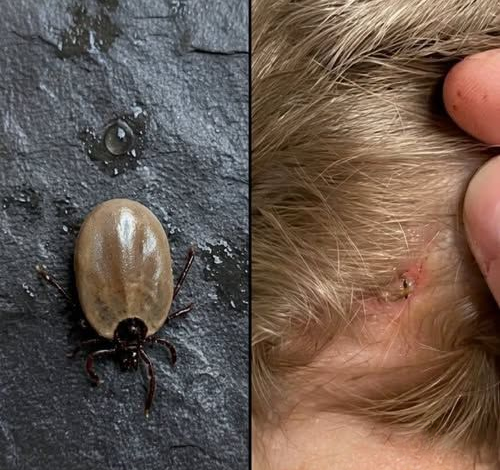
Children often pick up ticks during completely ordinary outdoor activities, especially in warmer months when ticks are more active.
It can happen while playing in the grass, running near wooded edges, hiking, camping, playing outdoor sports, or spending time around leaf piles, brush, and overgrown vegetation. For children, tick exposure is not unusual because they tend to move close to the ground, sit in grass, explore bushes, and play in areas where ticks commonly wait for a host to pass by.
One of the reasons ticks can be so easy to miss is their size.
Many are tiny, especially in earlier life stages, and they can attach without causing immediate pain or itching. A child may not notice anything at first. Parents may not notice either, particularly if the tick has attached in a hidden area.
The scalp is one of the places where ticks can go unnoticed for a while.
Hair can conceal them easily, and unless a child complains or a parent performs a careful check, a tick may remain hidden longer than it would on more visible skin. Ticks may also attach behind the ears, along the hairline, on the neck, under the arms, around the waistline, behind the knees, or in the groin area.
Finding a tick on a child can be alarming, but one reassuring point is important:
tick-borne disease transmission usually takes time.
Many infections are not transmitted immediately after a tick attaches. In general, a tick often needs to remain attached for a period before certain diseases can pass to a person. Because of that, finding and removing a tick promptly can significantly reduce the chance of complications.
The best first response is calm, careful removal.
Medical guidance commonly recommends using fine-tipped tweezers. Grasp the tick as close to the skin as possible, then pull upward with slow, steady pressure. The goal is to remove the tick cleanly without squeezing, twisting, crushing, or jerking it.
Twisting or squeezing is generally discouraged because it can make removal harder, irritate the skin, or leave parts of the tick behind.
Once the tick is removed, wash the area with soap and water. If available, a basic antiseptic can also be used afterward. It may help to save the tick in a small sealed bag or container for a short time, especially if symptoms develop later and a healthcare professional wants more information about what type of tick it may have been.
It is also important to avoid popular home remedies.
Methods such as covering the tick with petroleum jelly, oils, nail polish, alcohol, or trying to burn it off are not recommended. These approaches may irritate the skin or the tick and usually do not improve removal. They can also delay the safest and most effective step, which is simply removing the tick with tweezers.
After removal, monitoring is usually more helpful than panic.
A small amount of redness or irritation at the bite site can happen and does not automatically mean a child is sick. The area may look slightly inflamed for a short time, especially if the skin was irritated during removal.
What matters more is watching for symptoms over the following days and weeks.
Parents should consider contacting a healthcare professional if a child develops fever, chills, fatigue, body aches, headache, joint pain or swelling, swollen lymph nodes, a spreading rash, unusual skin changes, or any symptoms that feel concerning or out of character.
A rash that spreads or changes deserves attention, especially if it expands over time. Some tick-borne illnesses can begin with symptoms that resemble a viral infection, so it is worth mentioning the tick bite to a doctor if the child becomes unwell afterward.
Most tick bites do not lead to serious illness.
That point matters because fear can escalate quickly when a parent finds a tick on a child. In many cases, careful removal and observation are enough. Still, early medical advice can be helpful if symptoms appear, if the tick may have been attached for a long time, if removal was difficult, or if the family lives in an area where tick-borne diseases are common.
Prevention is another important part of keeping children safe.
After outdoor play, parents can do a quick tick check, especially during warm months or after time spent in grassy, wooded, or brushy areas. Areas to check include the scalp, behind the ears, hairline, neck, underarms, waistline, belly button, behind the knees, ankles, and groin.
A bath or shower after outdoor activity can also help make ticks easier to spot and remove before they attach firmly. Clothing can be checked as well, since ticks may cling to fabric before crawling to skin.
Around the home, keeping grass trimmed and clearing brush, leaf piles, and overgrown vegetation near play areas may reduce tick habitat. Pets should also be checked regularly, especially dogs, because animals can bring ticks indoors after walks, yard time, or hikes.
One point pediatric experts often emphasize is that finding a tick does not mean a parent failed or missed something obvious.
Ticks are small.
They hide well.
They attach quietly.
They are easy to overlook, even for careful families.
What matters most is not blame, but response.
Stay calm.
Remove the tick carefully.
Clean the area.
Monitor for symptoms.
Ask a healthcare professional if anything seems unusual.
In most cases, that steady approach is the safest and most protective path forward.