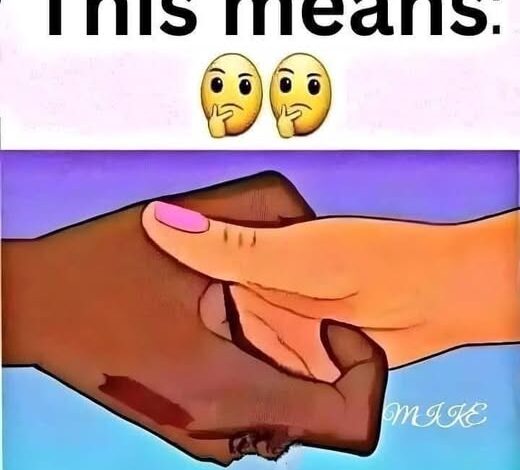
Human communication rarely relies on words alone. Much of what people express in everyday interactions is conveyed through posture, facial expressions, tone, and touch. These subtle signals form a kind of secondary language—one that can deepen connection but can also be easily misunderstood. Among the many gestures that spark curiosity and debate is the act of someone lightly scratching or tickling another person’s palm during a handshake or brief touch. While it may appear like a minor or accidental movement, people often wonder whether it carries a deeper meaning.
The truth is that gestures involving touch are highly dependent on context. In some Western social circles, the idea has circulated for decades that a light scratch on the palm during a handshake can signal romantic or flirtatious interest. According to popular lore, this motion supposedly acts as a discreet form of communication between two people in public—a subtle cue meant to gauge whether the other person might be receptive to further interaction. Because the gesture happens quickly and in close physical proximity, it has sometimes been described as a “private signal” hidden inside an otherwise ordinary greeting.
However, it is important to note that this interpretation is largely based on anecdote and social myth rather than any universal rule. Many people who experience such a gesture never interpret it as flirtation at all. In fact, in most everyday interactions it is far more likely to be accidental, a nervous habit, or simply a result of the way someone moves their fingers during a handshake.
Cultural differences also play a major role in how touch is understood. Around the world, social norms about physical contact vary widely. In some cultures, touch is a routine part of conversation and social warmth. Friends may hold hands, touch each other’s arms during conversation, or use physical gestures to emphasize a point. In these contexts, a movement involving someone’s palm might not carry any romantic implication whatsoever—it may simply be part of a relaxed and expressive communication style.
In other societies, personal space is more strictly defined, and even a small unexpected touch can feel significant. When contact occurs in these environments, people are more likely to analyze it or question the intention behind it. Because social expectations differ so much from place to place, a gesture that feels ordinary in one setting may seem confusing or inappropriate in another.
Another crucial factor is the relationship between the two people involved. Among close friends or partners who already share physical familiarity, playful gestures involving hands might simply be affectionate or joking. Between family members, a similar movement could be completely innocent and rooted in habit. But when the same action occurs between acquaintances or strangers, the meaning becomes much less clear.
In situations where two people do not know each other well, unexpected physical contact can easily be interpreted as uncomfortable or intrusive. Personal boundaries play an important role in how gestures are received, and what matters most is not only the intent of the person initiating the contact but also the comfort level of the person receiving it.
From a psychological perspective, the palm is a particularly sensitive part of the body. The human hand contains a dense network of sensory receptors that help us explore and interact with the world around us. Because we use our hands constantly—grasping objects, greeting others, or expressing affection—touch in this area can feel more noticeable than contact on less sensitive parts of the body.
For this reason, any unusual sensation in the palm tends to capture attention quickly. The brain immediately registers the touch and may prompt the person to analyze what just happened. This heightened awareness is one reason why small gestures involving hands can sometimes be overinterpreted.
In the modern digital era, discussions about body language often spread quickly online. Social media platforms frequently circulate lists of “hidden meanings” behind everyday gestures, claiming that certain touches or movements reveal secret intentions. While these explanations can be entertaining, they often oversimplify a much more complicated reality.
Human communication rarely follows a strict codebook. The same gesture can mean very different things depending on personality, mood, environment, and culture. A movement that one person considers flirtatious may be completely meaningless to another.
Ultimately, the meaning of a palm scratch—or any small gesture of touch—cannot be determined by the action alone. Context, relationship, and mutual comfort are what shape how the moment is interpreted. In many cases, it is best understood as simply part of the natural unpredictability of human interaction rather than a reliable signal of hidden intent.
In a broader sense, gestures like this remind us how complex and delicate human communication can be. People are constantly trying to express thoughts and emotions through subtle signals, sometimes successfully and sometimes awkwardly. Because these signals are shaped by culture, experience, and personal boundaries, their meaning is rarely universal.
What matters most in any interaction is awareness and respect for the other person’s comfort. Paying attention to cues, maintaining appropriate boundaries, and communicating clearly when needed helps prevent misunderstandings. Rather than relying on rigid interpretations of body language, it is often more helpful to focus on the overall tone of the interaction.
In the end, a small touch on the palm might mean many different things—or nothing at all. Like many aspects of human behavior, its significance is created in the moment by the people involved. And that uncertainty is part of what makes human connection both complex and fascinating.