The Meaning Behind Shoes Strung Up on a Power Line: Exploring the Origins, Cultural Significance, and Varied Interpretations of This Mysterious Urban Phenomenon, From Messages About Territory, Memorials, and Pranks to Social Commentary, Local Legends, and Why Communities Across the World Have Adopted This Strange but Fascinating Practice That Continues to Spark Curiosity and Conversation

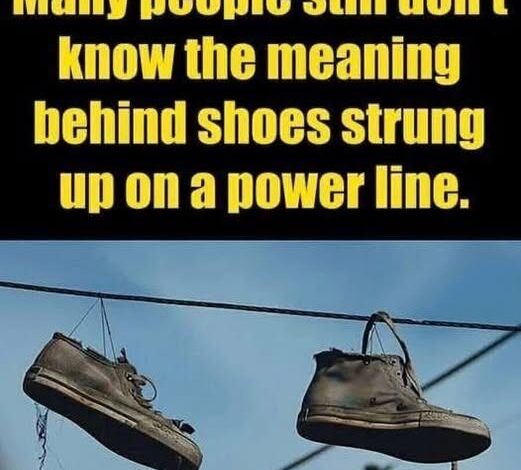
Few everyday sights are as oddly intriguing as sneakers hanging from power lines. Whether they appear above a calm suburban street, a crowded city intersection, or a quiet rural road, they tend to spark the same unspoken question: how did they get there, and why? Even though the practice isn’t as common as it once was, the image still captures attention and fuels speculation. People share stories, memories, and theories—some serious, others humorous—about what those dangling shoes might represent. In reality, the explanation is rarely simple. Like many cultural quirks, the phenomenon blends history, rumor, tradition, and a bit of youthful mischief.
If you ask different people about the meaning behind the hanging shoes, you’ll likely hear a wide range of answers. Some explanations are sentimental, connected to personal milestones or shared experiences. Others reflect urban legends or fears shaped by movies and television. And some are nothing more than playful guesses. Although many assume the shoes must signal something dangerous or secretive, most cases turn out to have far more ordinary origins. Still, every theory offers a glimpse into the stories and beliefs of the communities where the shoes appear.
One commonly repeated explanation traces the practice back to military culture. According to this idea, soldiers nearing the end of their service or completing basic training sometimes celebrated by tossing their boots over nearby power lines. The act symbolized leaving behind the discipline and hardship of military life and stepping back into civilian freedom. Some veterans recall seeing boots hanging near training areas or military bases, reinforcing the belief that the tradition once held real significance. Even if not every pair of shoes overhead comes from this custom, the symbolism resonates with many people who view the gesture as a small but meaningful farewell to a chapter of life.
Other theories move in a darker direction. A persistent urban legend claims that shoes on power lines mark gang territory or drug-dealing locations. The story has circulated for decades and is often reinforced by portrayals in movies and television. However, law enforcement officials and researchers who study gang activity generally dismiss the idea as exaggerated folklore. There is little evidence that gangs use hanging sneakers as a reliable form of communication. The rumor’s endurance likely stems from fear, stereotypes, and storytelling rather than documented patterns of criminal behavior.
Another explanation comes from schoolyard pranks and childhood mischief. Many adults remember incidents from their youth when someone’s shoes were snatched and thrown onto wires during recess, gym class, or after-school gatherings. The shoes would remain stranded overhead while the unlucky owner looked up helplessly, wondering how to get them back. While such incidents certainly happen, they account for only a portion of the shoes seen hanging above streets.
In many cases, the simplest explanation is also the most accurate: kids or teenagers throwing shoes for fun. Sometimes it’s a challenge between friends to see who can get their shoes stuck on the wire. Other times it’s the result of a late-night dare or a spontaneous decision to toss an old pair of sneakers that nobody wants anymore. Young people often look for ways to leave small marks on their surroundings, and a pair of shoes swinging above the street can serve as a playful reminder that someone once passed through that moment.
In some places, the practice even evolves into a local tradition. Certain communities recall students tossing their shoes onto power lines before graduation as a symbolic goodbye to school life. In these cases, the shoes represent transition rather than mischief—a lighthearted ritual that marks the move from adolescence into adulthood. Over time, the hanging sneakers become part of the neighborhood’s identity and shared memory.
Despite its playful reputation, however, the act does carry real-world consequences. Utility companies warn that objects thrown onto power lines can create safety hazards. While shoes themselves are not conductive, throwing items near electrical equipment can put people dangerously close to high-voltage wires. Once stuck, the shoes also become obstacles that utility workers must eventually remove, often requiring specialized tools or equipment. The removal process costs time and resources that could otherwise go toward maintaining essential infrastructure.
There are also environmental concerns. Shoes left outdoors deteriorate slowly, shedding bits of rubber and synthetic material into the environment. Strong winds or storms can knock them loose, turning them into roadside litter or potential hazards for drivers. Birds and other animals may also interact with the dangling shoes, which can sometimes lead to injury.
Because of these issues, many communities now encourage safer alternatives for disposing of old footwear. Donation programs collect usable shoes for people who need them. Recycling initiatives transform worn sneakers into materials for playground surfaces, sports fields, and running tracks. Some organizations even create designated “shoe toss” activities with safe structures designed specifically for symbolic throws—allowing people to participate in the tradition without damaging power lines or risking injury.
Even with these warnings, the sight of sneakers suspended above the street continues to capture people’s imagination. Passersby glance upward and wonder about the story behind them. They ask neighbors, recall childhood memories, and share theories passed down through years of local folklore. In many ways, the fascination with hanging shoes comes from the mystery itself.
Most of the time, the sneakers represent nothing sinister at all. They are simply reminders of fleeting moments—moments of celebration, curiosity, rebellion, or play. Yet the questions they provoke show how even small details in everyday environments can spark imagination and conversation.
In the end, there is no single explanation for why sneakers appear on power lines. The meaning often depends on the people and the place where they were thrown. Some pairs mark memories, others result from harmless pranks, and many have stories that will never be known. What remains constant is the curiosity they inspire—a reminder that even ordinary streets can hold small mysteries waiting just above our heads.