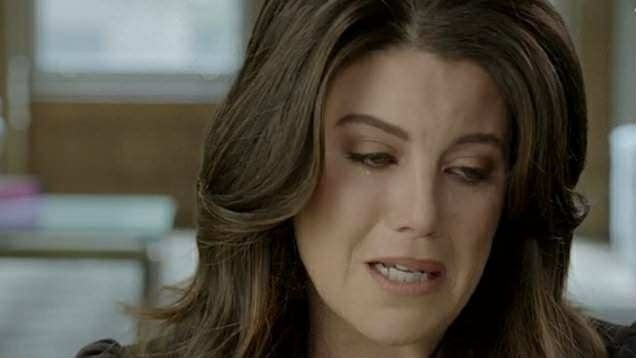
She knows, in a way few people ever will, what it means to have the most painful moment of your life transformed into a joke that refuses to fade. For decades, Monica Lewinsky’s name has not just been remembered—it has been repeated, repurposed, and reduced, often stripped of context and empathy. Her story became shorthand, her identity compressed into a reference point people return to without thinking.
So when she mentions the “irony” of testing positive for COVID, it doesn’t come from a place of seeking attention. It’s something quieter, sharper than that. It’s an awareness—almost a weary recognition—of how quickly the world still leans into the same old narrative. Even now, even after everything, it takes almost nothing for people to turn her reality into a setup for a familiar punchline.
A diagnosis becomes more than just a health update. It becomes material.
Her body becomes part of the joke.
And once again, her humanity risks being pushed to the background.
What’s striking, though, is not just that this pattern persists—it’s how she responds to it.
From quarantine, in a moment where many people might retreat or say nothing at all, she does something quietly radical: she speaks for herself. She narrates her experience in real time, not as a spectacle, but as a person. There’s no grand performance in it—just honesty. A little fatigue, a touch of dry humor, and a clear sense of presence.
In doing so, she disrupts something that has been in place for years.
Because for a long time, her story has been told about her, rarely by her. Others shaped it, simplified it, and circulated it until it hardened into something almost unchangeable. But here, in these small, personal updates, she shifts that dynamic. She is no longer just the subject of commentary—she becomes the voice that defines the moment.
That shift might seem subtle from the outside, but it carries real weight.
It’s a reminder that identity is not fixed by the worst thing that ever happened to you, no matter how widely it was seen or how often it’s repeated. It challenges the idea that a person can be permanently reduced to a single chapter, especially one shaped by public judgment.
There’s also something else in it—something about endurance.
Not the kind that simply survives quietly, but the kind that insists on being acknowledged in full. Because survival, in her case, has never just been about getting through the years. It has meant living with a narrative that the world refuses to let go of, and still finding ways to exist beyond it.
By choosing to speak, even in a small way, she pushes back against that narrative. She reminds people—gently, but firmly—that she is not a symbol, not a headline, not a punchline waiting to be reused.
She is a person, still here, still living, still defining herself.
And maybe that’s the deeper irony.
Not the coincidence of a diagnosis, but the fact that after all this time, the world can still be so quick to flatten a human life into something simple—while she continues, steadily, to make it more complex, more honest, and more real.
In that quiet insistence, there is something powerful.
Because sometimes reclaiming your story doesn’t come through a dramatic declaration. Sometimes it happens in small, steady acts—telling the truth, naming the moment, and refusing, again and again, to disappear into the version of you that others find easier to repeat.