-While Cleaning Out My Old House, I Found This Curious Object That Sparked Memories of Another Era, Revealed a Forgotten Kitchen Tradition, and Reminded Me Why So Many People Today Have No Idea What It Is or Why It Once Mattered So Much

While clearing out my old house, I came across something unexpected—an object that most people today wouldn’t recognize at all. It wasn’t tucked away like something valuable or preserved with care. Instead, it sat forgotten in the back of a cabinet, hidden behind chipped mugs and faded manuals. Time had dulled its surface, but it still felt solid and purposeful. The moment I picked it up, it triggered something—an old memory, a faint smell, a feeling that didn’t belong to the present.
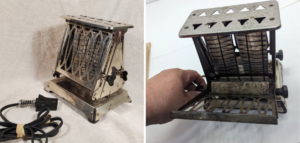
It was a stovetop toaster.
Not the kind we’re used to now—the sleek appliances that sit on countertops and pop bread up automatically. This was different. Heavy. Metallic. Built with simple wire racks and a handle that must have warmed countless mornings. It was meant to sit directly over a flame, turning bread into toast through nothing but heat, timing, and attention. To someone today, it might seem awkward or outdated. But once, it was a small luxury and a familiar part of everyday life.
Holding it felt like holding a fragment of someone else’s routine.
A Time When the Kitchen Was Alive
Picture a quiet morning in the mid-20th century. The house is still, but the kitchen is already awake. Sunlight filters through thin curtains. A radio murmurs softly in the background. Coffee brews slowly on the stove, filling the air with warmth.
At the center of it all is the stovetop.
Someone stands there, preparing breakfast. The toaster is placed carefully over the burner. Bread is set onto its racks, slice by slice. There’s no button to press, no timer to rely on. Just instinct and attention.
The bread is watched closely. It’s turned by hand. The color is judged by eye. Too early, and it’s pale. Too late, and it’s ruined. Getting it just right takes care—and a bit of experience.
This wasn’t just making breakfast. It was a small ritual.
Toasting Was an Active Process
Unlike modern appliances, this toaster required you to stay present. You couldn’t walk away or forget about it. You had to watch, listen, and even smell the changes as the bread slowly transformed.
There was a kind of quiet tension to it.
Would it burn? Was the heat too strong? Should it be flipped now or in a few seconds? These tiny decisions made the process feel personal. When the toast finally came out just right, it felt satisfying in a way that pressing a button never could.
Butter would melt instantly on the surface. Maybe jam would follow. Sometimes it was eaten just as it was—simple, but perfect.
That first bite felt earned.
Simple, Yet Meaningful
Today, the stovetop toaster might look primitive. But in its time, it was practical and even a bit aspirational. Not every home had access to electric appliances, and this tool offered a way to enjoy something as simple as evenly toasted bread without needing anything more than a stove.
It was basic, but thoughtful.
Owning one meant you cared about small comforts. It meant breakfast wasn’t rushed or overlooked—it mattered.
A Different Kind of Simplicity
There’s something striking about how simple it is. No electronics. No plastic. No hidden systems. Just metal, heat, and human involvement.
It didn’t try to do everything for you. It expected you to take part.
In a world where most things are automated, that feels almost unusual now.
Learning Through Doing
Using something like this naturally taught patience. You had to wait, observe, and adjust. Children learned by watching adults—how to judge the color, when to turn the bread, how to avoid burning it.
These weren’t lessons anyone sat down to teach, but they stuck.
It was one of those everyday tools that quietly shaped habits and awareness.
More Than Just Breakfast
Back then, mornings were often shared. People gathered, talked, and eased into the day together. Toast wasn’t made all at once—it came in batches. Someone always had to tend to it.
That created interaction.
It wasn’t just about eating. It was about being present with others.
Objects That Carry Stories
What stood out most when I found that toaster was how much it seemed to hold. Not physically—but emotionally.
Things like this weren’t thrown away quickly. They lasted. They were used daily, repaired when needed, and kept for years. Every scratch hinted at a moment—busy mornings, quiet weekends, conversations long forgotten.
It wasn’t just an object. It had been part of life.
Why It Feels Unfamiliar Today
Most people today wouldn’t recognize it. Some might think it’s decorative or meant for something else entirely. The idea of toasting bread over a flame feels strange now.
But that’s just because life has changed.
We’ve built convenience into everything. Tasks are faster, easier, and often invisible. But in doing so, we’ve stepped away from the process itself.
When Tools Asked for Your Attention
This toaster didn’t allow distraction. It required focus, even if only for a few minutes. And in that small window, you were fully present.
Today, many things happen in the background. We multitask constantly. Moments blur together.
This didn’t.
It slowed you down, just enough to notice what you were doing.
A Glimpse Into Another Era
In a broader sense, tools like this reflect a different mindset. A time when durability mattered. When small comforts were appreciated. When home life held importance and pride.
These weren’t just tools—they were part of how people cared for themselves and each other.
Imperfection Made It Personal
The toast wasn’t always flawless. Sometimes it browned unevenly. Sometimes an edge burned a little.
But that was part of it.
It showed that someone had been there, making it—not just a machine.
What We’ve Left Behind
Finding that toaster made me realize how many small, hands-on skills we’ve lost. Not because they weren’t useful—but because we no longer need them.
We don’t rely on judgment the same way. We don’t pay attention to small changes. Machines handle it.
We’ve gained efficiency—but lost a bit of connection.
Why It Still Matters
The stovetop toaster isn’t important because we should go back to using it. It matters because of what it represents.
A slower pace. A more involved way of living. A reminder that not everything needs to be optimized to be meaningful.
Sometimes, value comes from being part of the process.
A Small Piece of the Past
When I set it down again, I didn’t feel like throwing it away. I cleaned it instead. Held it for a moment longer. Thought about the people who had used it, the mornings it had been part of.
It felt like more than just a kitchen tool.
It felt like a story—quiet, simple, but still worth remembering.